Genetic prediction of increased erythropoietin levels was not linked to higher cardiovascular disease risk
Identification and single-base gene-editing functional validation of a cis-EPO variant as a genetic predictor for EPO-increasing therapies
Genome-wide association meta-analysis and Mendelian randomizationNo clear difference
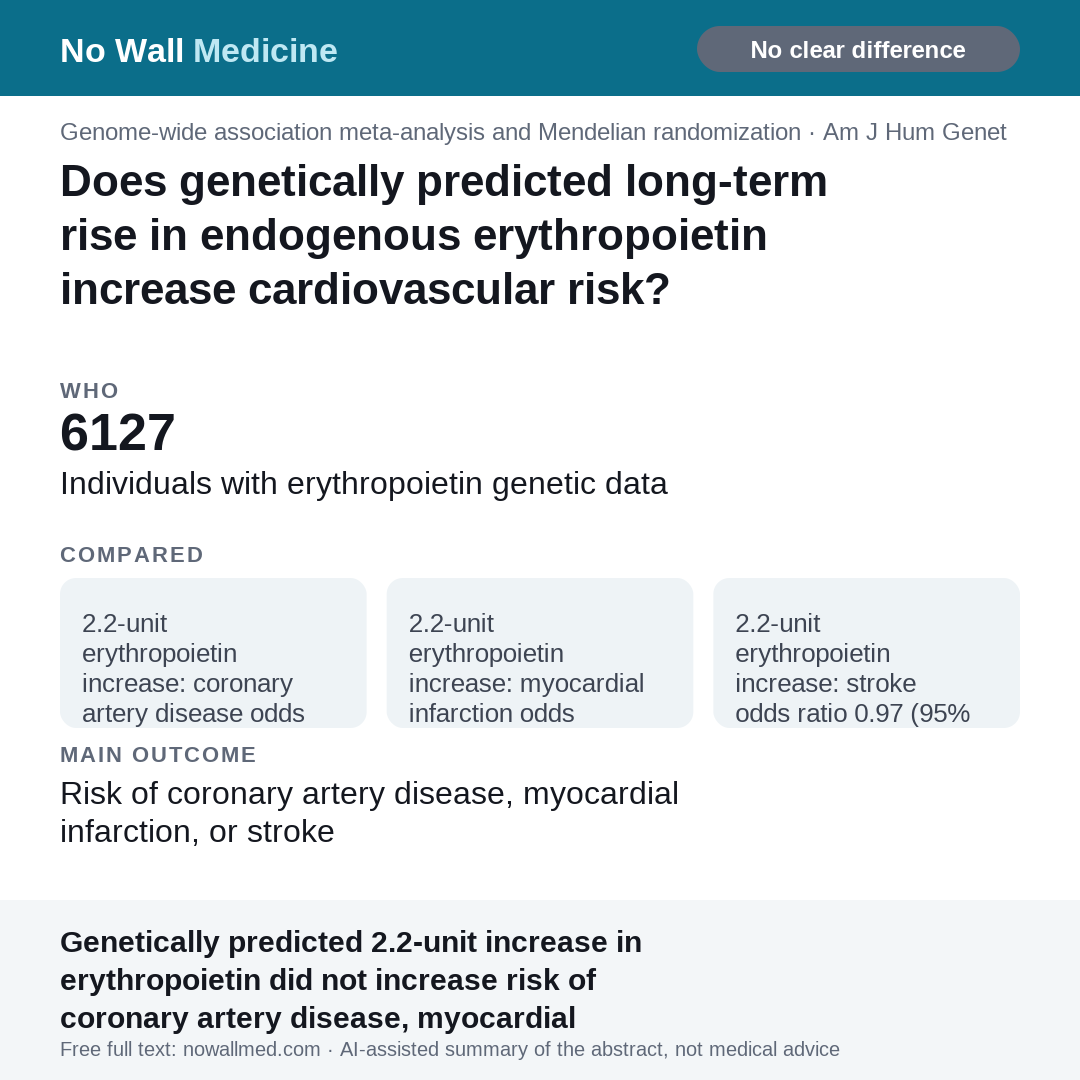
Does genetically predicted long-term rise in endogenous erythropoietin increase cardiovascular risk?
Who
6127
Individuals with erythropoietin genetic data
Compared
2.2-unit erythropoietin increase: coronary artery disease odds ratio 1.01 (95% CI 0.93 to 1.07)
2.2-unit erythropoietin increase: myocardial infarction odds ratio 0.99 (95% CI 0.87 to 1.15)
2.2-unit erythropoietin increase: stroke odds ratio 0.97 (95% CI 0.87 to 1.07)
Main outcome
Risk of coronary artery disease, myocardial infarction, or stroke
Result: odds ratio 1.01 (95% CI 0.93 to 1.07)
Bottom line: Genetically predicted 2.2-unit increase in erythropoietin did not increase risk of coronary artery disease, myocardial infarction, or stroke.
Am J Hum Genet · 2022-09-02Download image
Clinical question: Does genetically predicted long-term rise in endogenous erythropoietin increase cardiovascular risk?
Why it matters: It is important to monitor the cardiovascular safety of hypoxia-inducible factor prolyl hydroxylase inhibitors, which are drugs being developed to treat anemia in chronic kidney disease.
Key points
- Researchers performed a meta-analysis of 6,127 erythropoietin (EPO) genetic data and used Mendelian randomization to assess cardiovascular risks.
- A 2.2-unit increase in genetically predicted erythropoietin was not linked to increased risk of coronary artery disease (OR [95% CI] = 1.01 [0.93, 1.07]), myocardial infarction (OR [95% CI] = 0.99 [0.87, 1.15]), or stroke (OR [95% CI] = 0.97 [0.87, 1.07]).
- The study excluded an increased odds of 1.15 for cardiovascular disease for a 2.2-unit erythropoietin increase.
Headline and key points written with AI from the paper’s abstract, with every number checked against it. Read the paper before relying on them.
Was this summary helpful?
Subject terms
Cite this article
Harlow CE, Gandawijaya J, Bamford RA, Martin ER, Wood AR, van der Most PJ. Identification and single-base gene-editing functional validation of a cis-EPO variant as a genetic predictor for EPO-increasing therapies. Am J Hum Genet. 2022. doi:10.1016/j.ajhg.2022.08.004
Spotted a mistake? Suggest a correction
Top studies every Monday
The week’s key trials and guidelines in your specialties, plus any topics you follow. By email, free.
Get the weekly digest