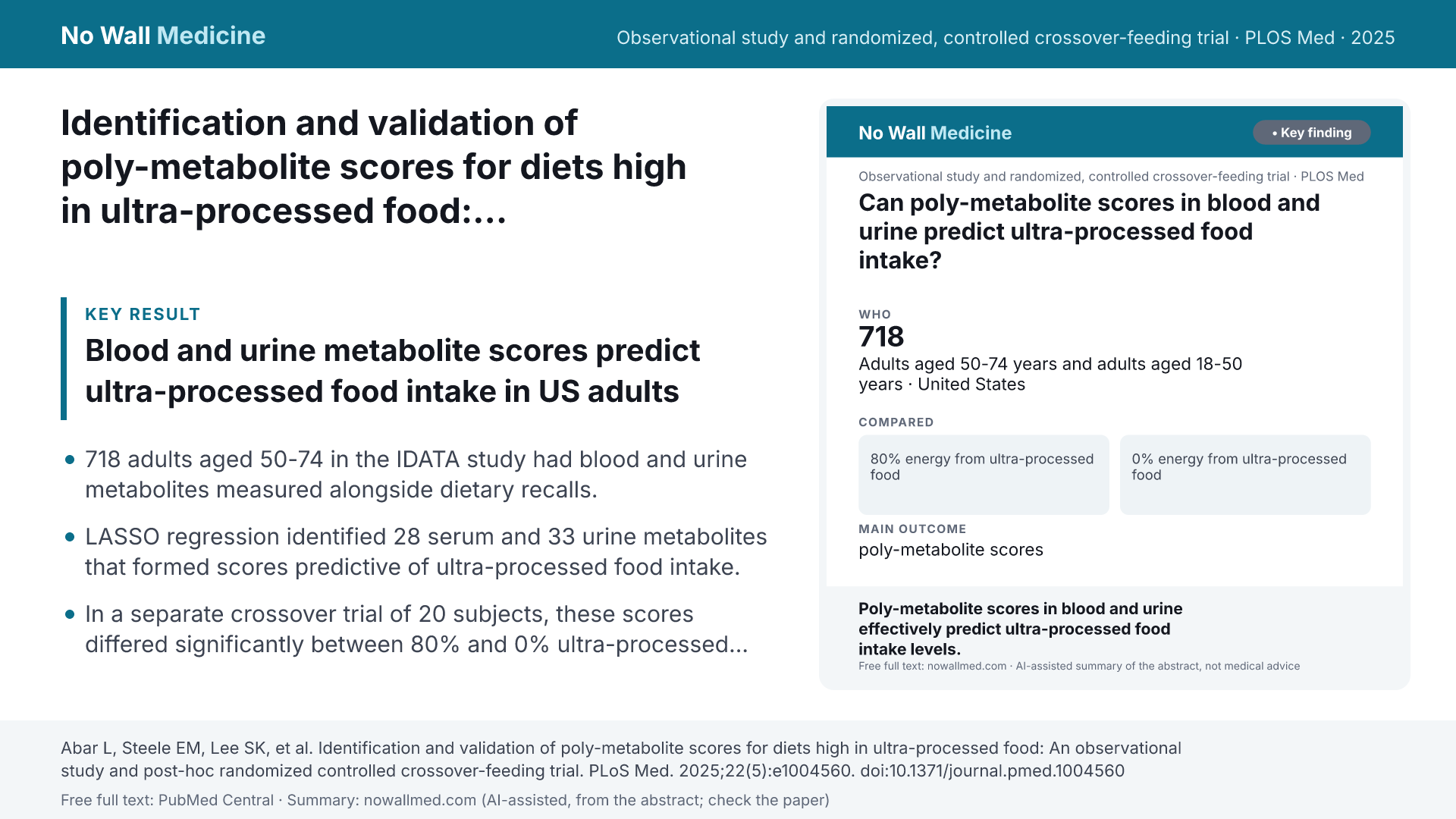
Blood and urine metabolite scores predict ultra-processed food intake in US adults
Identification and validation of poly-metabolite scores for diets high in ultra-processed food: An observational study and post-hoc randomized controlled crossover-feeding trial
Observational study and randomized, controlled crossover-feeding trialKey finding
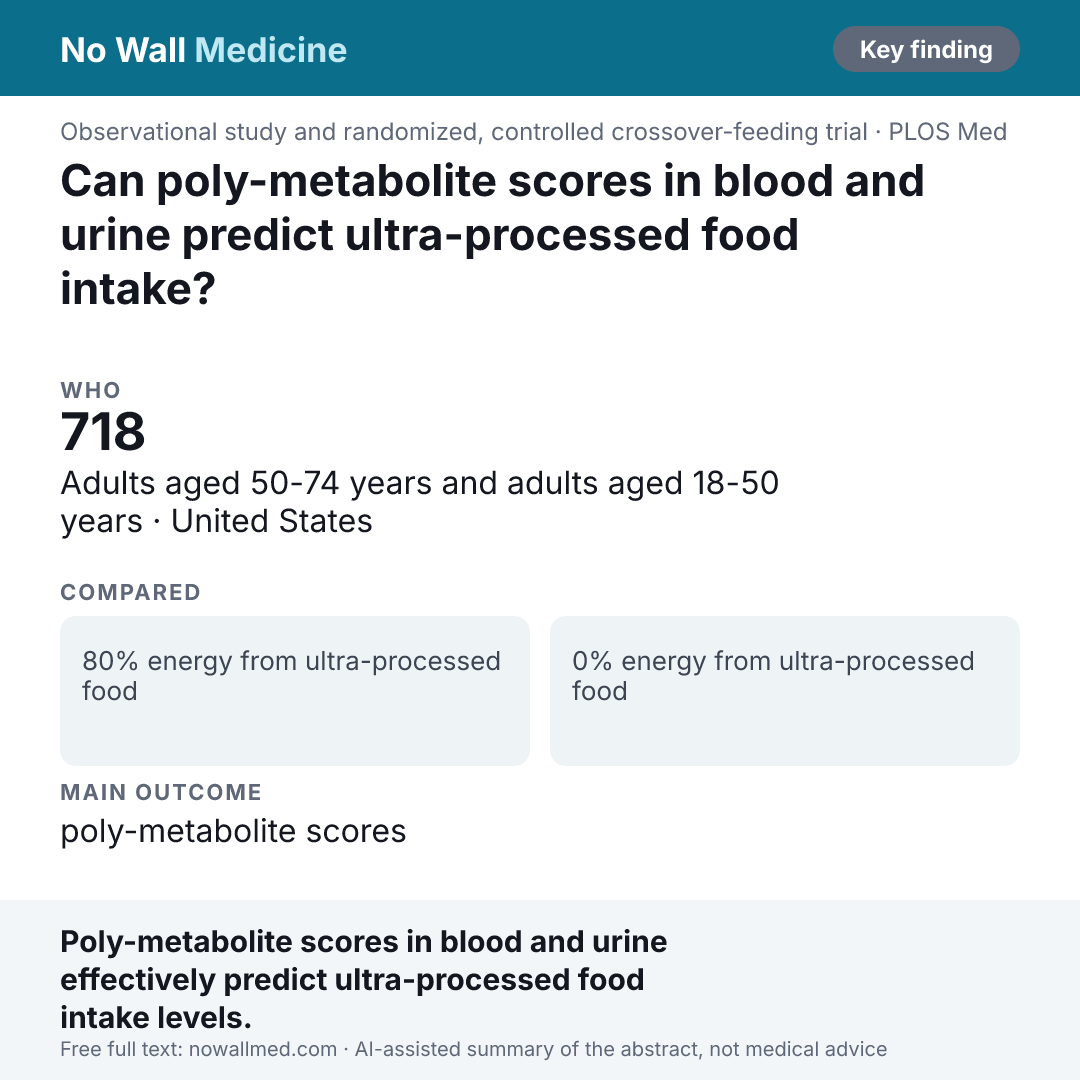
Can poly-metabolite scores in blood and urine predict ultra-processed food intake?
Who
718
Adults aged 50-74 years and adults aged 18-50 years · United States
Compared
80% energy from ultra-processed food
0% energy from ultra-processed food
Main outcome
poly-metabolite scores
Bottom line: Poly-metabolite scores in blood and urine effectively predict ultra-processed food intake levels.
PLOS Med · 2025-05-20 · Save PNG
Same trial (NCT03268577, NCT03407053)
Papers we list that report this registered trial, oldest first. Read a secondary analysis alongside the main results.
- Related analysis
Diet order affects weight loss on low-carb and low-fat diets differently Am J Clin Nutr 2024-08 - Main results Key finding
This paper PLOS Med 2025-05 - Secondary analysis
Unprocessed diets reduce energy intake through selection of low energy density foods and unbalanced macronutrient blends Am J Clin Nutr 2025-12
Clinical question: Can poly-metabolite scores in blood and urine predict ultra-processed food intake?
Why it matters: The impact of ultra-processed food on human health remains unclear, and objective biomarkers for intake are needed to improve epidemiological research.
Key points
- 718 adults aged 50-74 in the IDATA study had blood and urine metabolites measured alongside dietary recalls.
- LASSO regression identified 28 serum and 33 urine metabolites that formed scores predictive of ultra-processed food intake.
- In a separate crossover trial of 20 subjects, these scores differed significantly between 80% and 0% ultra-processed food diets.
Limitation the authors note: IDATA participants were older US adults whose diets may not be reflective of other populations.
Headline and key points written with AI from the paper’s abstract, with every number checked against it. Read the paper before relying on them.
Was this summary helpful?
Subject terms
Headline, design, result, key points, caveat and citation as plain text.
Cite this article
Abar L, Steele EM, Lee SK, et al. Identification and validation of poly-metabolite scores for diets high in ultra-processed food: An observational study and post-hoc randomized controlled crossover-feeding trial. PLoS Med. 2025;22(5):e1004560. doi:10.1371/journal.pmed.1004560
Spotted a mistake? Suggest a correction