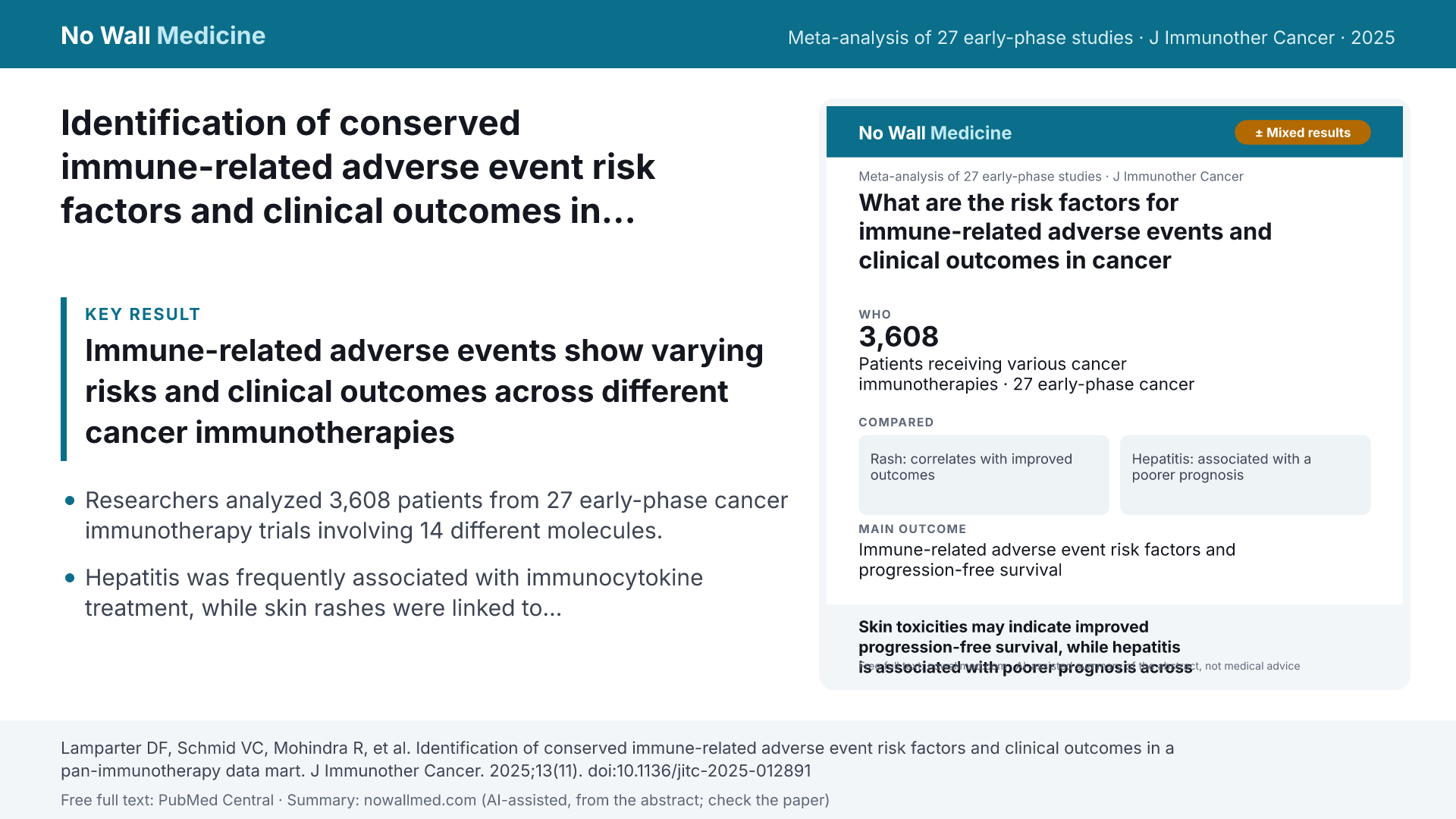
Immune-related adverse events show varying risks and clinical outcomes across different cancer immunotherapies
Identification of conserved immune-related adverse event risk factors and clinical outcomes in a pan-immunotherapy data mart
Meta-analysis of 27 early-phase studiesMixed results
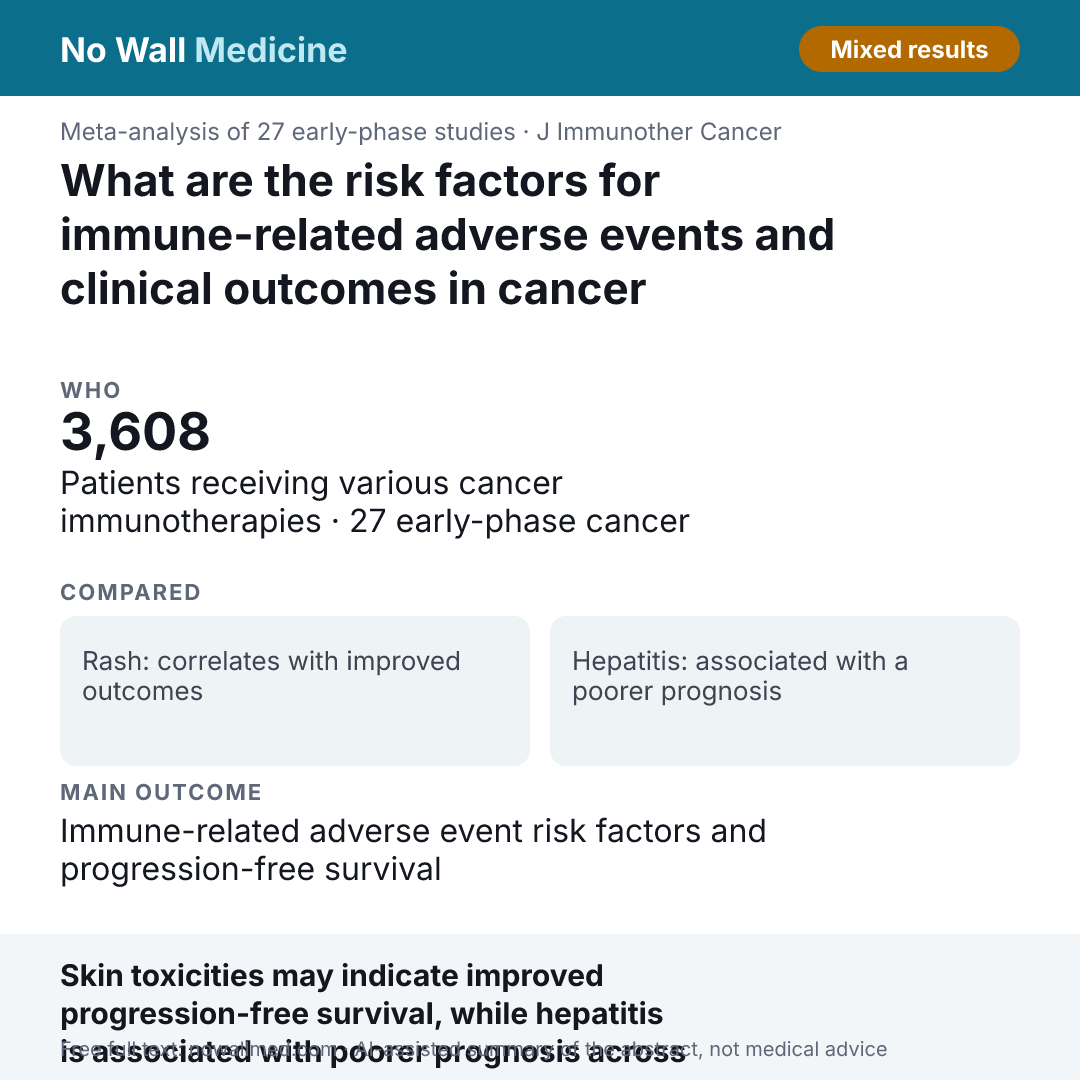
What are the risk factors for immune-related adverse events and clinical outcomes in cancer immunotherapy?
Who
3,608
Patients receiving various cancer immunotherapies · 27 early-phase cancer immunotherapy trials
Compared
Rash: correlates with improved outcomes
Hepatitis: associated with a poorer prognosis
Main outcome
Immune-related adverse event risk factors and progression-free survival
Bottom line: Skin toxicities may indicate improved progression-free survival, while hepatitis is associated with poorer prognosis across immunotherapy contexts.
Limitation: Polygenic risk scores show limited utility in this setting.
J Immunother Cancer · 2025-11-13 · Save PNG
Clinical question: What are the risk factors for immune-related adverse events and clinical outcomes in cancer immunotherapy?
Why it matters: Data on immune-related adverse events in non-standard cancer immunotherapies are limited and systematic exploration of predictive biomarkers is lacking.
Key points
- Researchers analyzed 3,608 patients from 27 early-phase cancer immunotherapy trials involving 14 different molecules.
- Hepatitis was frequently associated with immunocytokine treatment, while skin rashes were linked to improved progression-free survival.
- Hepatic metastases were associated with hepatitis, while elevated liver enzymes were also linked to hepatitis risk.
Headline and key points written with AI from the paper’s abstract, with every number checked against it. Read the paper before relying on them.
Was this summary helpful?
Abstract
Background
Cancer immunotherapy (CIT) often triggers immune-related adverse events (irAEs). Analysis of irAEs in large checkpoint inhibitor (CPI) trials has enhanced their management and demonstrated their prognostic value for treatment outcome. However, data on irAEs in non-standard CITs are limited, and systematic exploration is lacking. Identifying predictive biomarkers for irAEs in these therapies is still emerging and essential for improving patient care. Methods
We established a harmonized data mart from 27 early-phase CIT trials, encompassing 14 molecules with diverse mechanisms across various cancer indications. This dataset includes 3,608 patients, both CPI-naïve and CPI-experienced, with detailed information on clinical data, tumor characteristics, soluble biomarkers, and genome-wide genotyping. We examined the occurrence of different irAEs and CIT molecules concerning incidence, severity, and onset. A meta-analysis was conducted to assess the association between risk factors and the time to onset of irAEs. Finally, we explored the predictive value of irAEs for clinical outcomes, specifically measured by progression-free survival (PFS). Results
Our analysis reveals significant variation in irAE incidence and kinetics across CIT molecules. Common irAEs include hepatitis, rash, acute kidney injuries, and hypothyroidism, with hepatitis often severe and others mild. Hepatitis is frequently associated with immunocytokine treatment, while T-cell bispecifics are linked to organ-specific toxicities. Hepatic metastases correlate with hepatitis but inversely with rash; elevated liver enzymes are associated with hepatitis, and high ferritin levels with acute kidney injury risk. Higher myeloid cell counts are associated with reduced rash likelihood. No tumor microenvironment associations were found, and polygenic risk scores show limited utility in our setting. Rash correlates with improved outcomes, whereas hepatitis is associated with a poorer prognosis, independent of baseline prognostic state assessed by the Real World Prognostic score. Conclusions
These findings highlight the complexity of immune toxicities in early-phase trials, emphasizing the importance of the CIT class, as well as the roles of tumor burden, metastasis sites, and systemic immune state in the development of irAEs. Additionally, the observed association between skin toxicities and improved PFS suggests that skin toxicity could serve as a marker of systemic immune activation across immunotherapy contexts.
Abstract reproduced under the article’s CC BY NC licence.
Subject terms
Headline, design, result, key points, caveat and citation as plain text.
Cite this article
Lamparter DF, Schmid VC, Mohindra R, et al. Identification of conserved immune-related adverse event risk factors and clinical outcomes in a pan-immunotherapy data mart. J Immunother Cancer. 2025;13(11). doi:10.1136/jitc-2025-012891
Spotted a mistake? Suggest a correction