Activities and environmental factors are the most common categories used to describe child functioning
Identification of International Classification of Functioning, Disability and Health (ICF) codes most frequently used to describe functioning in children: a systematic review
Systematic reviewBenefit found
Which International Classification of Functioning, Disability and Health categories are most used for children?
Who
Children aged 0 to 18 years
Compared
40.7%Activities and participation
30.6%Environmental factors
27.3%Body functions
1.4%Body structures
Main outcome
Frequency of International Classification of Functioning, Disability and Health categories used
Bottom line: Most studies emphasize a biopsychosocial model focusing on activities, participation, and environmental factors in children.
BMJ Paediatr Open · 2026-06-19Download image
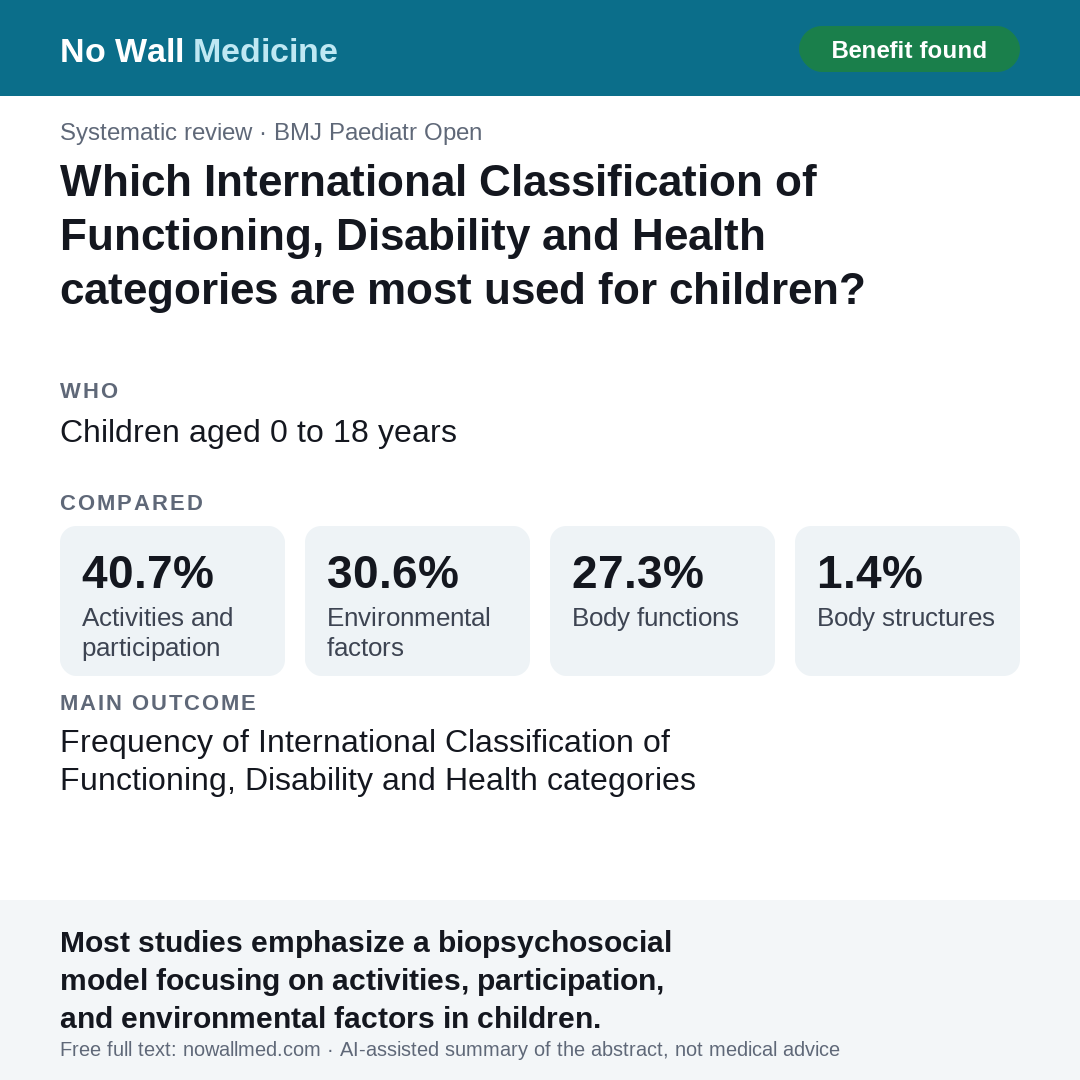
Clinical question: Which International Classification of Functioning, Disability and Health categories are most used for children?
Why it matters: There is a need to identify which classification categories are most frequently used to describe child functioning to inform inclusive assessments and policy frameworks.
Key points
- Researchers conducted a systematic review of eight studies involving 29 International Classification of Functioning, Disability and Health core sets and 1665 instances of data.
- The most frequent categories were activities and participation at 40.7%, environmental factors at 30.6%, body functions at 27.3%, and body structures at 1.4%.
- Key chapters identified in the data included learning and applying knowledge, interpersonal interactions, support and relationships, and services and policies.
Headline and key points written with AI from the paper’s abstract, with every number checked against it. Read the paper before relying on them.
Abstract
Objectives
To identify and synthesise the International Classification of Functioning, Disability and Health (ICF) categories most used to describe child functioning across health conditions, informing inclusive, context-sensitive assessments and policy frameworks. Design
Systematic review. Data sources
PubMed, Scopus, Web of Science and CINAHL were searched from inception to September 2024 following Cochrane guidelines. Eligibility criteria
Peer-reviewed studies using ICF categories to assess functioning in children (0-18 years), regardless of health condition, were included. Eligible designs comprised randomised controlled trials, observational and qualitative studies reporting ICF Core Set (CS). Data extraction and synthesis
Two reviewers independently conducted screening, data extraction and risk of bias assessment using the Mixed Methods Appraisal Tool (MMAT, 2018). ICF codes were categorised by domain and synthesised narratively. Results
Eight studies met inclusion criteria, comprising 29 ICF CS (1665 instances; 194 unique ICF categories after deduplication). Most instances related to activities and participation (40.7%) and environmental factors (30.6%), followed by body functions (27.3%) and body structures (1.4%). Key chapters included learning and applying knowledge, interpersonal interactions, support and relationships and services and policies. Conclusions
Findings highlight a shift towards a biopsychosocial model of child functioning, emphasising participation and environmental context. Results support use of the ICF framework in multidisciplinary assessment and policy development and inform development of a Portuguese National Functioning Table for Children. Prospero registration number
CRD42024588533.
Abstract reproduced under the article’s CC BY licence.
Topics
Spotted a mistake? Suggest a correction