Accuracy of administrative health data for identifying maintenance dialysis patients varies by definition used
Identification of Maintenance Dialysis Recipients in Administrative Health Data: A Systematic Review
Systematic reviewMixed results
How accurate is administrative health data for identifying maintenance dialysis recipients?
Who
Individuals with kidney failure treated with maintenance dialysis · High-income countries
Compared
85.9%Positive predictive value (25th and 75th percentiles, 74.4%-92.9%)
75.8%Sensitivity (63.5%-83.8%)
79.5%F1 score (70.2%-81.9%)
Main outcome
Accuracy of administrative data and case definitions for identifying dialysis recipients
Bottom line: Case definition performance is context-dependent and varies, though most methods were reasonably accurate.
Limitation: Findings based on studies from high-income countries and a lack of contemporary data.
Am J Kidney Dis · 2026-06-19 · Save PNG
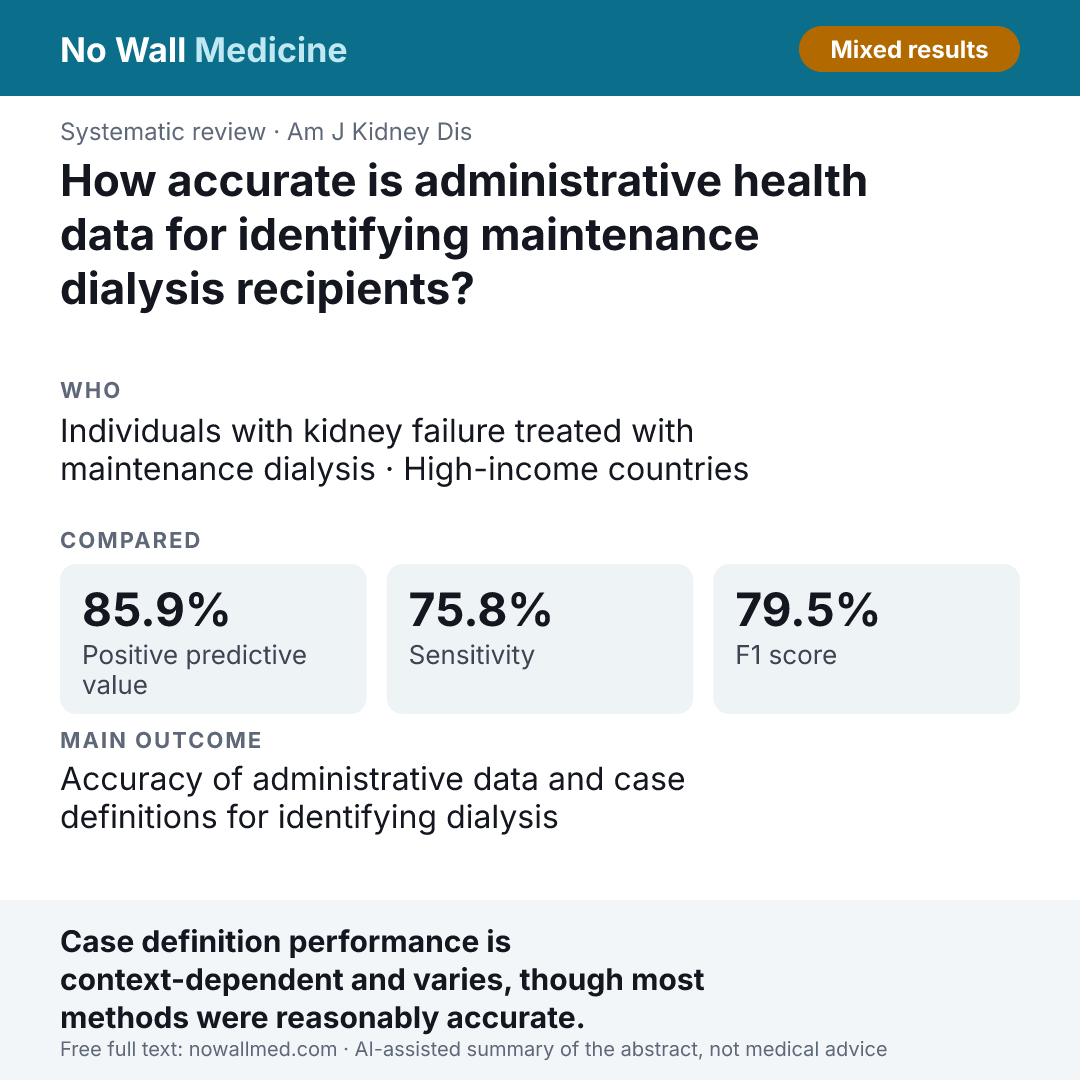
Clinical question: How accurate is administrative health data for identifying maintenance dialysis recipients?
Key points
- Researchers reviewed nine studies that evaluated how well administrative data and different case definitions identify people receiving long-term dialysis treatments.
- The median positive predictive value, which measures how many identified patients actually receive dialysis, was 85.9% across 37 case definitions.
- The median sensitivity, or the ability to correctly identify all dialysis patients, was 75.8% across 18 case definitions.
Headline and key points written with AI from the paper’s abstract, with every number checked against it. Read the paper before relying on them.
Was this summary helpful?
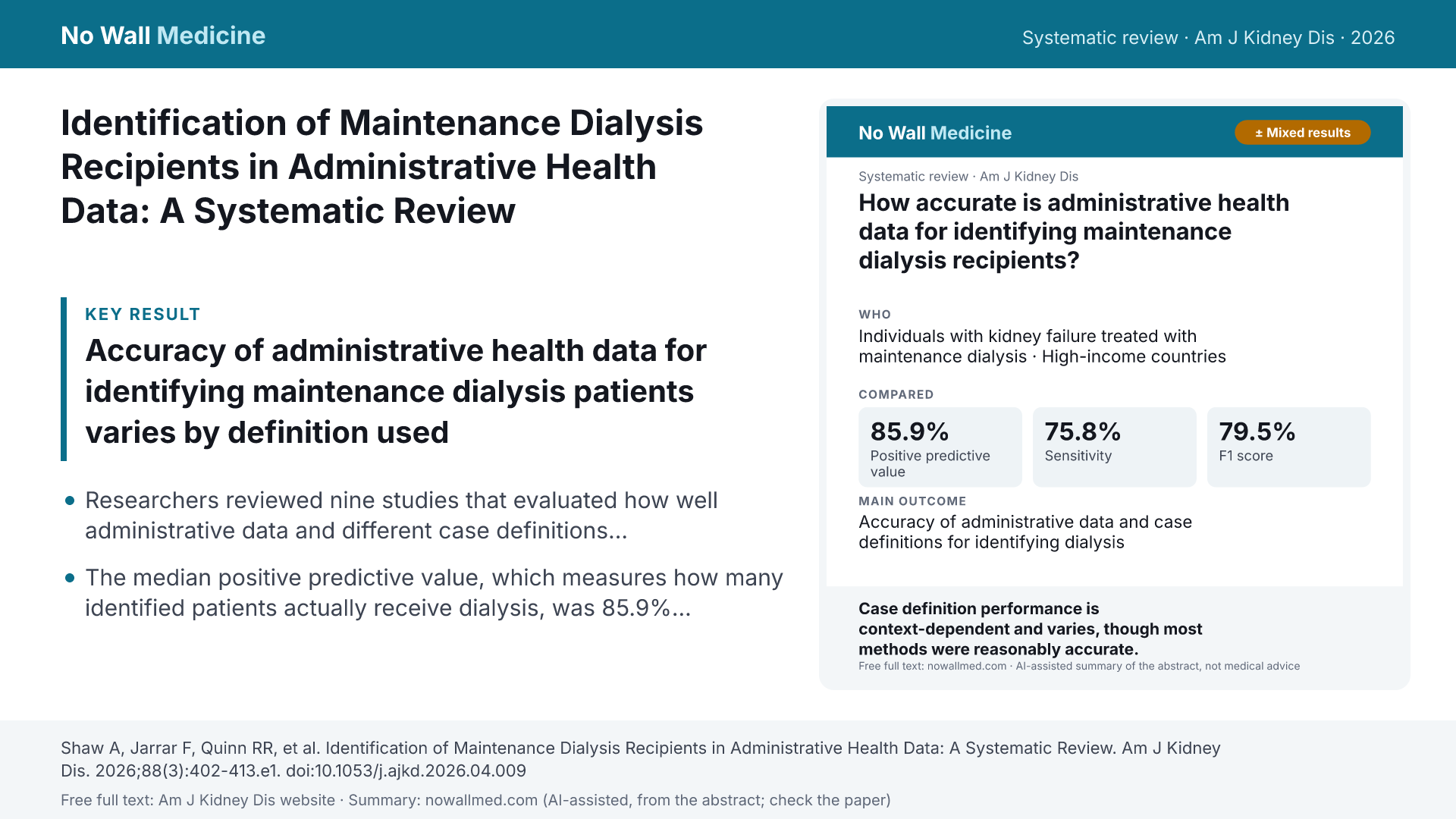
Subject terms
Headline, design, result, key points, caveat and citation as plain text.
Cite this article
Shaw A, Jarrar F, Quinn RR, et al. Identification of Maintenance Dialysis Recipients in Administrative Health Data: A Systematic Review. Am J Kidney Dis. 2026;88(3):402-413.e1. doi:10.1053/j.ajkd.2026.04.009
Spotted a mistake? Suggest a correction