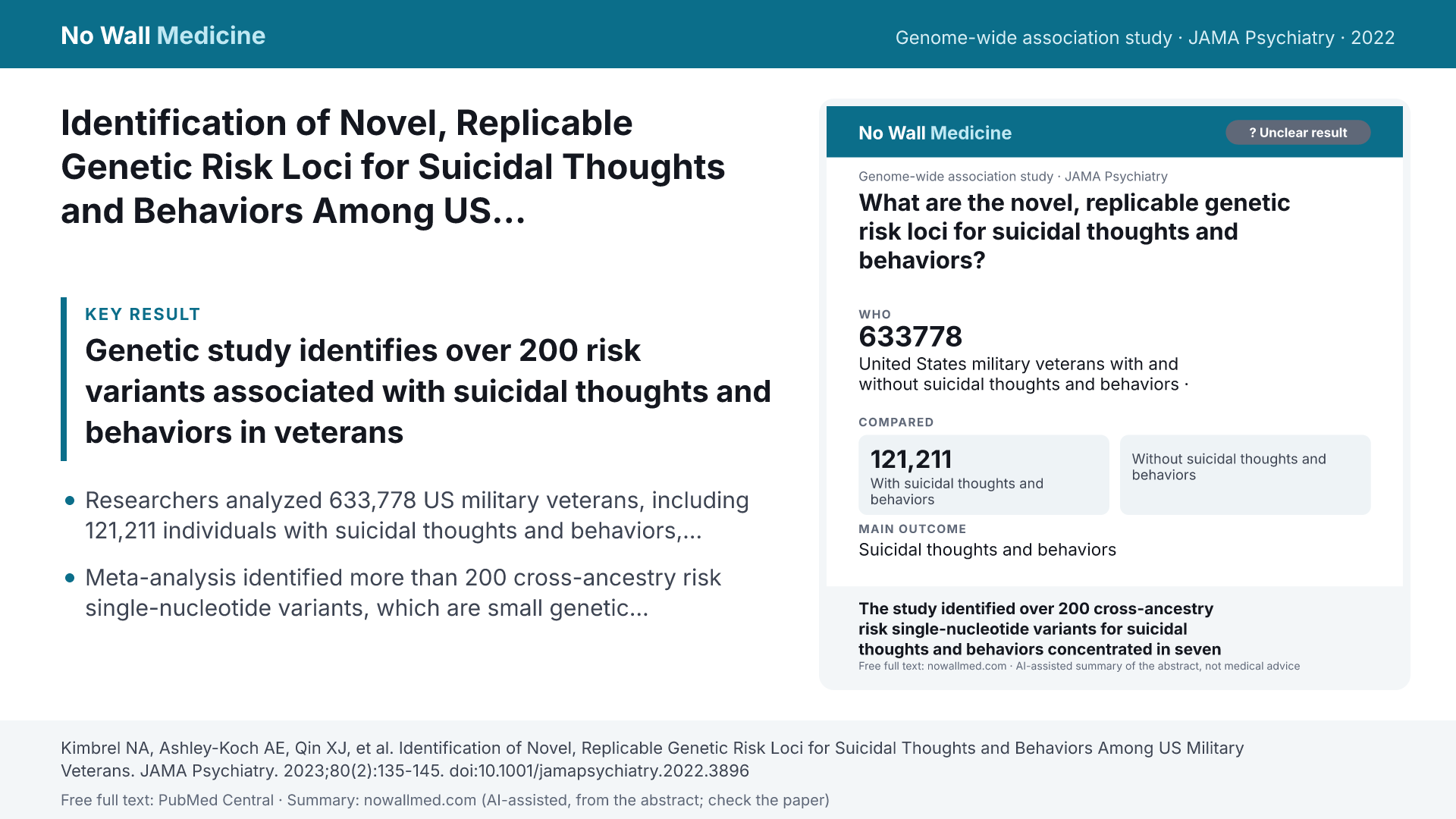
Genetic study identifies over 200 risk variants associated with suicidal thoughts and behaviors in veterans
Identification of Novel, Replicable Genetic Risk Loci for Suicidal Thoughts and Behaviors Among US Military Veterans
Genome-wide association studyUnclear result
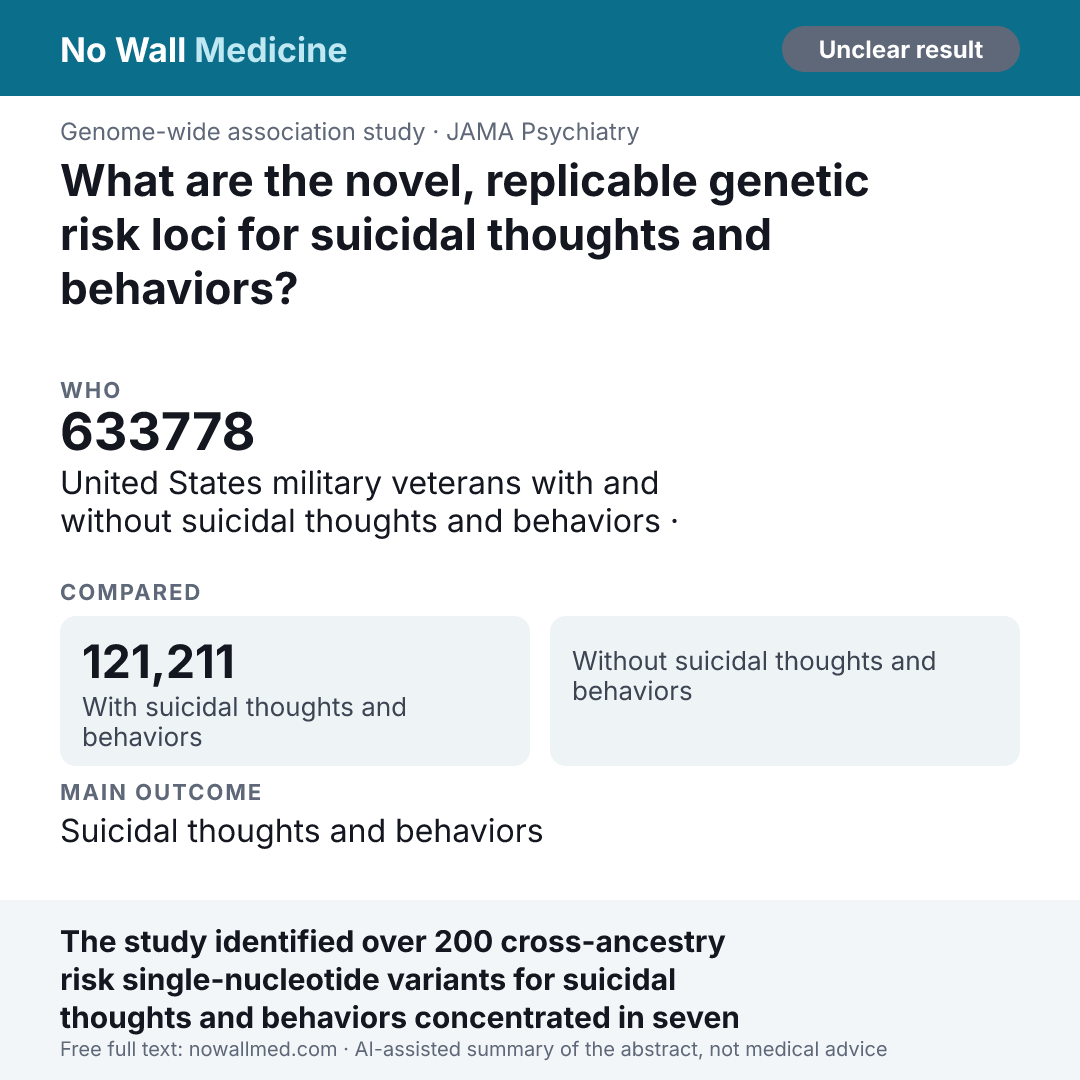
What are the novel, replicable genetic risk loci for suicidal thoughts and behaviors?
Who
633778
United States military veterans with and without suicidal thoughts and behaviors · United States
Compared
121,211With suicidal thoughts and behaviors (19.1%)
Without suicidal thoughts and behaviors
Main outcome
Suicidal thoughts and behaviors
Bottom line: The study identified over 200 cross-ancestry risk single-nucleotide variants for suicidal thoughts and behaviors concentrated in seven chromosomal regions.
Limitation: More work is needed to replicate these findings and determine clinical impact.
JAMA Psychiatry · 2022-12-15 · Save PNG
Clinical question: What are the novel, replicable genetic risk loci for suicidal thoughts and behaviors?
Key points
- Researchers analyzed 633,778 US military veterans, including 121,211 individuals with suicidal thoughts and behaviors, using electronic health records.
- Meta-analysis identified more than 200 cross-ancestry risk single-nucleotide variants, which are small genetic variations, concentrated in 7 regions on chromosomes 2, 6, 9, 11, 14, 16, and 18.
- In the European ancestry group, suicidal thoughts and behaviors were associated with genetic correlations (r > 0.75) to depression, posttraumatic stress disorder, and suicide attempt-only phenotypes.
Headline and key points written with AI from the paper’s abstract, with every number checked against it. Read the paper before relying on them.
Was this summary helpful?
Subject terms
Headline, design, result, key points, caveat and citation as plain text.
Cite this article
Kimbrel NA, Ashley-Koch AE, Qin XJ, et al. Identification of Novel, Replicable Genetic Risk Loci for Suicidal Thoughts and Behaviors Among US Military Veterans. JAMA Psychiatry. 2023;80(2):135-145. doi:10.1001/jamapsychiatry.2022.3896
Spotted a mistake? Suggest a correction