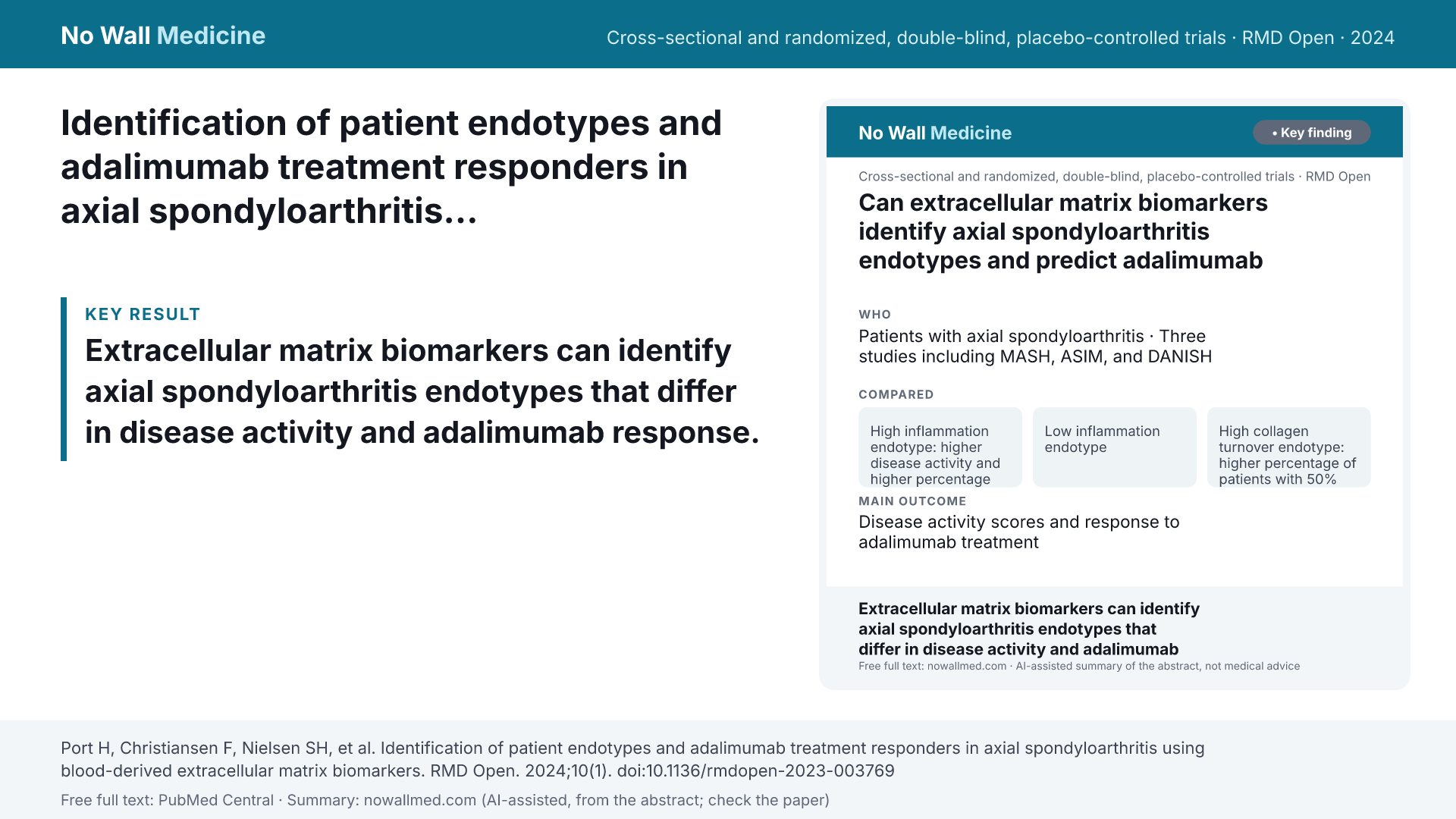
Identification of patient endotypes and adalimumab treatment responders in axial spondyloarthritis using blood-derived extracellular matrix biomarkers
Cross-sectional and randomized, double-blind, placebo-controlled trialsKey finding
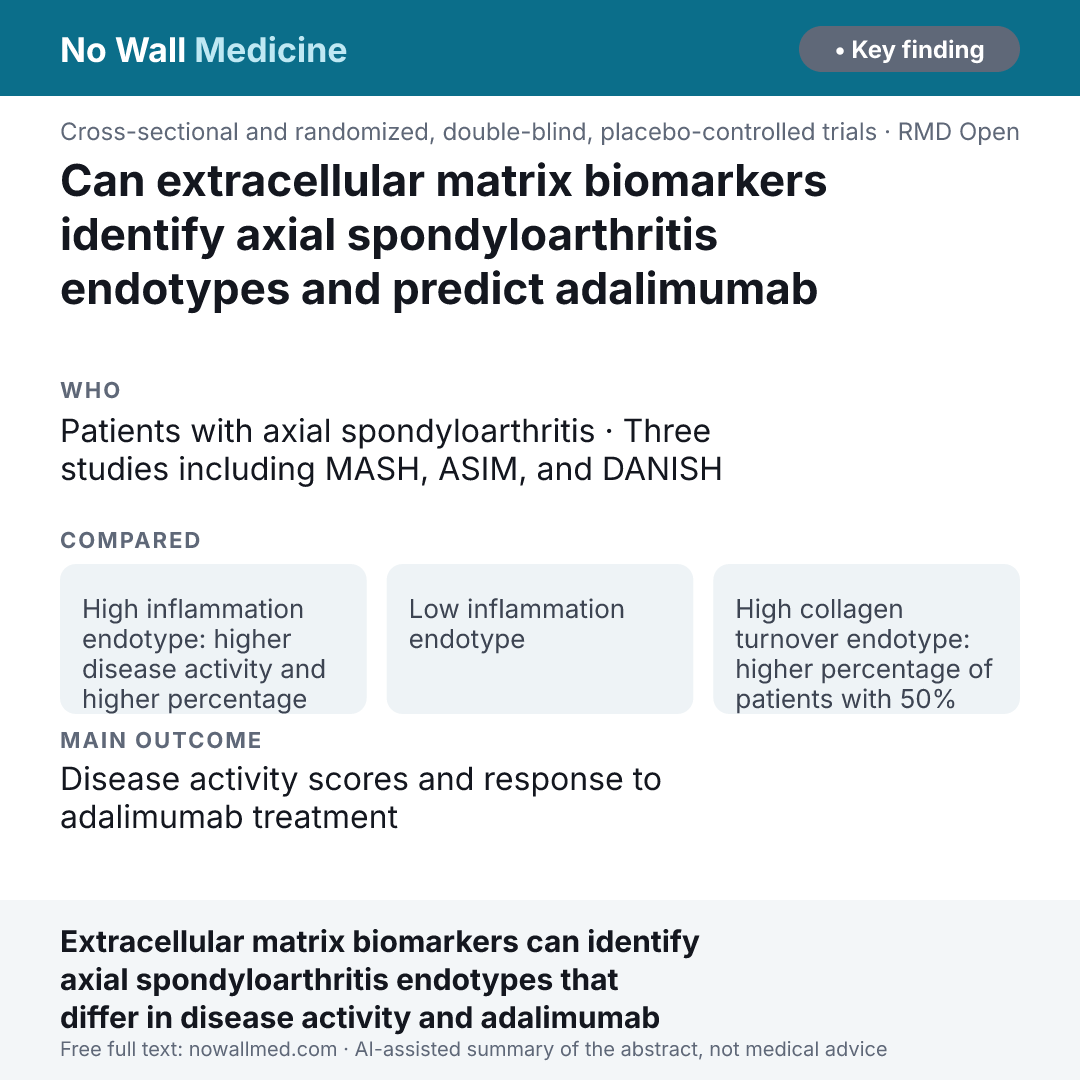
Can extracellular matrix biomarkers identify axial spondyloarthritis endotypes and predict adalimumab response?
Who
Patients with axial spondyloarthritis · Three studies including MASH, ASIM, and DANISH
Compared
High inflammation endotype: higher disease activity and higher percentage responding to adalimumab
Low inflammation endotype
High collagen turnover endotype: higher percentage of patients with 50% improvement in Bath Ankylosing Spondylitis Disease Activity Index
Main outcome
Disease activity scores and response to adalimumab treatment
Bottom line: Extracellular matrix biomarkers can identify axial spondyloarthritis endotypes that differ in disease activity and adalimumab response.
RMD Open · 2024-01-10 · Save PNG
Clinical question: Can extracellular matrix biomarkers identify axial spondyloarthritis endotypes and predict adalimumab response?
Abstract
Objective
To explore the potential of a panel of ECM remodelling markers as endotyping tools for axial spondyloarthritis (axSpA) by separating patients into subtypes and investigate how they differ among each other in disease activity scores and response to treatment with adalimumab. Methods
In three axSpA studies, a panel of 14 blood-based ECM biomarkers related to formation of collagen (PRO-C2, PRO-C3, PRO-C6), degradation of collagen by metalloproteinases (C1M, C2M, T2CM, C3M, C4M, C6M, C10C), matrix metalloproteinase (MMP)-degraded prolargin (PROM), MMP-degraded and citrullinated vimentin (VICM), basement membrane turnover (PRO-C4) and neutrophil activity (CPa9-HNE) were assessed to enable patient clustering (endotyping). MASH (n=41) was a cross-sectional study, while Adalimumab in Axial Spondyloarthritis study (ASIM,n=45) and Danish Multicenter Study of Adalimumab in Spondyloarthritis (DANISH, n=49) were randomised, double-blind placebo-controlled trials of adalimumab versus placebo every other week for 6 or 12 weeks, respectively, followed by active treatment. Biomarker data were log-transformed, standardised by mean centering and scaled by the SD prior to principal component analysis and K-means clustering. Results
Based on all three studies, we identified two orthogonal dimensions reflecting: (1) inflammation and neutrophil activity (driven by C1M and CPa9-HNE) and (2) collagen turnover (driven by PRO-C2). Three endotypes were identified: high inflammation endotype (Endotype1), low inflammation endotype (Endotype 2) and high collagen turnover endotype (Endotype3). Endotype1 showed higher disease activity (Ankylosing Spondylitis Disease Activity Score (ASDAS)) at baseline compared with Endotype2 and Endotype3 and higher percentage of patients responding to adalimumab based on ASDAS clinical improvement at week 24. Endotype3 showed higher percentage of patients with 50% improvement in Bath Ankylosing Spondylitis Disease Activity Index response at week 24 compared with Endotype2. Conclusion
These endotypes differ in their tissue remodelling profile and may in the future have utility for patient stratification and treatment tailoring.
Abstract reproduced under the article’s CC BY NC licence.
Subject terms
Headline, design, result, key points, caveat and citation as plain text.
Cite this article
Port H, Christiansen F, Nielsen SH, et al. Identification of patient endotypes and adalimumab treatment responders in axial spondyloarthritis using blood-derived extracellular matrix biomarkers. RMD Open. 2024;10(1). doi:10.1136/rmdopen-2023-003769
Spotted a mistake? Suggest a correction