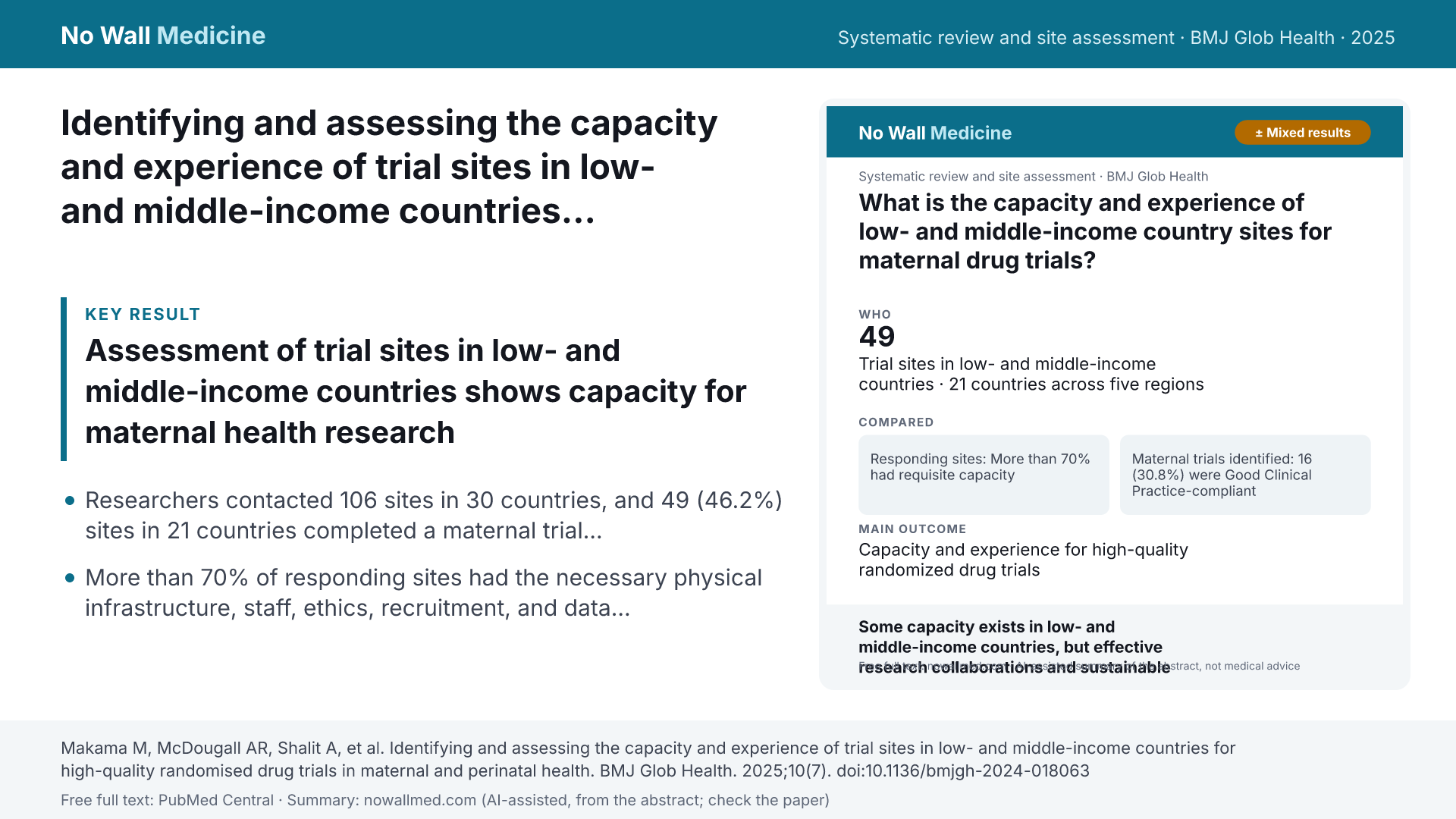
Assessment of trial sites in low- and middle-income countries shows capacity for maternal health research
Identifying and assessing the capacity and experience of trial sites in low- and middle-income countries for high-quality randomised drug trials in maternal and perinatal health
Systematic review and site assessmentMixed results
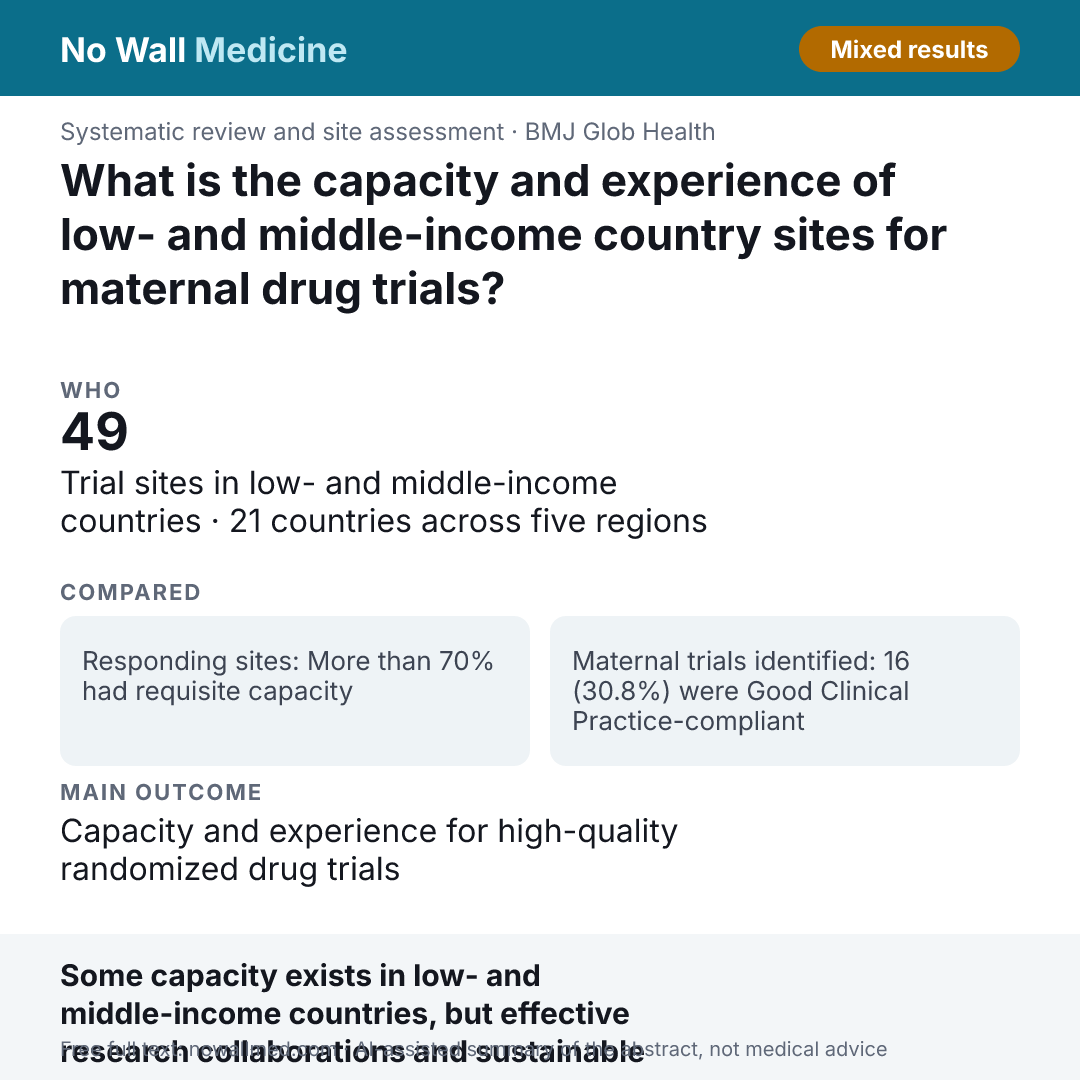
What is the capacity and experience of low- and middle-income country sites for maternal drug trials?
Who
49
Trial sites in low- and middle-income countries · 21 countries across five regions
Compared
Responding sites: More than 70% had requisite capacity
Maternal trials identified: 16 (30.8%) were Good Clinical Practice-compliant
Main outcome
Capacity and experience for high-quality randomized drug trials
Bottom line: Some capacity exists in low- and middle-income countries, but effective research collaborations and sustainable networks are needed.
BMJ Glob Health · 2025-07-27 · Save PNG
Clinical question: What is the capacity and experience of low- and middle-income country sites for maternal drug trials?
Why it matters: Existing international consortia for maternal and perinatal health trials have focused largely on pragmatic trials using medicines already approved for other uses.
Key points
- Researchers contacted 106 sites in 30 countries, and 49 (46.2%) sites in 21 countries completed a maternal trial site assessment checklist.
- More than 70% of responding sites had the necessary physical infrastructure, staff, ethics, recruitment, and data management services for randomized trials.
- Of 52 maternal trials identified, 16 (30.8%) were Good Clinical Practice-compliant, 22 (42.3%) were phase III, and one was a regulatory trial.
Headline and key points written with AI from the paper’s abstract, with every number checked against it. Read the paper before relying on them.
Was this summary helpful?
Abstract
Existing international consortia for drug trials in maternal and perinatal health have focused largely on pragmatic trials using off-label medicines. This study aimed to identify and assess the capacity and experience of sites in low- and middle-income countries (LMICs) for conducting trials for regulatory approval of medicines for pregnancy-related conditions. We systematically reviewed site assessment checklists across any disease area to develop a maternal trial site assessment checklist. The checklist was pretested, revised and used to collect data from trial sites in LMICs. Sites were systematically identified from a scoping review of maternal trials conducted in LMICs, known networks and snowball searching. Data reported by sites were verified against publicly accessible sources (clinical trial registries and published articles). We contacted 106 sites in 30 countries, of which 49 (46.2%) sites in 21 countries completed the checklist. Sites were from five regions-Sub-Saharan Africa (37), South Asia (6), Latin America and the Caribbean (4), Middle East and North Africa (1) and East Asia and the Pacific (1). More than 70% of responding sites had the requisite physical infrastructure, clinical and research staff, ethics, participant recruitment and data management services to conduct randomised trials. Respondents collectively identified 52 completed, ongoing or planned maternal trials across their sites. Of these 52 trials, 16 (30.8%) were Good Clinical Practice-compliant, 22 (42.3%) were phase III and one was a regulatory trial. 14 trials were conducted by a collaborative group established mostly for a specific trial or a small group of related trials. Only two of these groups were pre-established trial networks. While there is some capacity to conduct high-quality maternal drug trials in LMICs, effective research collaborations are needed to further strengthen and expand this capacity. Establishing a sustainable LMIC-based trial network will accelerate the development and testing of novel drugs to improve maternal and newborn health outcomes in these regions.
Abstract reproduced under the article’s CC BY licence.
Subject terms
Headline, design, result, key points, caveat and citation as plain text.
Cite this article
Makama M, McDougall AR, Shalit A, et al. Identifying and assessing the capacity and experience of trial sites in low- and middle-income countries for high-quality randomised drug trials in maternal and perinatal health. BMJ Glob Health. 2025;10(7). doi:10.1136/bmjgh-2024-018063
Spotted a mistake? Suggest a correction