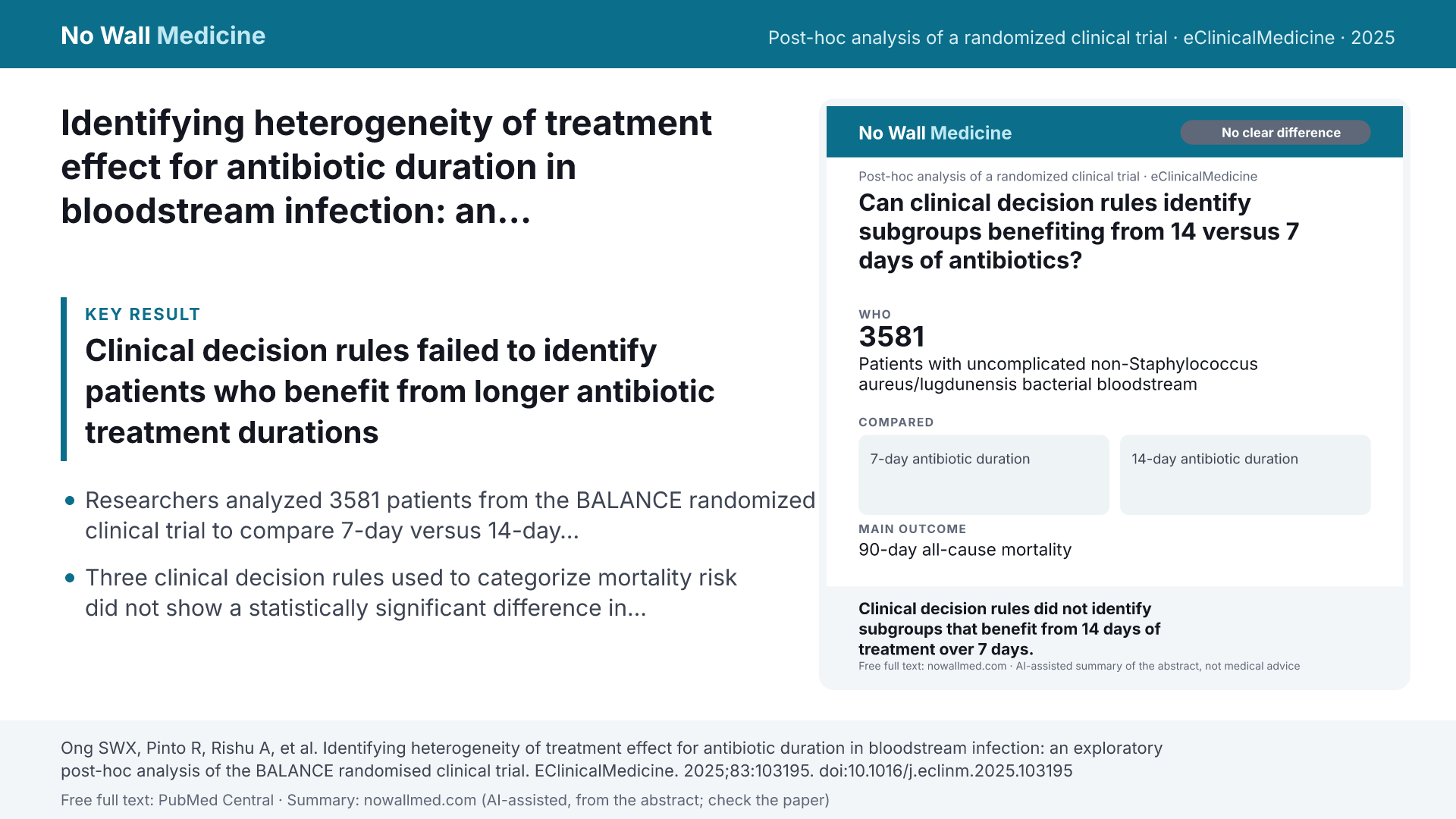
Clinical decision rules failed to identify patients who benefit from longer antibiotic treatment durations
Identifying heterogeneity of treatment effect for antibiotic duration in bloodstream infection: an exploratory post-hoc analysis of the BALANCE randomised clinical trial
Post-hoc analysis of a randomized clinical trialNo clear difference
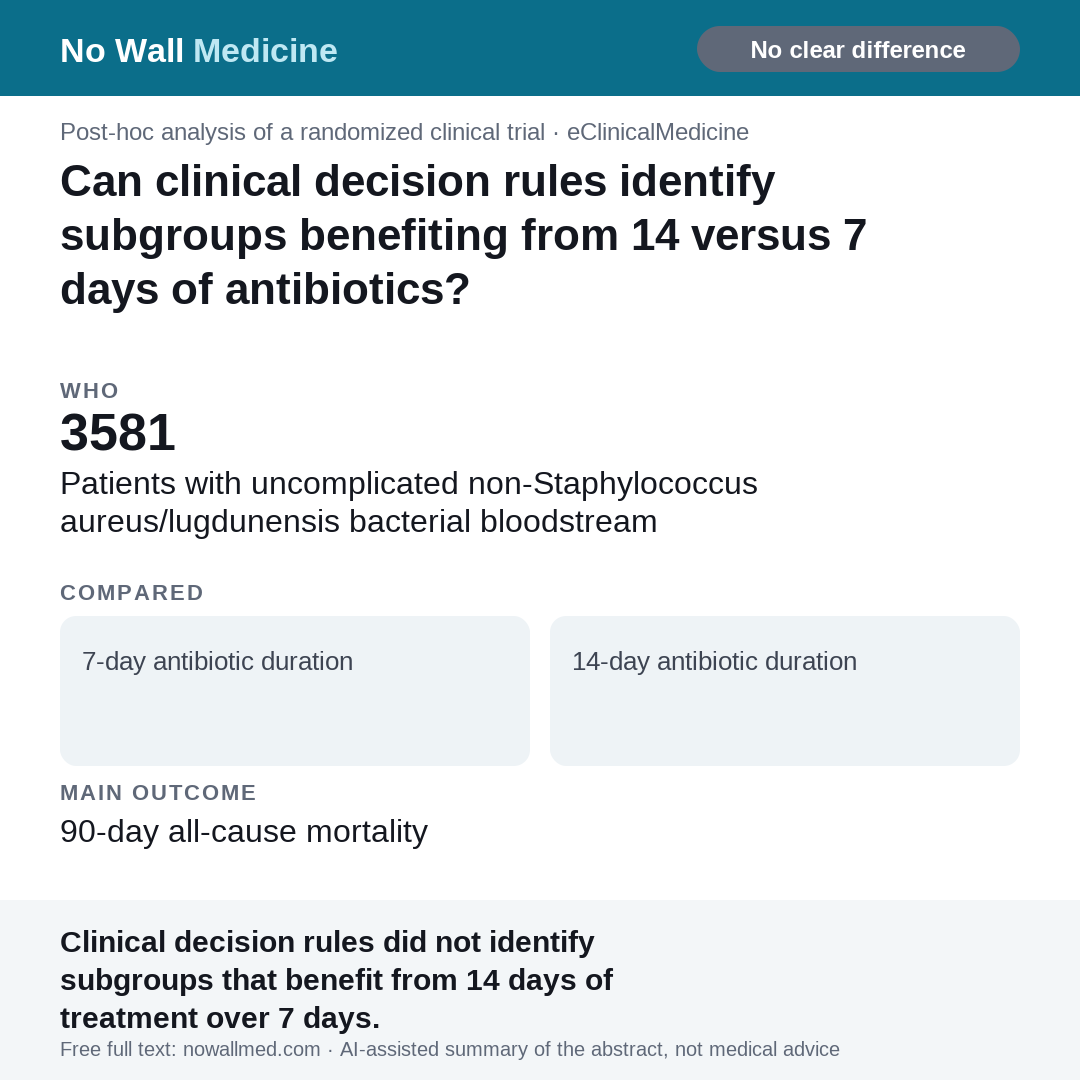
Can clinical decision rules identify subgroups benefiting from 14 versus 7 days of antibiotics?
Who
3581
Patients with uncomplicated non-Staphylococcus aureus/lugdunensis bacterial bloodstream infections · Multicentre
Compared
7-day antibiotic duration
14-day antibiotic duration
Main outcome
90-day all-cause mortality
Bottom line: Clinical decision rules did not identify subgroups that benefit from 14 days of treatment over 7 days.
Limitation: This was an exploratory post-hoc analysis.
Funded by: Canadian Institutes of Health Research and others
eClinicalMedicine · 2025-04-10Download image
Clinical question: Can clinical decision rules identify subgroups benefiting from 14 versus 7 days of antibiotics?
Why it matters: It is unknown if specific patient subgroups benefit from longer antibiotic durations for uncomplicated non-Staphylococcus aureus or non-lugdunensis bacterial bloodstream infections.
Key points
- Researchers analyzed 3581 patients from the BALANCE randomized clinical trial to compare 7-day versus 14-day antibiotic durations for bloodstream infections.
- Three clinical decision rules used to categorize mortality risk did not show a statistically significant difference in 90-day mortality between the two treatment groups.
- The static rule showed a risk difference of -0.58 in low-risk patients and -2.65 in high-risk patients, but the interaction test was not significant (p = 0.74).
Headline and key points written with AI from the paper’s abstract, with every number checked against it. Read the paper before relying on them.
Was this summary helpful?
Cite this article
Ong SWX, Pinto R, Rishu A, Tong SYC, Commons RJ, Conly JM. Identifying heterogeneity of treatment effect for antibiotic duration in bloodstream infection: an exploratory post-hoc analysis of the BALANCE randomised clinical trial. eClinicalMedicine. 2025. doi:10.1016/j.eclinm.2025.103195
Spotted a mistake? Suggest a correction
Top studies every Monday
The week’s key trials and guidelines in your specialties, plus any topics you follow. By email, free.
Get the weekly digest