Higher serum urate levels were associated with more gout flares after one year of treatment
Identifying the association between serum urate levels and gout flares in patients taking urate-lowering therapy: a post hoc cohort analysis of the CARES trial with consideration of dropout
Post hoc cohort analysis of a randomized controlled trialBenefit found
How do serum urate levels associate with gout flare rates during urate-lowering therapy?
Who
6183
Patients taking urate-lowering therapy
Compared
Serum urate ≤3.9 mg/dL: Lower flare rates
Serum urate 4.0-5.9 mg/dL
Serum urate ≥10 mg/dL: greater rates
Main outcome
gout flare
Bottom line: Gout flare rates were persistently higher when serum urate was 6.0-7.9, 8.0-9.9, or ≥10 mg/dL after the first year.
Ann Rheum Dis · 2024-09-30Download image
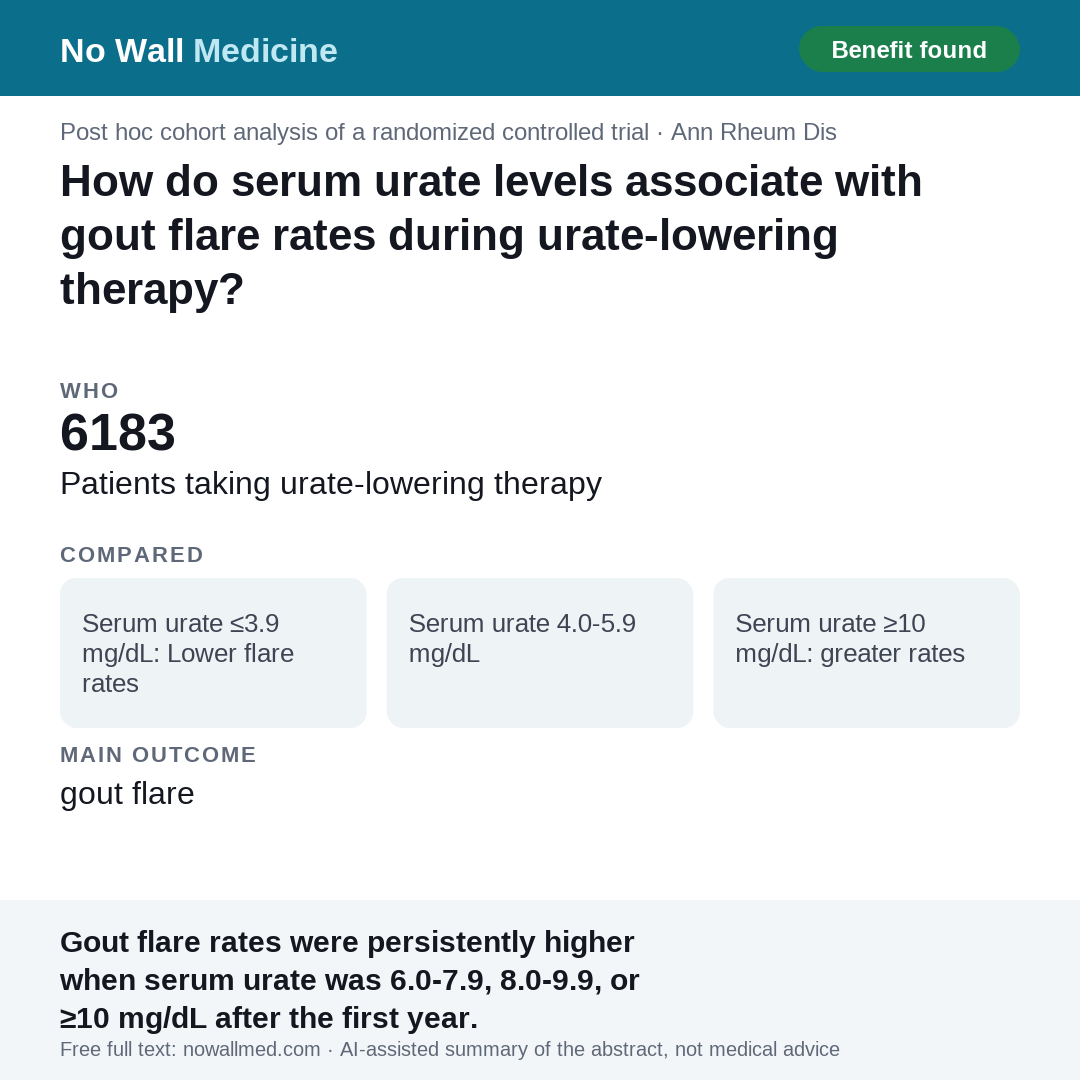
Clinical question: How do serum urate levels associate with gout flare rates during urate-lowering therapy?
Why it matters: It was unknown how repeated serum urate measurements relate to the frequency of gout flares in patients receiving urate-lowering therapy over several years.
Key points
- Researchers analyzed 6183 participants from a randomized controlled trial comparing febuxostat and allopurinol for gout treatment.
- Between months 36-72, lower flare rates were associated with serum urate levels ≤3.9 mg/dL and higher rates with levels ≥10 mg/dL compared to 4.0-5.9 mg/dL.
- Gout flare rates were similar across all serum urate groups during the first year of urate-lowering therapy.
Headline and key points written with AI from the paper’s abstract, with every number checked against it. Read the paper before relying on them.
Topics
Cite this article
Tedeschi SK, Hayashi K, Zhang Y, Choi H, Solomon DH. Identifying the association between serum urate levels and gout flares in patients taking urate-lowering therapy: a post hoc cohort analysis of the CARES trial with consideration of dropout. Ann Rheum Dis. 2024. doi:10.1136/ard-2024-225761
Spotted a mistake? Suggest a correction
Top studies every Monday
The week’s key trials and guidelines in your specialties, plus any topics you follow. By email, free.
Get the weekly digest