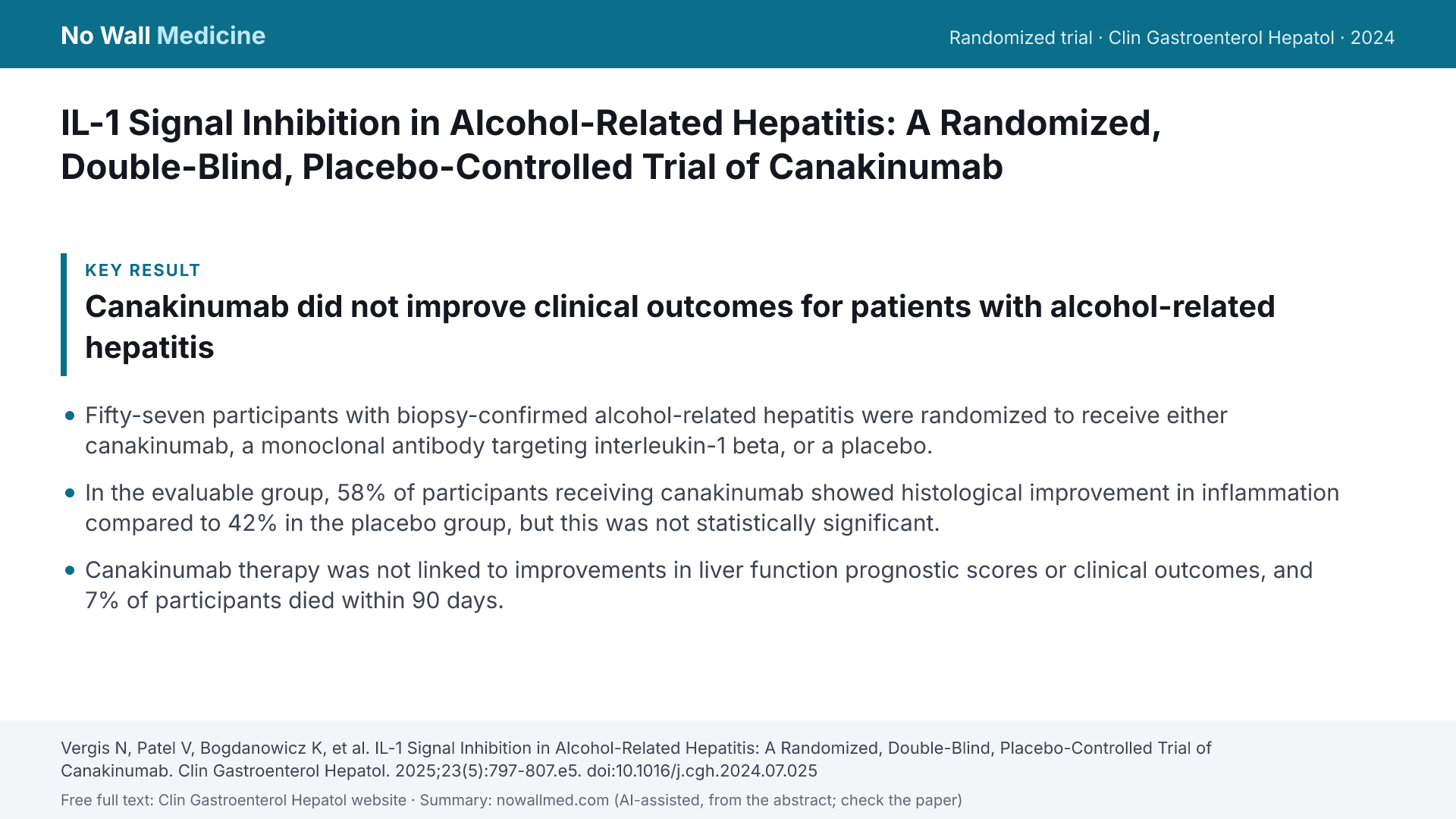
Canakinumab did not improve clinical outcomes for patients with alcohol-related hepatitis
IL-1 Signal Inhibition in Alcohol-Related Hepatitis: A Randomized, Double-Blind, Placebo-Controlled Trial of Canakinumab
Key points
- Fifty-seven participants with biopsy-confirmed alcohol-related hepatitis were randomized to receive either canakinumab, a monoclonal antibody targeting interleukin-1 beta, or a placebo.
- In the evaluable group, 58% of participants receiving canakinumab showed histological improvement in inflammation compared to 42% in the placebo group, but this was not statistically significant.
- Canakinumab therapy was not linked to improvements in liver function prognostic scores or clinical outcomes, and 7% of participants died within 90 days.
Headline and key points written with AI from the paper’s abstract, with every number checked against it. Read the paper before relying on them.
Was this summary helpful?
Subject terms
Headline, design, result, key points, caveat and citation as plain text.
Cite this article
Vergis N, Patel V, Bogdanowicz K, et al. IL-1 Signal Inhibition in Alcohol-Related Hepatitis: A Randomized, Double-Blind, Placebo-Controlled Trial of Canakinumab. Clin Gastroenterol Hepatol. 2025;23(5):797-807.e5. doi:10.1016/j.cgh.2024.07.025
Spotted a mistake? Suggest a correction