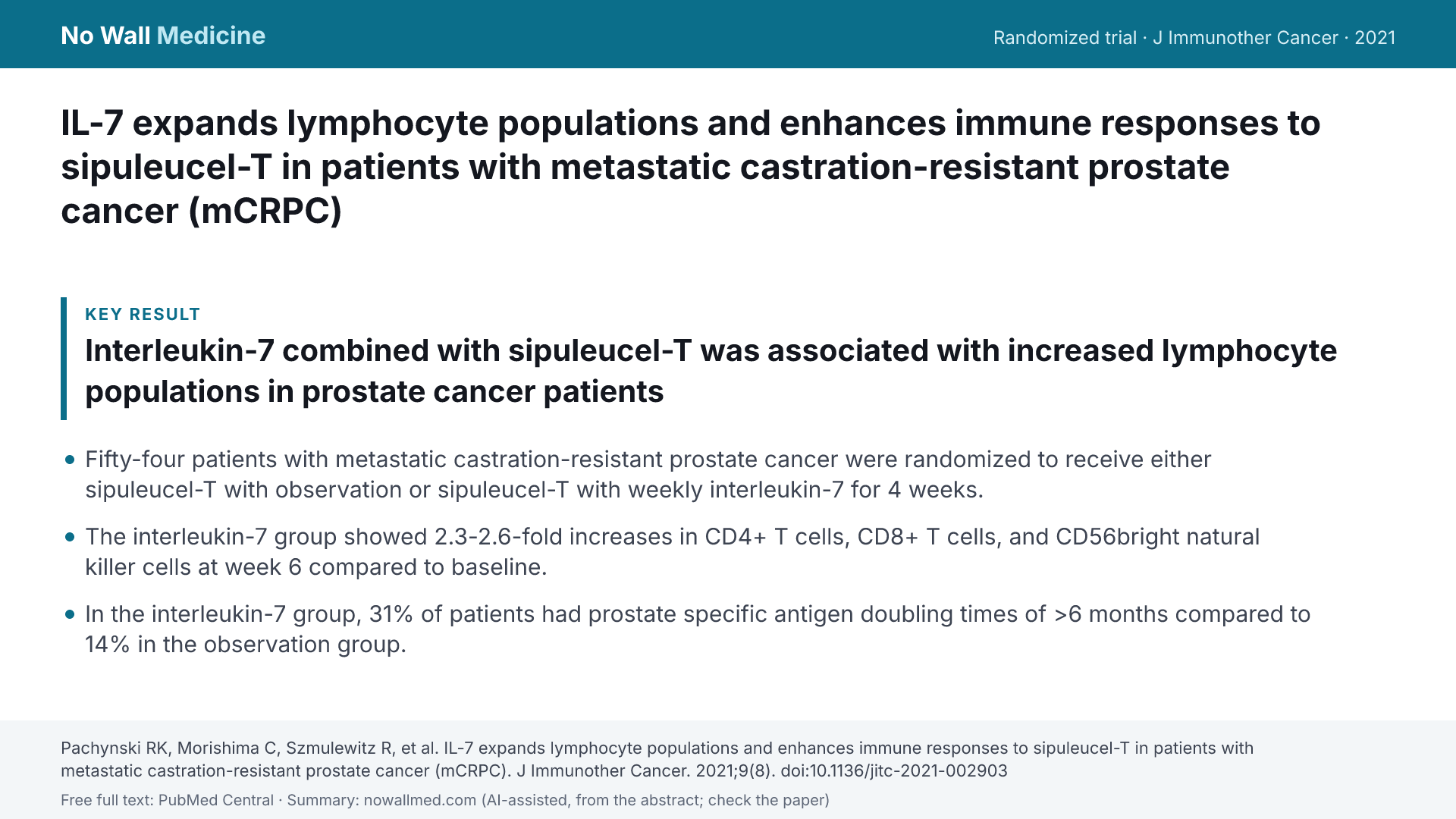
Interleukin-7 combined with sipuleucel-T was associated with increased lymphocyte populations in prostate cancer patients
IL-7 expands lymphocyte populations and enhances immune responses to sipuleucel-T in patients with metastatic castration-resistant prostate cancer (mCRPC)
Key points
- Fifty-four patients with metastatic castration-resistant prostate cancer were randomized to receive either sipuleucel-T with observation or sipuleucel-T with weekly interleukin-7 for 4 weeks.
- The interleukin-7 group showed 2.3-2.6-fold increases in CD4+ T cells, CD8+ T cells, and CD56bright natural killer cells at week 6 compared to baseline.
- In the interleukin-7 group, 31% of patients had prostate specific antigen doubling times of >6 months compared to 14% in the observation group.
Headline and key points written with AI from the paper’s abstract, with every number checked against it. Read the paper before relying on them.
Was this summary helpful?
Abstract
Background
Sipuleucel-T (sip-T) is a Food and Drug Administration (FDA)-approved autologous cellular immunotherapy for metastatic castration-resistant prostate cancer (mCRPC). We hypothesized that combining sip-T with interleukin (IL)-7, a homeostatic cytokine that enhances both B and T cell development and proliferation, would augment and prolong antigen-specific immune responses against both PA2024 (the immunogen for sip-T) and prostatic acid phosphatase (PAP). Methods
Fifty-four patients with mCRPC treated with sip-T were subsequently enrolled and randomized 1:1 into observation (n=26) or IL-7 (n=28) arms of a phase II clinical trial (NCT01881867). Recombinant human (rh) IL-7 (CYT107) was given weekly×4. Immune responses were evaluated using flow cytometry, mass cytometry (CyTOF), interferon (IFN)-γ ELISpot, 3H-thymidine incorporation, and ELISA. Results
Treatment with rhIL-7 was well tolerated. For the rhIL-7-treated, but not observation group, statistically significant lymphocyte subset expansion was found, with 2.3-2.6-fold increases in CD4+T, CD8+T, and CD56bright NK cells at week 6 compared with baseline. No significant differences in PA2024 or PAP-specific T cell responses measured by IFN-γ ELISpot assay were found between rhIL-7 and observation groups. However, antigen-specific T cell proliferative responses and humoral IgG and IgG/IgM responses significantly increased over time in the rhIL-7-treated group only. CyTOF analyses revealed pleiotropic effects of rhIL-7 on lymphocyte subsets, including increases in CD137 and intracellular IL-2 and IFN-γ expression. While not powered to detect clinical outcomes, we found that 31% of patients in the rhIL-7 group had prostate specific antigen (PSA) doubling times of >6 months, compared with 14% in the observation group. Conclusions
Treatment with rhIL-7 led to a significant expansion of CD4+ and CD8+ T cells, and CD56bright natural killer (NK) cells compared with observation after treatment with sip-T. The rhIL-7 treatment also led to improved antigen-specific humoral and T cell proliferative responses over time as well as to increased expression of activation markers and beneficial cytokines. This is the first study to evaluate the use of rhIL-7 after sip-T in patients with mCRPC and demonstrates encouraging results for combination approaches to augment beneficial immune responses.
Abstract reproduced under the article’s CC BY NC licence.
Subject terms
Headline, design, result, key points, caveat and citation as plain text.
Cite this article
Pachynski RK, Morishima C, Szmulewitz R, et al. IL-7 expands lymphocyte populations and enhances immune responses to sipuleucel-T in patients with metastatic castration-resistant prostate cancer (mCRPC). J Immunother Cancer. 2021;9(8). doi:10.1136/jitc-2021-002903
Spotted a mistake? Suggest a correction