Illusory movements did not change energy metabolism or insulin sensitivity in patients with extensive burns
Illusory movements for immobile patients with extensive burns (IMMOBILE): A randomized, controlled, cross-over trial
Randomized, controlled, crossover trialMixed results
Do illusory movements affect energy metabolism, insulin sensitivity, and skeletal muscle biology in burn patients?
Who
Adult critically ill patients with deep burns covering 30% or more · Burn centre in a tertiary teaching hospital
Compared
Standard physical therapy
Illusory movements plus standard physical therapy
Main outcome
Energy expenditure, nitrogen balance, insulin sensitivity, and skeletal muscle biology
Bottom line: Illusory movements improved mitochondrial ATP synthesis capacity but did not change energy expenditure, nitrogen balance, or insulin sensitivity.
Limitation: Clinical effects remain to be demonstrated in adequately powered trials.
Burns · 2024-09-16Download image
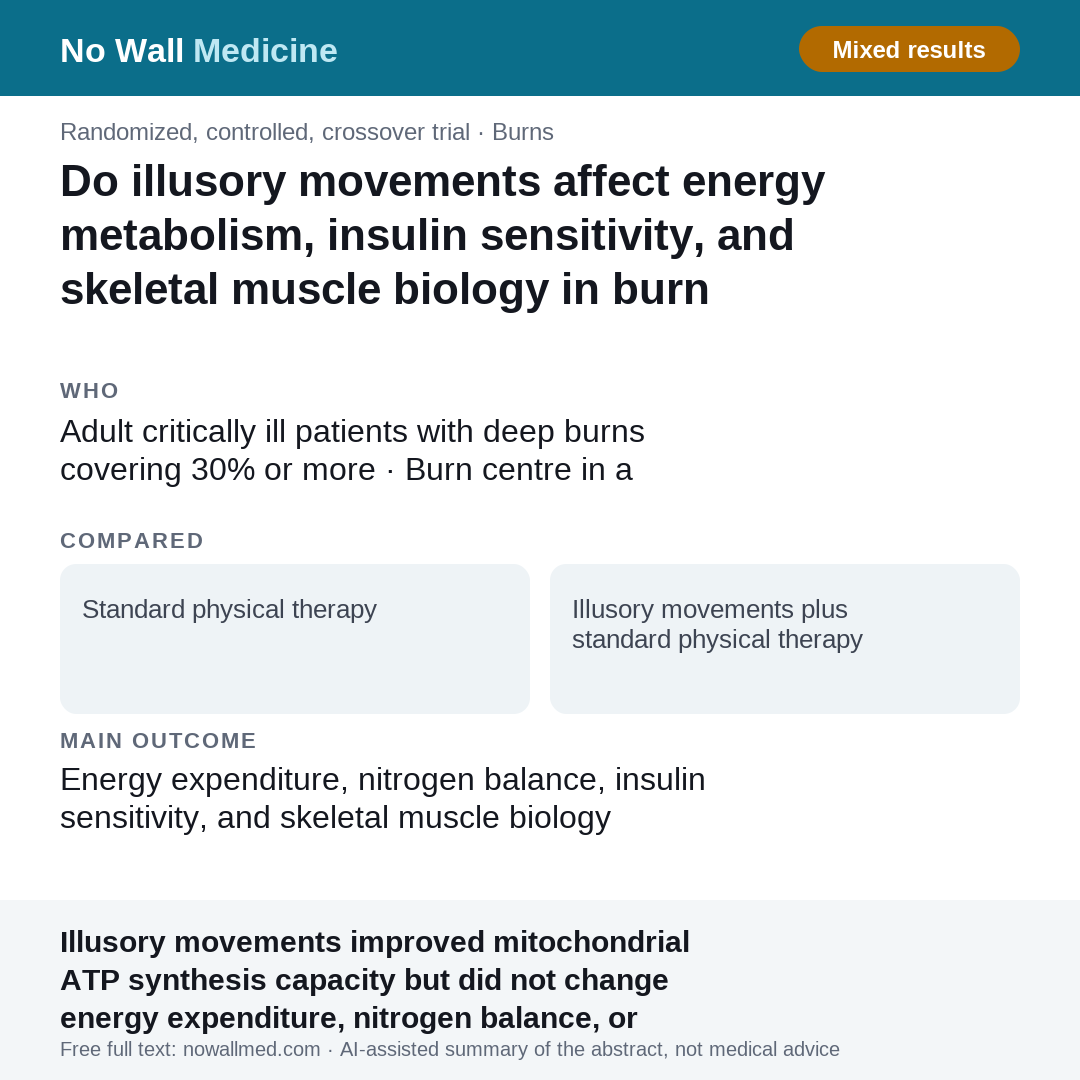
Clinical question: Do illusory movements affect energy metabolism, insulin sensitivity, and skeletal muscle biology in burn patients?
Why it matters: It was unknown if functional proprioceptive stimulation, or illusory movements, could facilitate rehabilitation for patients with extensive burns who have limited physiotherapy options.
Key points
- Researchers studied adult critically ill patients with deep burns covering 30% or more of their body surface area using a randomized crossover trial.
- Adding two 30-minute daily sessions of functional proprioceptive stimulation to standard therapy did not change energy expenditure, nitrogen balance, or insulin sensitivity.
- At the cellular level, the intervention increased the capacity of mitochondria, the cell's energy producers, to synthesize ATP by aerobic phosphorylation.
Limitation the authors note: Clinical effects remain to be demonstrated in adequately powered trials.
Headline and key points written with AI from the paper’s abstract, with every number checked against it. Read the paper before relying on them.
Was this summary helpful?
Subject terms
Cite this article
Bakalář B, Švecová M, Duška F, Grünerová-Lippertová M, Urban T, Waldauf P. Illusory movements for immobile patients with extensive burns (IMMOBILE): A randomized, controlled, cross-over trial. Burns. 2024. doi:10.1016/j.burns.2024.09.003
Spotted a mistake? Suggest a correction
Top studies every Monday
The week’s key trials and guidelines in your specialties, plus any topics you follow. By email, free.
Get the weekly digest