Imaging-based artificial intelligence shows diagnostic accuracy for predicting lymphovascular space invasion in cervical cancer
Imaging-Based AI for Predicting Lymphovascular Space Invasion in Cervical Cancer: Systematic Review and Meta-Analysis
Systematic review and meta-analysisBenefit found
What is the diagnostic accuracy of imaging-based artificial intelligence for predicting lymphovascular space invasion?
Who
2514
Patients with cervical cancer
Compared
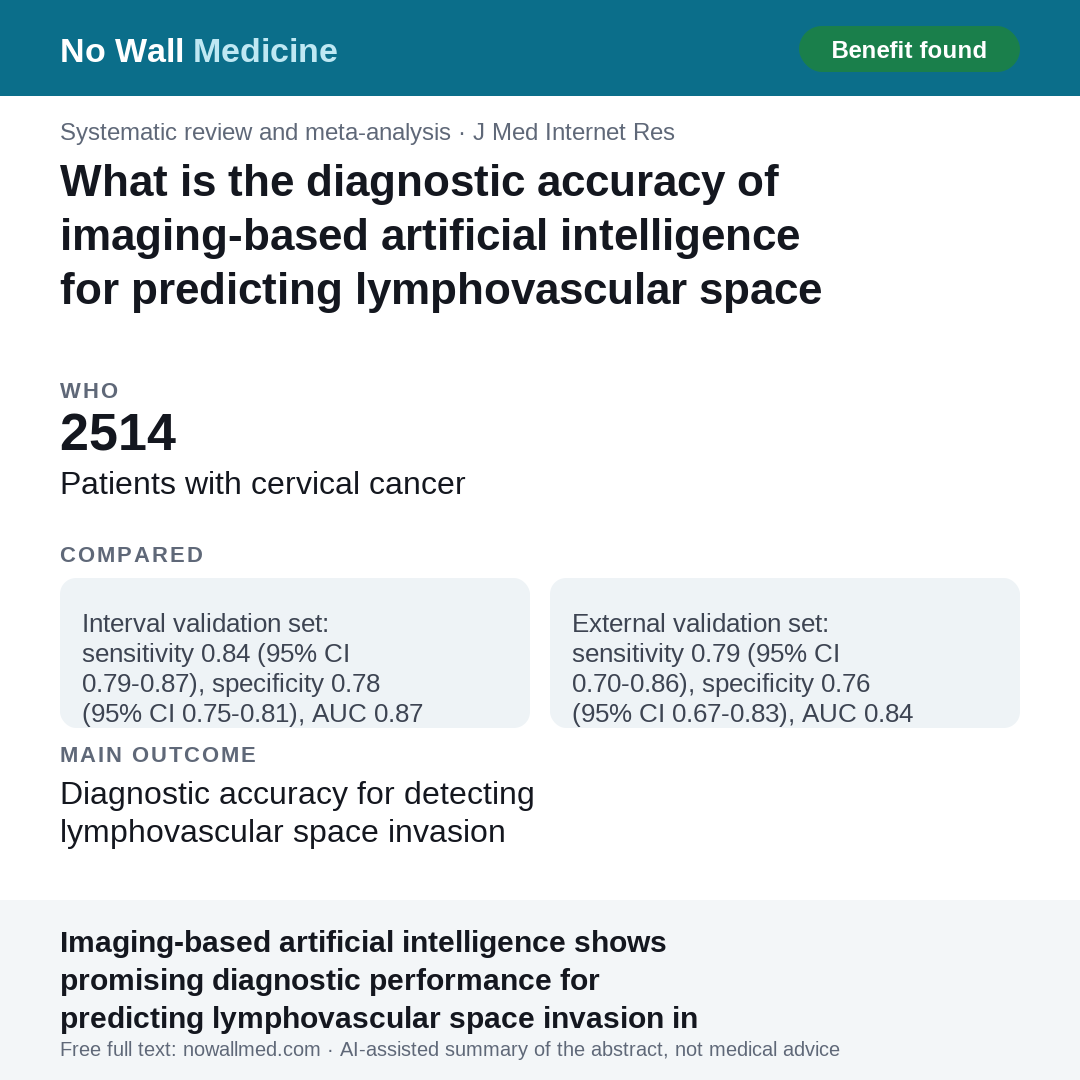
Interval validation set: sensitivity 0.84 (95% CI 0.79-0.87), specificity 0.78 (95% CI 0.75-0.81), AUC 0.87 (95% CI 0.84-0.90)
External validation set: sensitivity 0.79 (95% CI 0.70-0.86), specificity 0.76 (95% CI 0.67-0.83), AUC 0.84 (95% CI 0.81-0.87)
Main outcome
Diagnostic accuracy for detecting lymphovascular space invasion
Bottom line: Imaging-based artificial intelligence shows promising diagnostic performance for predicting lymphovascular space invasion in cervical cancer.
Limitation: Limited external validation datasets and the retrospective nature of the research may introduce potential biases.
J Med Internet Res · 2025-06-16Download image
Clinical question: What is the diagnostic accuracy of imaging-based artificial intelligence for predicting lymphovascular space invasion?
Why it matters: The accuracy of using artificial intelligence to detect lymphovascular space invasion in cervical cancer remains a subject of debate.
Key points
- Researchers analyzed 16 studies involving 2514 patients to evaluate how well artificial intelligence predicts lymphovascular space invasion, which is the spread of cancer into blood or lymphatic vessels.
- In interval validation sets, the pooled sensitivity was 0.84, specificity was 0.78, and the area under the curve was 0.87.
- In external validation sets, the pooled sensitivity was 0.79, specificity was 0.76, and the area under the curve was 0.84.
Limitation the authors note: The authors state that the retrospective nature of the research and limited external validation datasets may introduce potential biases.
Headline and key points written with AI from the paper’s abstract, with every number checked against it. Read the paper before relying on them.
Topics
Cite this article
She L, Li Y, Wang H, Zhang J, Zhao Y, Cui J. Imaging-Based AI for Predicting Lymphovascular Space Invasion in Cervical Cancer: Systematic Review and Meta-Analysis. J Med Internet Res. 2025. doi:10.2196/71091
Spotted a mistake? Suggest a correction
Top studies every Monday
The week’s key trials and guidelines in your specialties, by email. Free.
Get the weekly digest