Randomized trialNew England Journal of Medicine · Aug 31, 2026

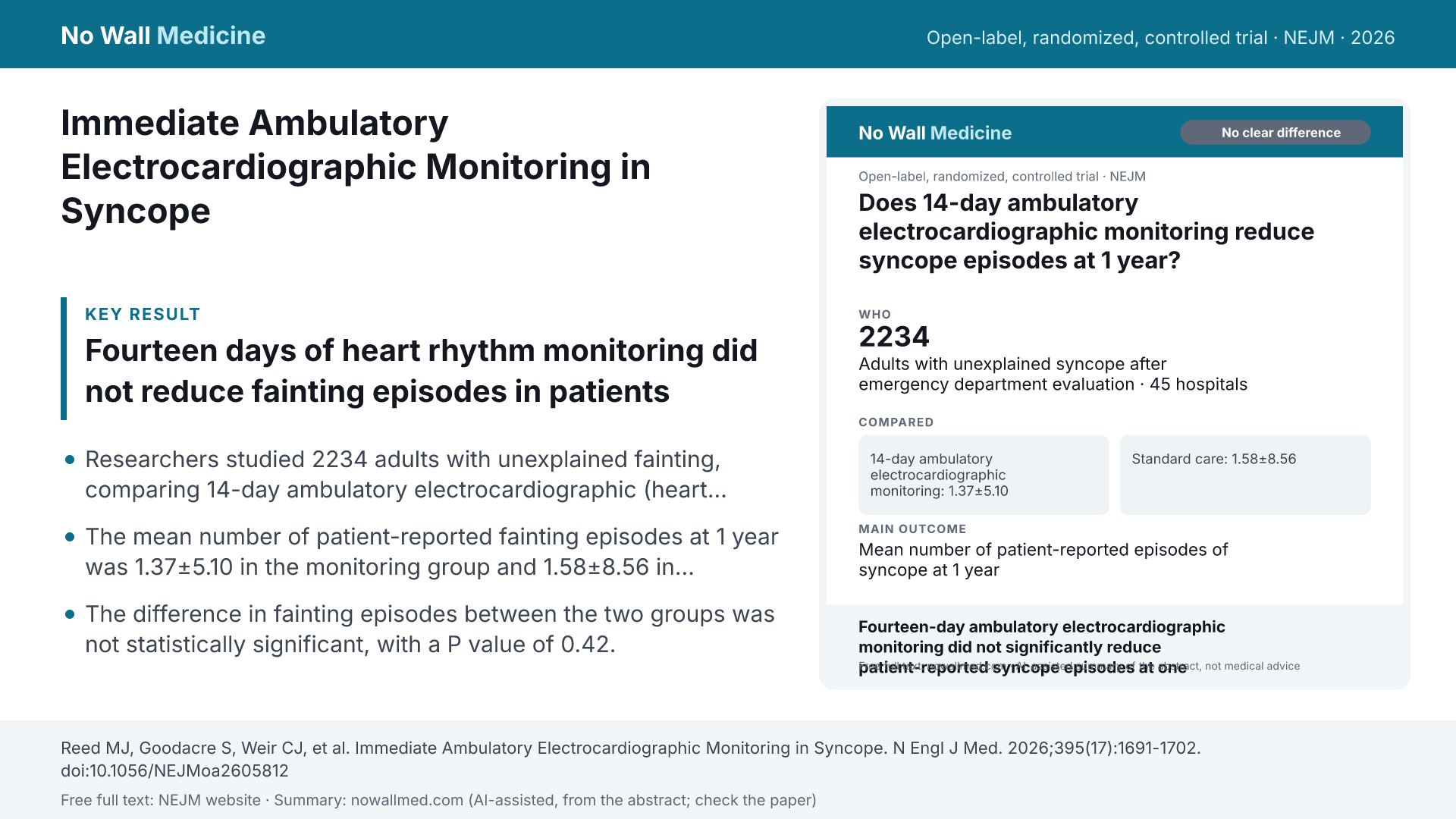
Fourteen days of heart rhythm monitoring did not reduce fainting episodes in patients

Immediate Ambulatory Electrocardiographic Monitoring in Syncope

Reed MJ, Goodacre S, Weir CJ, Dinsmore L, Nugent A, Kennel T, et al
CardiologyAdult
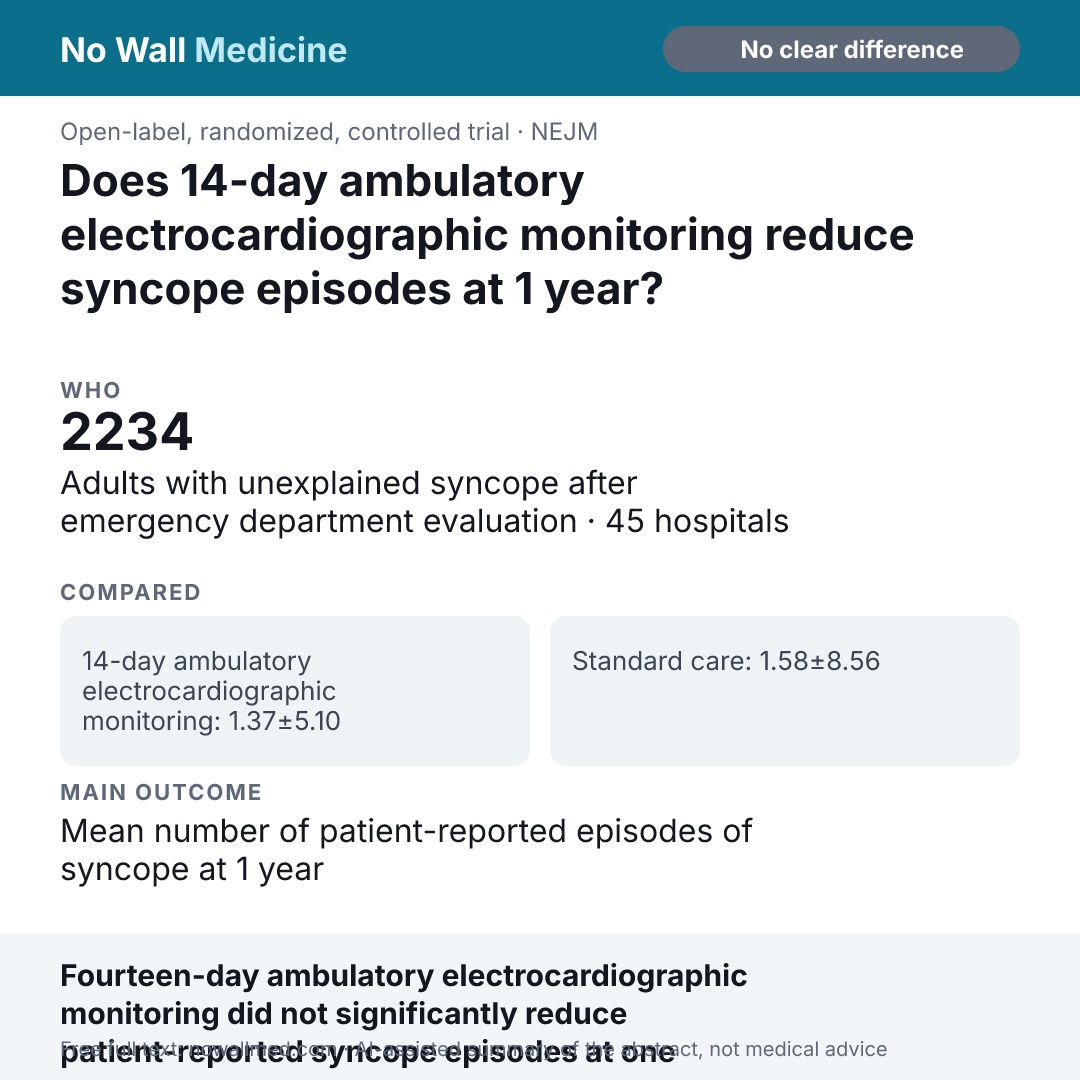
Open-label, randomized, controlled trialNo clear difference
Does 14-day ambulatory electrocardiographic monitoring reduce syncope episodes at 1 year?
Who
2234
Adults with unexplained syncope after emergency department evaluation · 45 hospitals in the United Kingdom
Compared
14-day ambulatory electrocardiographic monitoring: 1.37±5.10
Standard care: 1.58±8.56
Main outcome
Mean number of patient-reported episodes of syncope at 1 year
Result: incidence rate ratio 0.89 (95% confidence interval 0.68 to 1.18)
Bottom line: Fourteen-day ambulatory electrocardiographic monitoring did not significantly reduce patient-reported syncope episodes at one year compared to standard care.
NEJM · 2026-08-31 · Funded by British Heart Foundation and National Health Service Research Scotland · ISRCTN10278811
Read the full paper free at the publisher ↗
Save PNG⬇ Slide🖨 Handout

Why it matters: Diagnosing an underlying heart rhythm disorder remains difficult in patients who present to the emergency department with syncope, or fainting.

Headline and visual abstract written with AI from the paper’s abstract, with every number checked against it. Read the paper before relying on them.

Was this summary helpful?

Subject terms

Aged; Female; Humans; Male; Middle Aged; Arrhythmias, Cardiac; Electrocardiography, Ambulatory; Emergency Room Visits; Syncope; Follow-Up Studies; Adult; Recurrence

DOI: 10.1056/NEJMoa2605812 · PubMed: 42670977 · Registered: ISRCTN10278811

Cite this article

Reed MJ, Goodacre S, Weir CJ, et al. Immediate Ambulatory Electrocardiographic Monitoring in Syncope. N Engl J Med. 2026;395(17):1691-1702. doi:10.1056/NEJMoa2605812

RIS (EndNote, Zotero, Mendeley)BibTeX

Spotted a mistake? Suggest a correction

Top Cardiology studies every Monday

The week’s key trials and guidelines, free to read, in one short email. No account; unsubscribe in one click.

Choose specialties and topics

Similar articles

Secondary analysis of a trial n = 6,004 · JAMA Cardiol · Feb 16, 2023 · Cardiology

Continuous heart monitoring was associated with more bradyarrhythmia diagnoses than usual care

Meta-analysis · J Am Heart Assoc · May 26, 2025 · Pediatric · Cardiology, Pediatrics

Meta-analysis defines normal heart rhythm ranges for healthy infants, children, and adolescents

Research · J Am Heart Assoc · Apr 22, 2026 · Basic science · Cardiology

Pulsed Ultrahigh Frequency Spinal Cord Stimulation for Arrhythmia After Myocardial Infarction

Research · J Am Heart Assoc · Sep 9, 2026 · Cardiology

Sex Differences in Cardiac Rhythm and Conduction Abnormalities After Noncardioembolic Ischemic Stroke

Research · J Am Heart Assoc · Dec 17, 2025 · Cardiology

Time Course of Cardiac Arrhythmia Following High-Volume Exercise in Recreational Cyclists