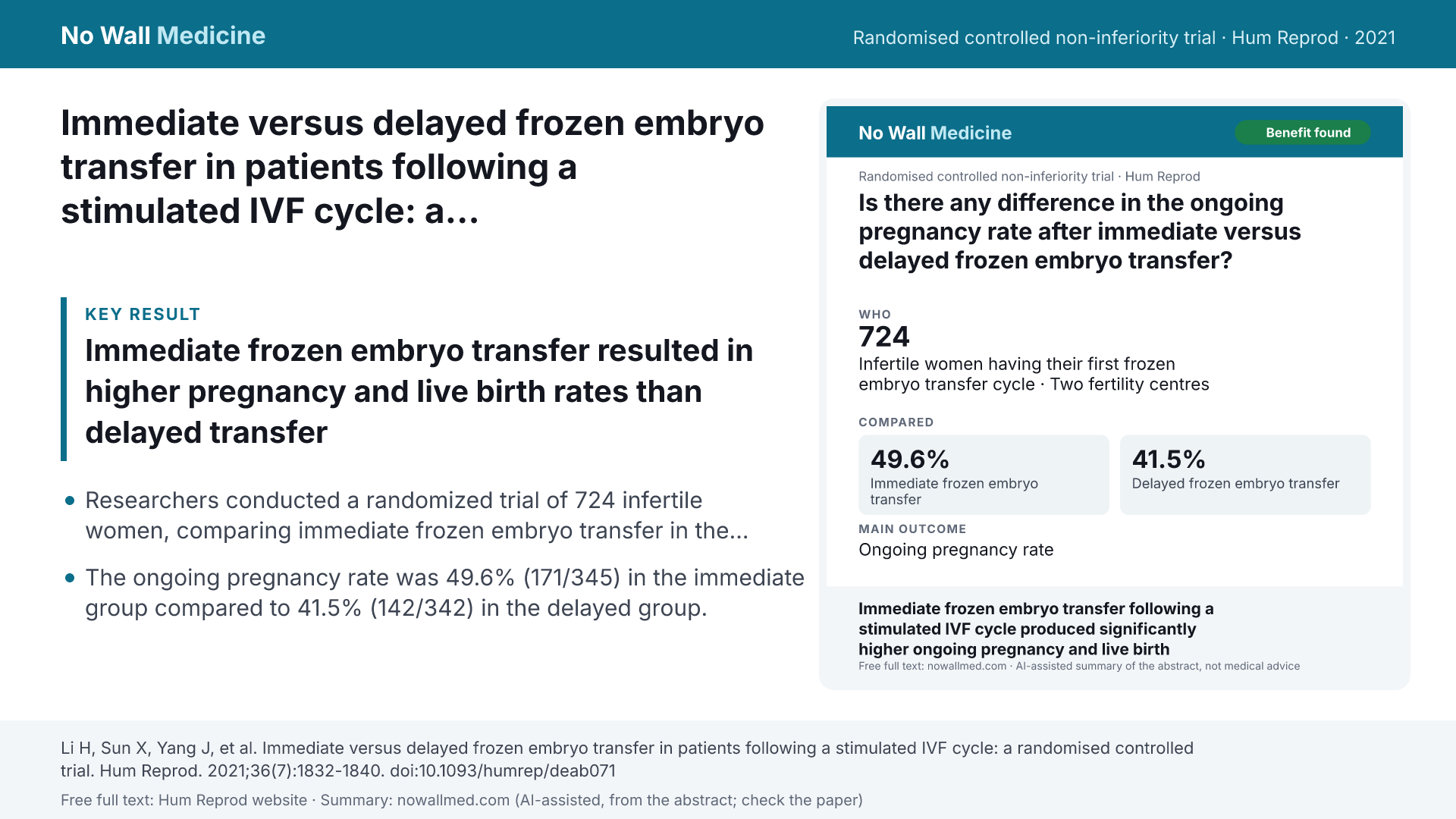
Immediate frozen embryo transfer resulted in higher pregnancy and live birth rates than delayed transfer
Immediate versus delayed frozen embryo transfer in patients following a stimulated IVF cycle: a randomised controlled trial
Randomised controlled non-inferiority trialBenefit found
Is there any difference in the ongoing pregnancy rate after immediate versus delayed frozen embryo transfer?
Who
724
Infertile women having their first frozen embryo transfer cycle · Two fertility centres in China
Compared
49.6%Immediate frozen embryo transfer (171/345)
41.5%Delayed frozen embryo transfer (142/342)
Main outcome
Ongoing pregnancy rate
Result: odds ratios 0.72, 95% CI 0.53-0.98
Bottom line: Immediate frozen embryo transfer following a stimulated IVF cycle produced significantly higher ongoing pregnancy and live birth rates than delayed transfer.
Limitation: The two groups still differed slightly in the age of the women at IVF.
Hum Reprod · 2021-04-23 · Save PNG
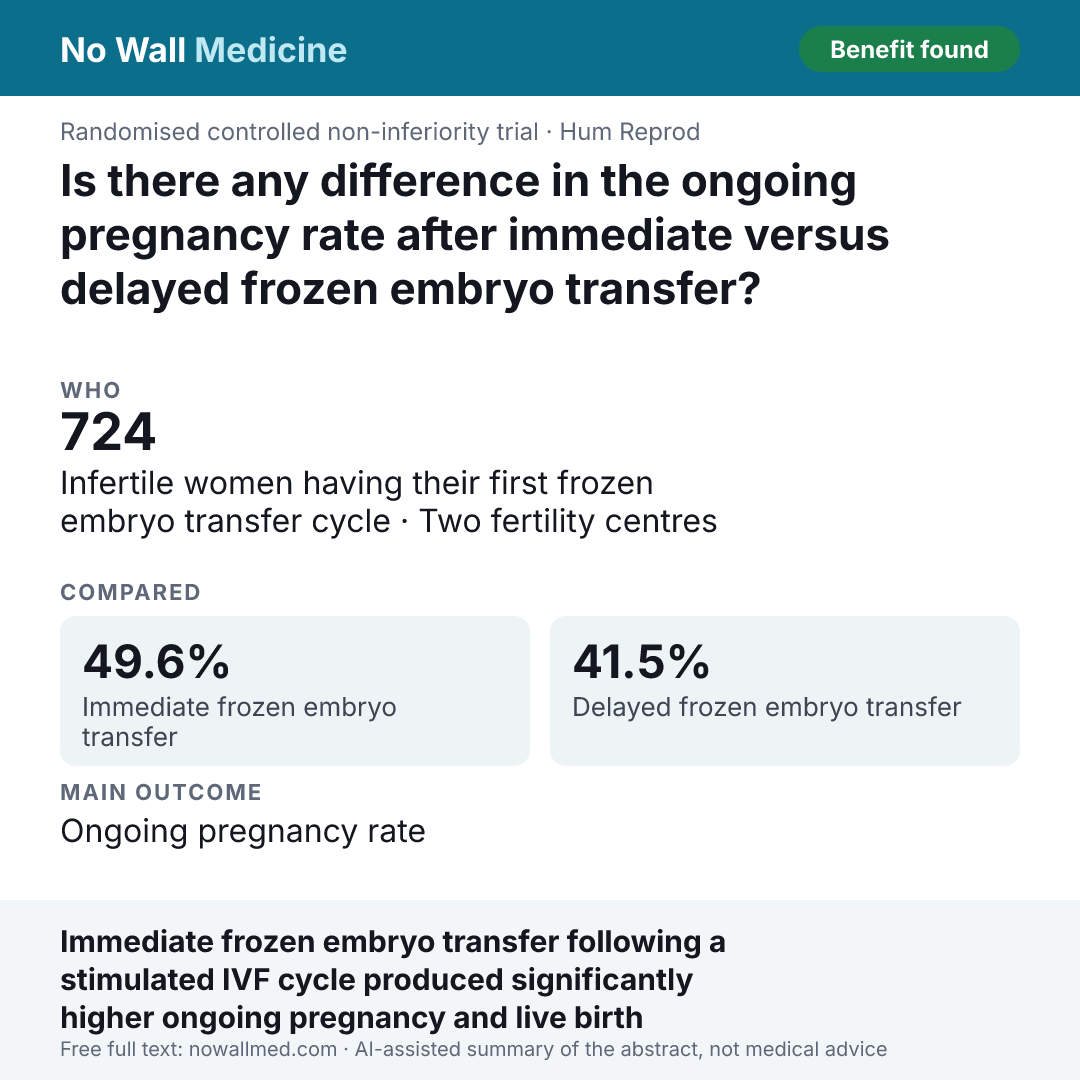
Clinical question: Is there any difference in the ongoing pregnancy rate after immediate versus delayed frozen embryo transfer?
Key points
- Researchers conducted a randomized trial of 724 infertile women, comparing immediate frozen embryo transfer in the first menstrual cycle to delayed transfer in the second or later cycle.
- The ongoing pregnancy rate was 49.6% (171/345) in the immediate group compared to 41.5% (142/342) in the delayed group.
- The live birth rate was 47.2% (163/345) in the immediate group and 37.7% (129/342) in the delayed group, while the miscarriage rate was 13.2% in the immediate group versus 24.2% in the delayed group.
Limitation the authors note: Despite randomization, the two groups differed slightly in the age of the women at in vitro fertilization.
Headline and key points written with AI from the paper’s abstract, with every number checked against it. Read the paper before relying on them.
Was this summary helpful?
Subject terms
Headline, design, result, key points, caveat and citation as plain text.
Cite this article
Li H, Sun X, Yang J, et al. Immediate versus delayed frozen embryo transfer in patients following a stimulated IVF cycle: a randomised controlled trial. Hum Reprod. 2021. doi:10.1093/humrep/deab071
Spotted a mistake? Suggest a correction