Virtual reality with neurostimulation improved motor function in stroke patients
Immersive virtual reality with synchronous neurostimulation for upper-limb recovery after stroke: a randomized feasibility trial
Randomized feasibility trialBenefit found
Is immersive virtual reality with synchronous neurostimulation feasible and effective for stroke recovery?
Who
25
Patients with chronic stroke
Compared
MultiSensy intervention: FMA-UE 13.17 ± 1.30
Conventional rehabilitation: FMA-UE 7.54 ± 1.48
Main outcome
Motor function assessed by Fugl-Meyer Assessment Upper Extremity and Action Research Arm Test
Bottom line: MultiSensy intervention resulted in greater motor improvement compared to conventional rehabilitation in patients with chronic stroke.
Limitation: The study was a small feasibility trial with a limited sample size.
Nat Med · 2026-06-26Download image
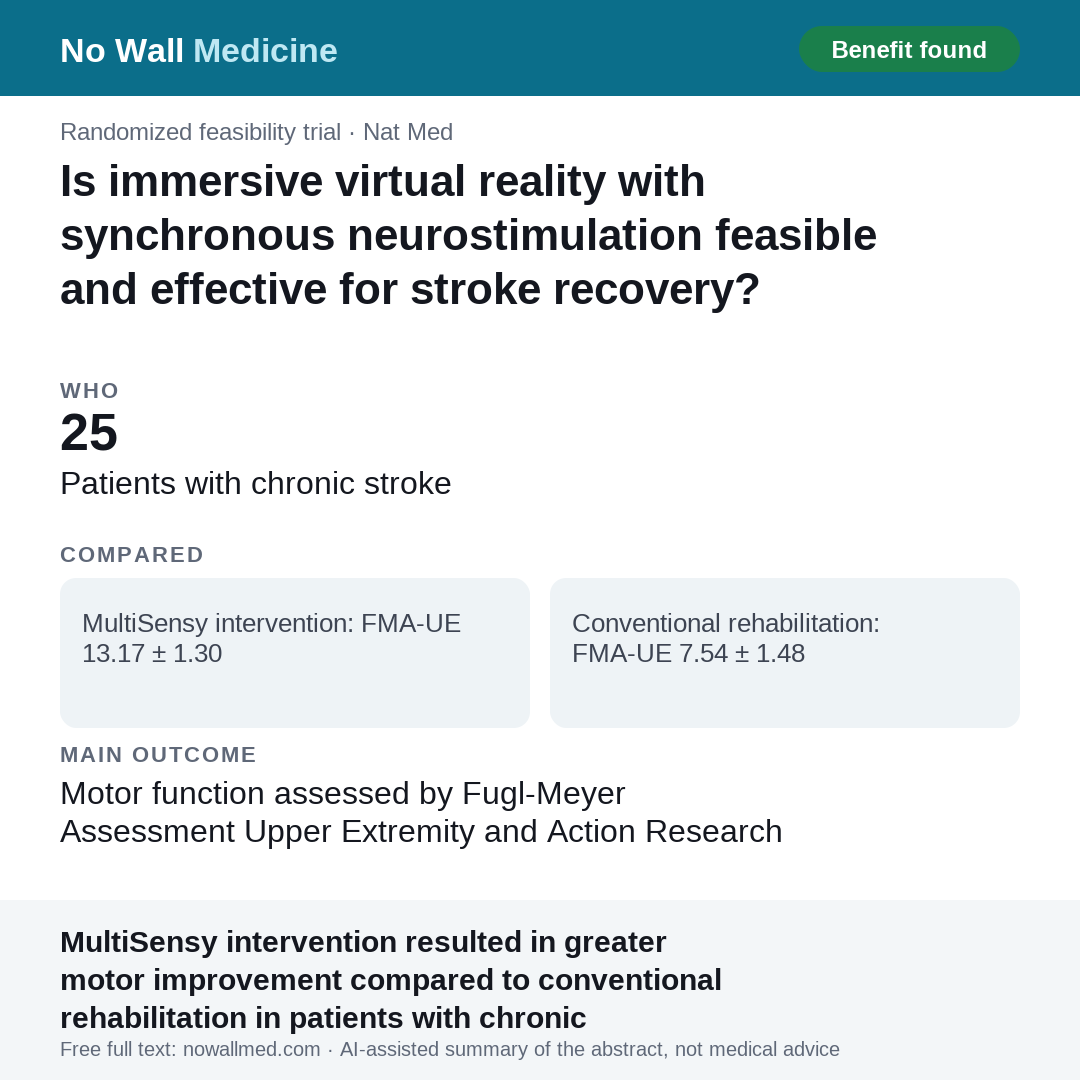
Clinical question: Is immersive virtual reality with synchronous neurostimulation feasible and effective for stroke recovery?
Why it matters: Rehabilitation delivery for stroke patients remains partial and inconsistent, highlighting an unmet clinical need
Key points
- Thirty-four chronic stroke patients were enrolled and compared to conventional rehabilitation.
- MultiSensy resulted in greater motor improvement, with FMA-UE scores of 13.17 versus 7.54.
- The platform improved body self-representation and hand tactile acuity.
Limitation the authors note: The study was a small-scale feasibility trial with a short duration of 33 days
Headline and key points written with AI from the paper’s abstract, with every number checked against it. Read the paper before relying on them.
Topics
Spotted a mistake? Suggest a correction
More in Cardiology
Clonal hematopoiesis mutations linked to higher atrial fibrillation risk in cancer populations
Association of Clonal Hematopoiesis Mutations With Incident Atrial Fibrillation: A Systematic Review and Meta-Analysis
Deep learning model detects aortic stenosis from finger-cuff pressure waveforms accurately
Aortic Valve Stenosis Screening Using Deep Learning on Noninvasive Arterial Pressure Waveforms
Spontaneous coronary artery dissection affects younger women more often than expected
Spontaneous coronary artery dissection: implications for women's health, clinical care, and future research
Early lipid-lowering strategies may reduce atherosclerotic cardiovascular disease risk
Lipid-Lowering Strategies in the Era of Early Atherosclerosis Detection: 2026 ACC Scientific Statement: A Report of the American College of Cardiology