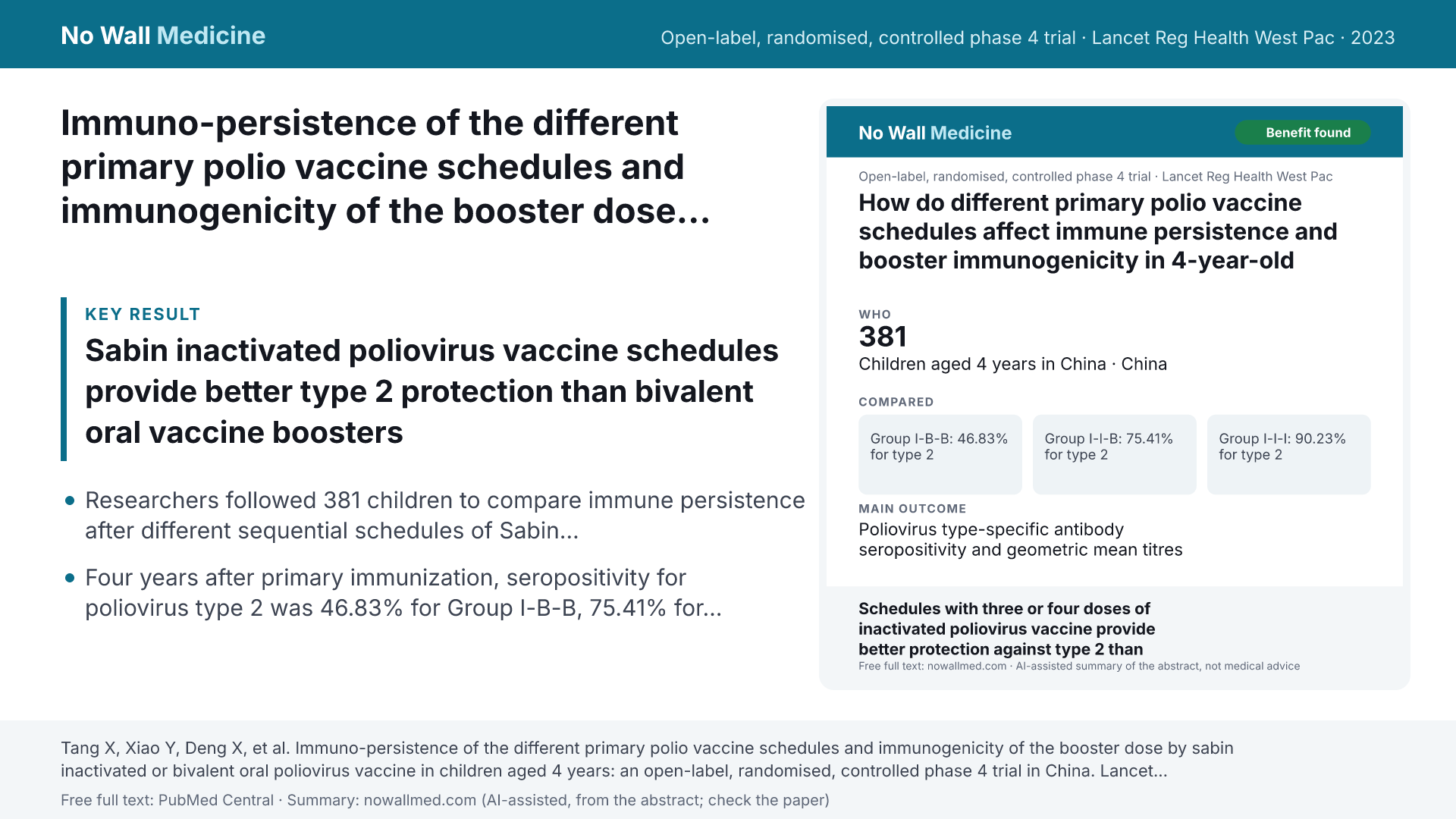
Sabin inactivated poliovirus vaccine schedules provide better type 2 protection than bivalent oral vaccine boosters
Immuno-persistence of the different primary polio vaccine schedules and immunogenicity of the booster dose by sabin inactivated or bivalent oral poliovirus vaccine in children aged 4 years: an open-label, randomised, controlled phase 4 trial in China
Open-label, randomised, controlled phase 4 trialBenefit found
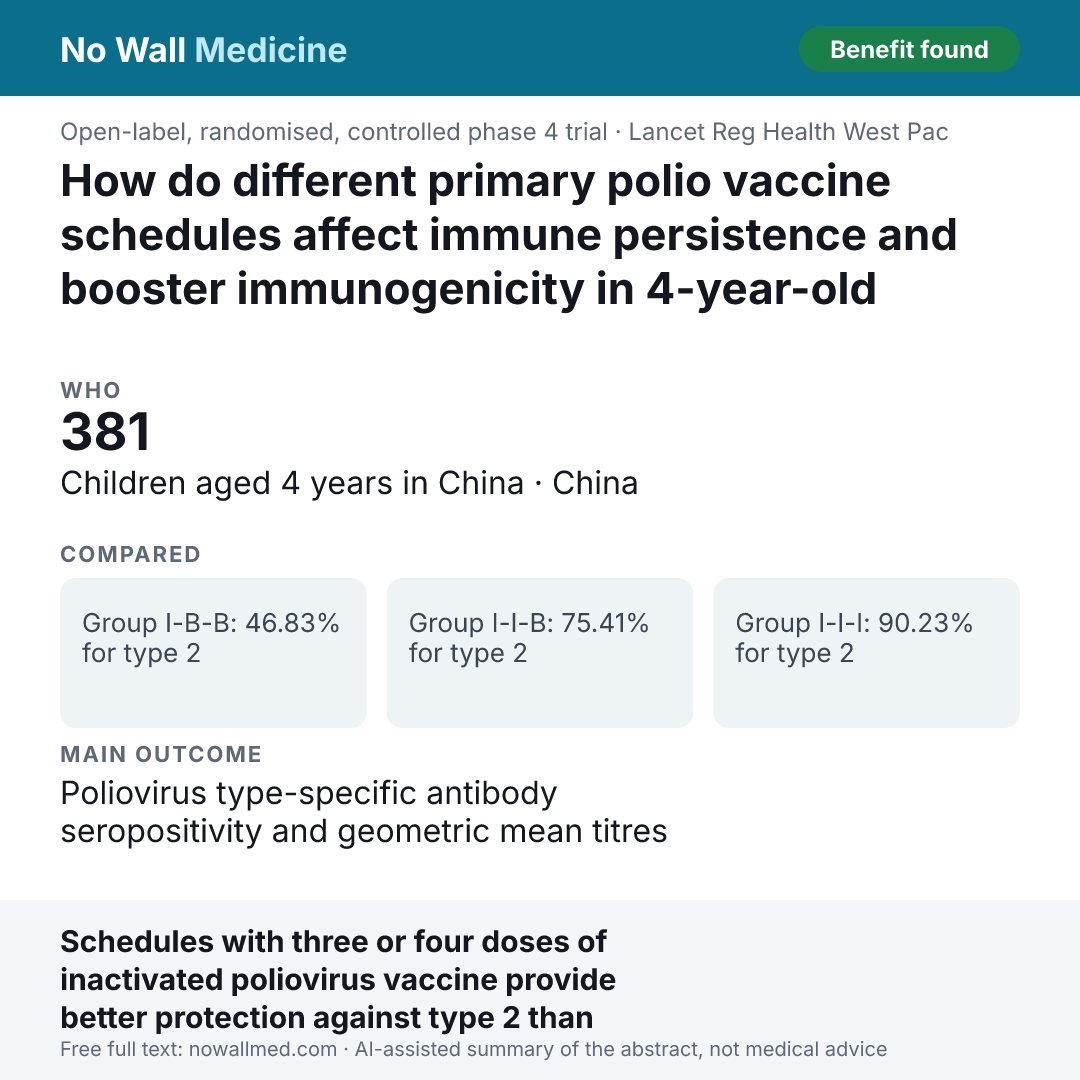
How do different primary polio vaccine schedules affect immune persistence and booster immunogenicity in 4-year-old children?
Who
381
Children aged 4 years in China · China
Compared
Group I-B-B: 46.83% for type 2
Group I-I-B: 75.41% for type 2
Group I-I-I: 90.23% for type 2
Main outcome
Poliovirus type-specific antibody seropositivity and geometric mean titres
Bottom line: Schedules with three or four doses of inactivated poliovirus vaccine provide better protection against type 2 than current schedules.
Funded by: Medical and Health Science and Technology of Zhejiang Province
Lancet Reg Health West Pac · 2023-03-17 · Save PNG
Clinical question: How do different primary polio vaccine schedules affect immune persistence and booster immunogenicity in 4-year-old children?
Key points
- Researchers followed 381 children to compare immune persistence after different sequential schedules of Sabin inactivated poliovirus vaccine (sIPV) or bivalent oral poliovirus vaccine (bOPV).
- Four years after primary immunization, seropositivity for poliovirus type 2 was 46.83% for Group I-B-B, 75.41% for Group I-I-B, and 90.23% for Group I-I-I.
- After a booster dose, geometric mean titres for type 2 were significantly lower in groups receiving bOPV boosters compared to those receiving sIPV boosters.
Headline and key points written with AI from the paper’s abstract, with every number checked against it. Read the paper before relying on them.
Was this summary helpful?
Abstract
Background
Sabin inactivated and bivalent oral poliovirus vaccine (sIPV, bOPV) were commonly used in China since 2016. We conducted an open-label, randomised, controlled phase 4 trial to assess immune persistence following sequential immunisation with sIPV or bOPV, and immunogenicity and safety of a booster dose of poliovirus vaccine in children aged 4 years. Methods
Participants from a previous clinical trial with three different sequential schedules with sIPV (I) or bOPV (B) at ages 2, 3, and 4 months (Groups I-B-B, I-I-B, I-I-I) in 2017 were followed-up. The children were further divided into five subgroups after sIPV was given for Group I-B-B, and sIPV or bOPV randomly given for Group I-I-B and Group I-I-I (128 children in Groups I-B-B-I, 60 in Group I-I-B-B, 64 in Group I-I-B-I, 68 in Group I-I-I-B, 67 in Group I-I-I-I). Immune persistence and immunogenicity were assessed by measuring poliovirus type-specific antibodies, and safety were analysed in all children who received the booster dose. Findings
Between Dec 5, 2020 and Jun 30, 2021, we respectively enrolled 381 participants in the immune persistence analysis, and 352 participants in per protocol (PP) analysis of the immunogenicity of the booster immunisation. Seropositivity rates of antibodies against poliovirus types 1 and 3 were all >90% four years after primary immunisation, while for poliovirus type 2 were 46.83%, 75.41%, and 90.23% (χ2 = 60.948, P < 0.001) for Groups I-B-B, I-I-B, and I-I-I, respectively. After the booster dose, seropositivity rates were 100% for all three serotypes in Group I-B-B-I, I-I-B-I and I-I-I-I; In Group I-I-B-B and I-I-I-B, the seropositivity rates for types 1 and 3 were all 100%, for type 2 were 92.59% and 98.46%. The geometric mean titres (GMTs) against poliovirus 1 and 3 were all high in five groups (>1860.73), and the GMTs against type 2 were significantly lower in groups booster with bOPV: Group I-I-B-B (50.60) and Group I-I-I-B (247.84). There was no significant difference in seropositivity rates or GMTs for all three serotypes (P > 0.05) between Group I-I-B-I and I-I-I-I. No serious adverse events occurred during the study. Interpretation
Our findings suggest that at least two sIPV doses are needed in the current routine poliovirus immunisation schedule, and schedules containing 3 or 4 doses of sIPV provide better protection against poliovirus type 2 than the current sIPV-sIPV-bOPV-bOPV schedule in China. Funding
Medical and Health Science and Technology of Zhejiang Province (2021KY118). This trial was registered with ClinicalTrials.gov (NCT04576910).
Abstract reproduced under the article’s CC BY-NC-ND licence.
Headline, design, result, key points, caveat and citation as plain text.
Cite this article
Tang X, Xiao Y, Deng X, et al. Immuno-persistence of the different primary polio vaccine schedules and immunogenicity of the booster dose by sabin inactivated or bivalent oral poliovirus vaccine in children aged 4 years: an open-label, randomised, controlled phase 4 trial in China. Lancet Reg Health West Pac. 2023;34:100725. doi:10.1016/j.lanwpc.2023.100725
Spotted a mistake? Suggest a correction