Immunoadsorption did not reduce symptom severity in patients with post-Covid syndrome
Immunoadsorption Versus Sham Treatment for Post-COVID Syndrome: A Randomised Sham-Controlled Crossover Trial
Randomised, patient-blinded, sham-controlled crossover trialNo clear difference
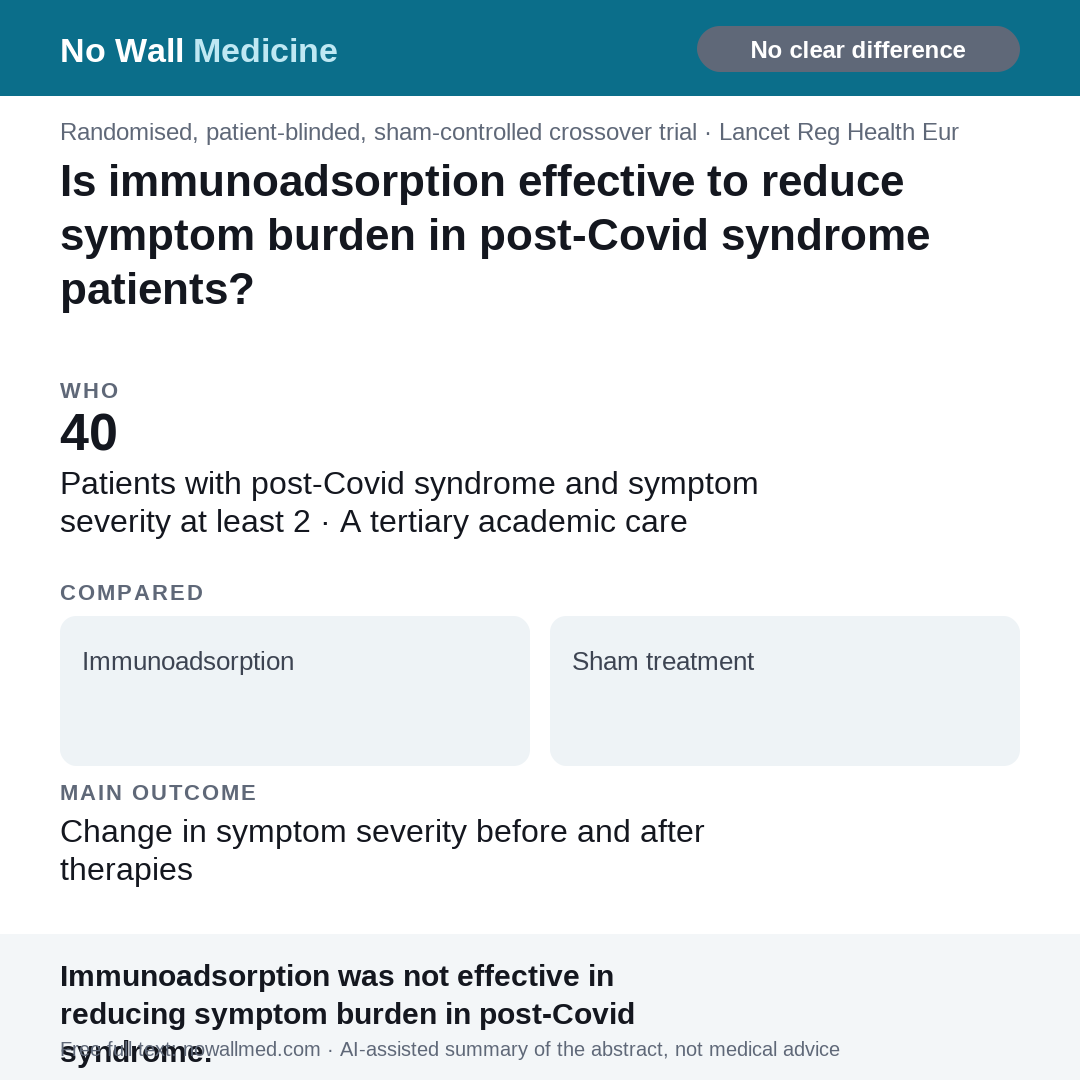
Is immunoadsorption effective to reduce symptom burden in post-Covid syndrome patients?
Who
40
Patients with post-Covid syndrome and symptom severity at least 2 · A tertiary academic care centre
Compared
Immunoadsorption
Sham treatment
Main outcome
Change in symptom severity before and after therapies
Result: odds ratio 1.17 (95% CI, 0.41-3.36)
Bottom line: Immunoadsorption was not effective in reducing symptom burden in post-Covid syndrome.
Funded by: Ministry of Health, Rhineland-Palatinate; Mainz University Medical Centre; DIAMED Medical Technology
Lancet Reg Health Eur · 2026-06-11Download image
Clinical question: Is immunoadsorption effective to reduce symptom burden in post-Covid syndrome patients?
Why it matters: It is unclear if removing autoantibodies through immunoadsorption can reduce the symptom burden in people suffering from post-Covid syndrome.
Key points
- Researchers studied 40 patients with post-Covid syndrome using a crossover trial to compare immunoadsorption, a process to remove antibodies, against a sham treatment.
- There was no significant difference in symptom severity changes between the two groups, including the Post-Covid-19 Functional Scale with an odds ratio of 1.17 (95% CI, 0.41-3.36; p = 0.771).
- While immunoadsorption depleted autoantibodies against G protein-coupled receptors, 34 total adverse events occurred during or after the treatments.
Headline and key points written with AI from the paper’s abstract, with every number checked against it. Read the paper before relying on them.
Spotted a mistake? Suggest a correction