Mixed Japanese encephalitis vaccine schedules worked as well as same product schedules
Immunogenicity and safety of an interchangeable vaccination schedule of two inactivated Japanese encephalitis vaccines: a multicentric, phase IV, open-label, randomized controlled trial
Randomized controlled trialNo clear difference
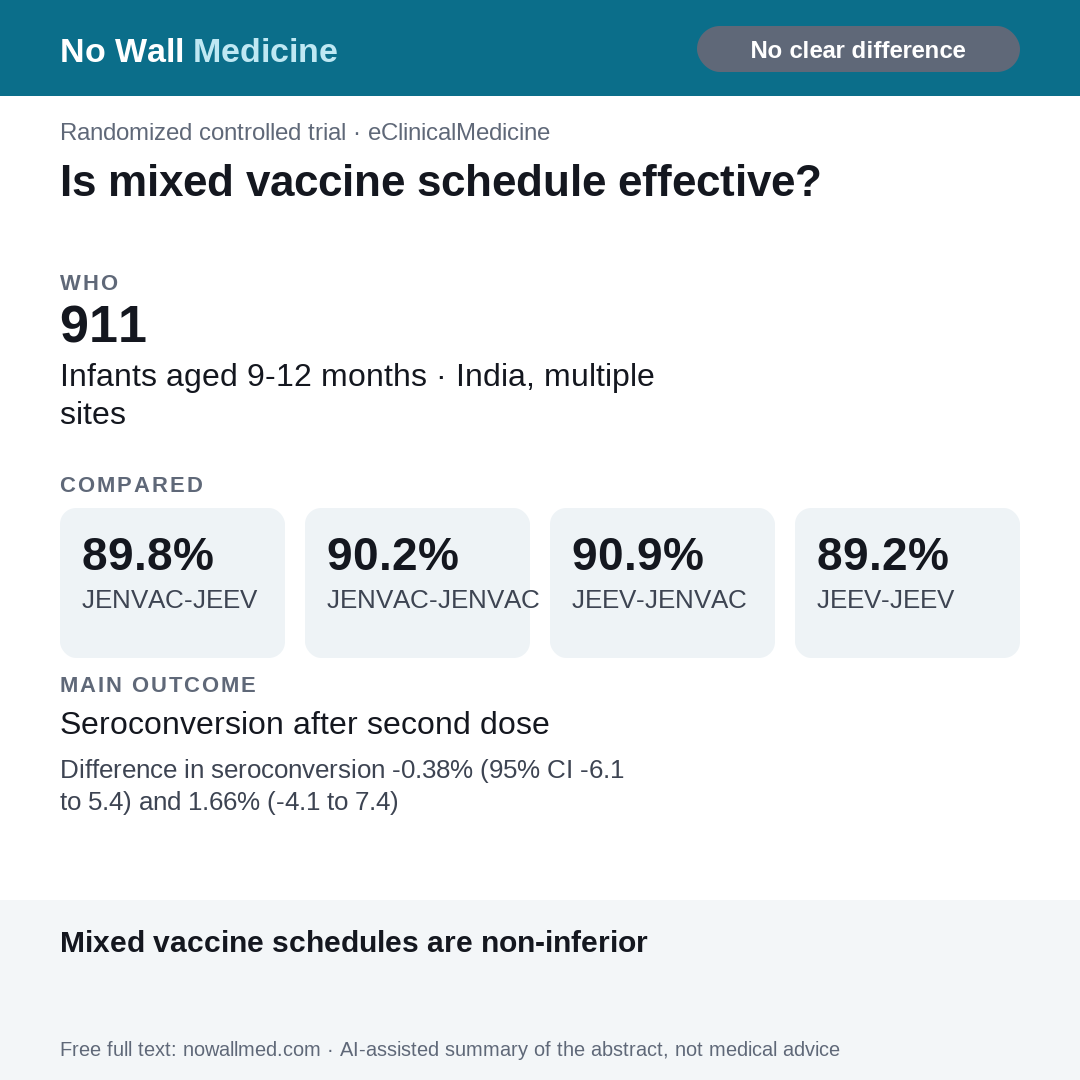
Is mixed vaccine schedule effective?
Who
911
Infants aged 9-12 months · India, multiple sites
Compared
89.8%JENVAC-JEEV (194/216)
90.2%JENVAC-JENVAC (184/204)
90.9%JEEV-JENVAC (189/208)
89.2%JEEV-JEEV (190/213)
Main outcome
Seroconversion after second dose
Result: Difference in seroconversion -0.38% (95% CI -6.1 to 5.4) and 1.66% (-4.1 to 7.4)
Bottom line: Mixed vaccine schedules are non-inferior
Funded by: Indian Council of Medical Research
eClinicalMedicine · 2026-09-22Download image
Clinical question: Is mixed vaccine schedule effective?
Key points
- 911 infants aged 9-12 months were assigned to different vaccine schedules, including mixed and same products.
- Seroconversion after second dose was 89.2-90.9% across the four study groups, with no significant difference between mixed and same product schedules.
- Solicited adverse events occurred in 35.5-37.9% of infants, with no serious adverse events related to the vaccine.
Headline and key points written with AI from the paper’s abstract, with every number checked against it. Read the paper before relying on them.
Spotted a mistake? Suggest a correction