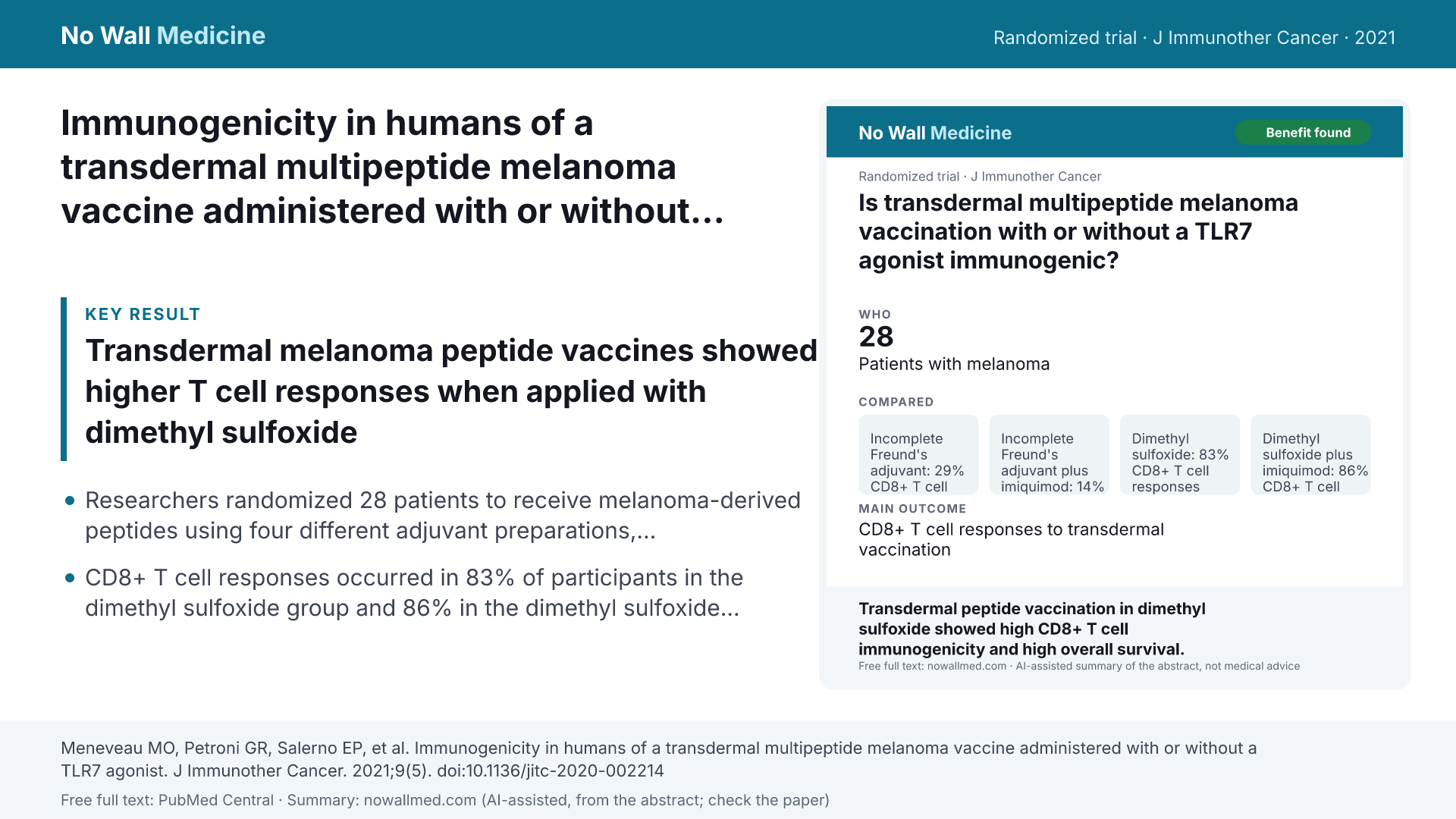
Transdermal melanoma peptide vaccines showed higher T cell responses when applied with dimethyl sulfoxide
Immunogenicity in humans of a transdermal multipeptide melanoma vaccine administered with or without a TLR7 agonist
Randomized trialBenefit found
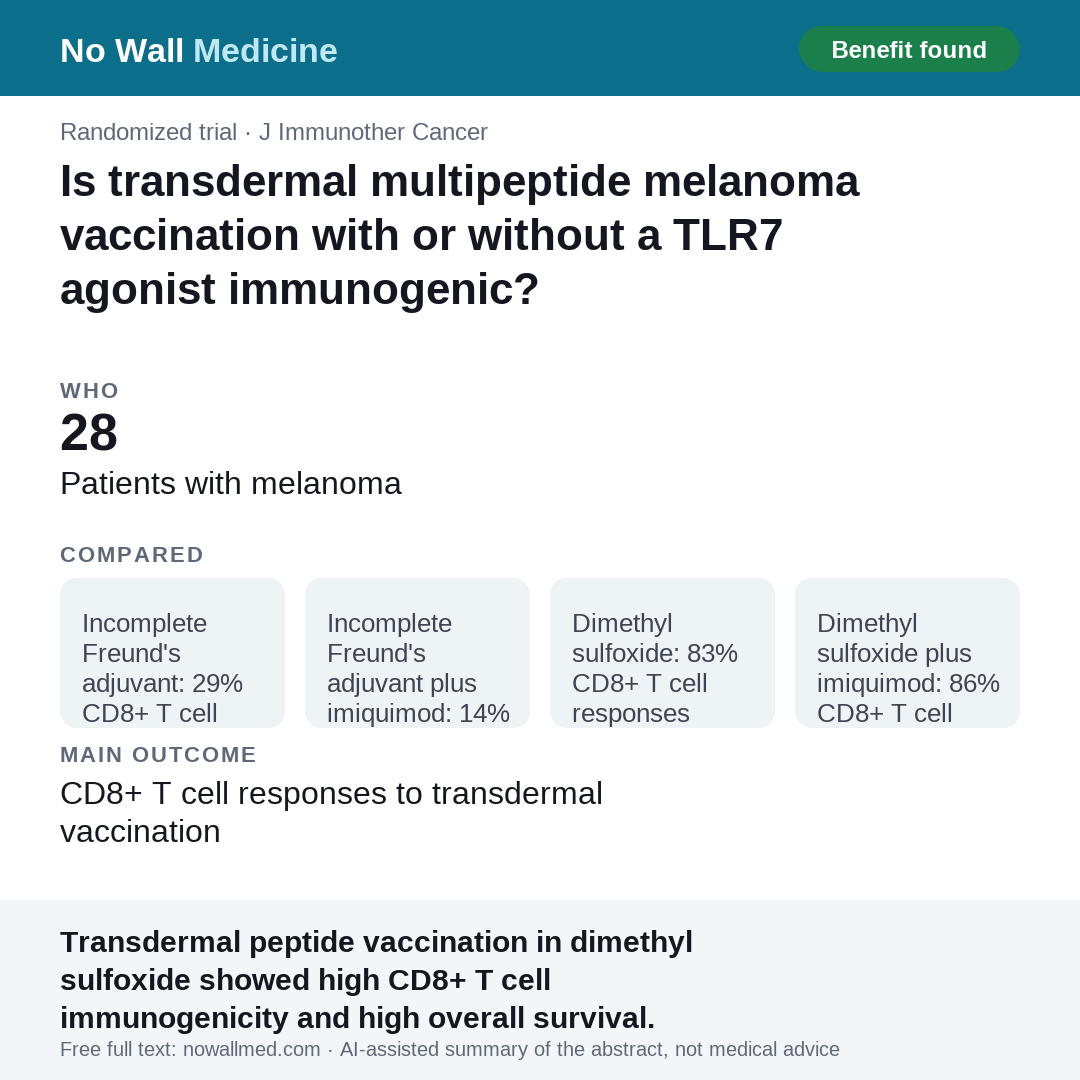
Is transdermal multipeptide melanoma vaccination with or without a TLR7 agonist immunogenic?
Who
28
Patients with melanoma
Compared
Incomplete Freund's adjuvant: 29% CD8+ T cell responses
Incomplete Freund's adjuvant plus imiquimod: 14% CD8+ T cell responses
Dimethyl sulfoxide: 83% CD8+ T cell responses
Dimethyl sulfoxide plus imiquimod: 86% CD8+ T cell responses
Main outcome
CD8+ T cell responses to transdermal vaccination
Bottom line: Transdermal peptide vaccination in dimethyl sulfoxide showed high CD8+ T cell immunogenicity and high overall survival.
Limitation: Further study is warranted into the pharmacokinetics and immunobiology of toll-like receptor 7 agonists.
J Immunother Cancer · 2021-05-26Download image
Clinical question: Is transdermal multipeptide melanoma vaccination with or without a TLR7 agonist immunogenic?
Key points
- Researchers randomized 28 patients to receive melanoma-derived peptides using four different adjuvant preparations, including dimethyl sulfoxide and toll-like receptor 7 agonists.
- CD8+ T cell responses occurred in 83% of participants in the dimethyl sulfoxide group and 86% in the dimethyl sulfoxide plus toll-like receptor 7 agonist group.
- In the dimethyl sulfoxide plus toll-like receptor 7 agonist group, five of seven participants experienced a severe rash.
Headline and key points written with AI from the paper’s abstract, with every number checked against it. Read the paper before relying on them.
Was this summary helpful?
Abstract
Background
Experimental cancer vaccines are traditionally administered by injection in subcutaneous tissue or muscle, commonly with adjuvants that create chronic inflammatory depots. Injection of melanoma-derived peptides induces T cell responses; however, the depots that form following injection may inhibit optimization of the immune response. In skin, epidermal Langerhans cells (LC) are a dominant source of professional antigen presenting cells. We hypothesized that: (1) applying melanoma-derived peptides topically, in proximity to LC, could be immunogenic and safe, with low vaccine-site toxicity and (2) topical toll-like receptor 7 (TLR7) agonist would increase immunogenicity of the peptide vaccine. Methods
Twelve melanoma peptides plus a tetanus helper peptide were combined with granulocyte macrophage colony stimulating factor (GM-CSF) and were administered topically on days 1, 8, and 15, to 28 patients randomized to one of four adjuvant preparations: (1) incomplete Freund's adjuvant (IFA); (2) IFA plus a TLR7 agonist (imiquimod) administered on days 0, 7, 14; (3) dimethyl sulfoxide (DMSO) or (4) DMSO+ imiquimod administered on day 0, 7, 14. Every 3 weeks thereafter (x 6), the peptides were combined with GM-CSF and were injected into the dermis and subcutis in an emulsion with IFA. Toxicities were recorded and immune responses assayed by ELIspot. Results
CD8+ T cell responses to transdermal vaccination in DMSO occurred in 83% of participants in group 3 and 86% in group 4, and responses to vaccination in IFA were observed in 29% of participants in group 1 and 14% in group 2. Overall, 61% of participants had CD4+ T cell immune responses to the tetanus peptide, with large, durable responses in groups 3 and 4. Five of seven participants in group 4 had a severe rash, one that was dose limiting. Ten-year overall survival was 67% and disease-free survival was 44%. Conclusions
These data provide proof of principle for immunogenicity in humans of transdermal immunization using peptides in DMSO. Further study is warranted into the pharmacokinetics and immunobiology of TLR agonists as vaccine adjuvants during transcutaneous application. Overall survival is high, supporting further investigation of this immunization approach.
Abstract reproduced under the article’s CC BY NC licence.
Subject terms
Headline, design, result, key points, caveat and citation as plain text.
Cite this article
Meneveau MO, Petroni GR, Salerno EP, et al. Immunogenicity in humans of a transdermal multipeptide melanoma vaccine administered with or without a TLR7 agonist. J Immunother Cancer. 2021. doi:10.1136/jitc-2020-002214
Spotted a mistake? Suggest a correction