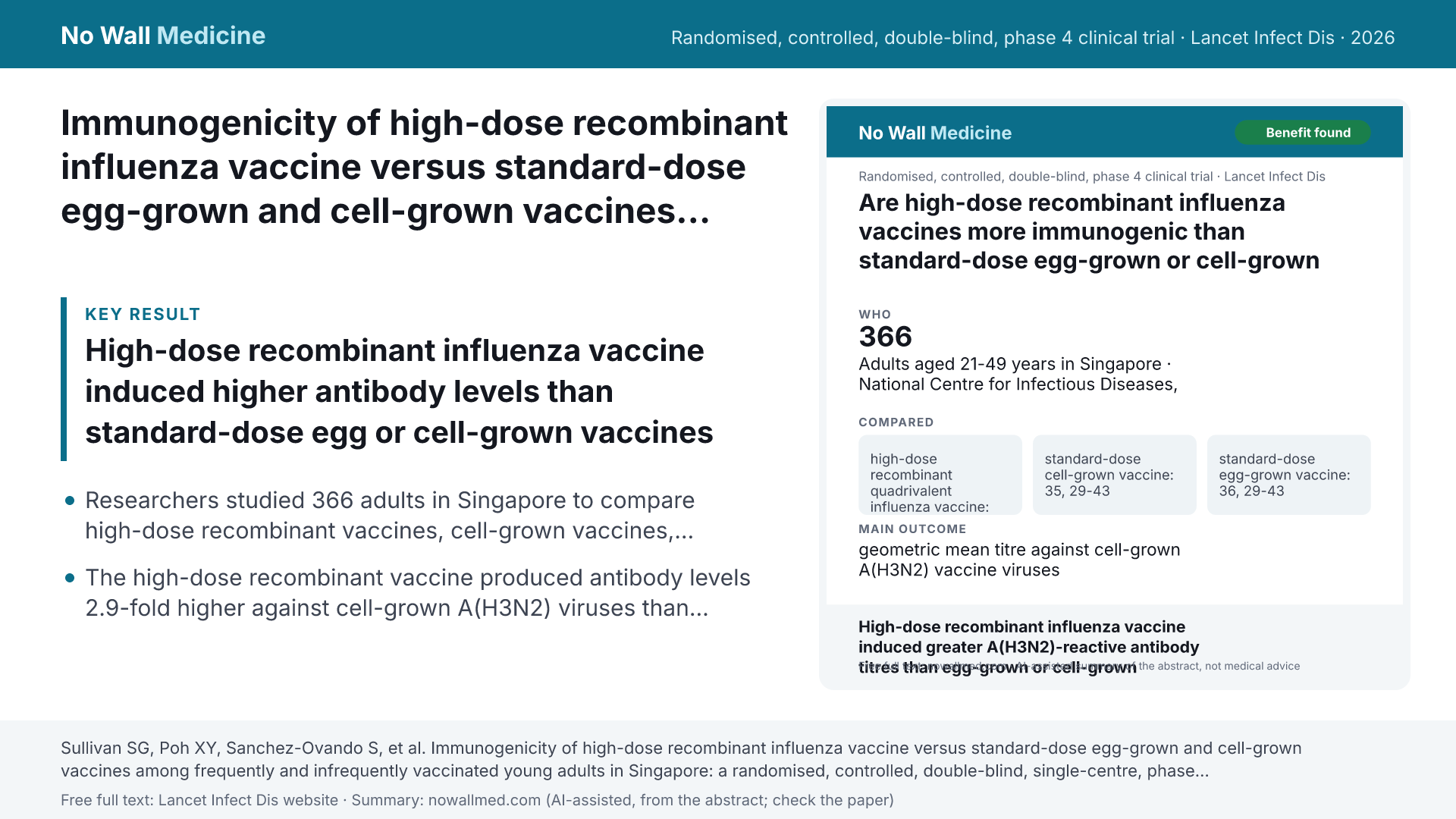
High-dose recombinant influenza vaccine induced higher antibody levels than standard-dose egg or cell-grown vaccines
Immunogenicity of high-dose recombinant influenza vaccine versus standard-dose egg-grown and cell-grown vaccines among frequently and infrequently vaccinated young adults in Singapore: a randomised, controlled, double-blind, single-centre, phase 4 clinical trial
Randomised, controlled, double-blind, phase 4 clinical trialBenefit found
Are high-dose recombinant influenza vaccines more immunogenic than standard-dose egg-grown or cell-grown vaccines?
Who
366
Adults aged 21-49 years in Singapore · National Centre for Infectious Diseases, Singapore
Compared
high-dose recombinant quadrivalent influenza vaccine: GMT 100, 95% CI 84-120
standard-dose cell-grown vaccine: 35, 29-43
standard-dose egg-grown vaccine: 36, 29-43
Main outcome
geometric mean titre against cell-grown A(H3N2) vaccine viruses
Result: 2·9-fold higher (95% CI 2·2-3·8)
Bottom line: High-dose recombinant influenza vaccine induced greater A(H3N2)-reactive antibody titres than egg-grown or cell-grown vaccines.
Funded by: Sanofi
Lancet Infect Dis · 2026-04-02 · Save PNG
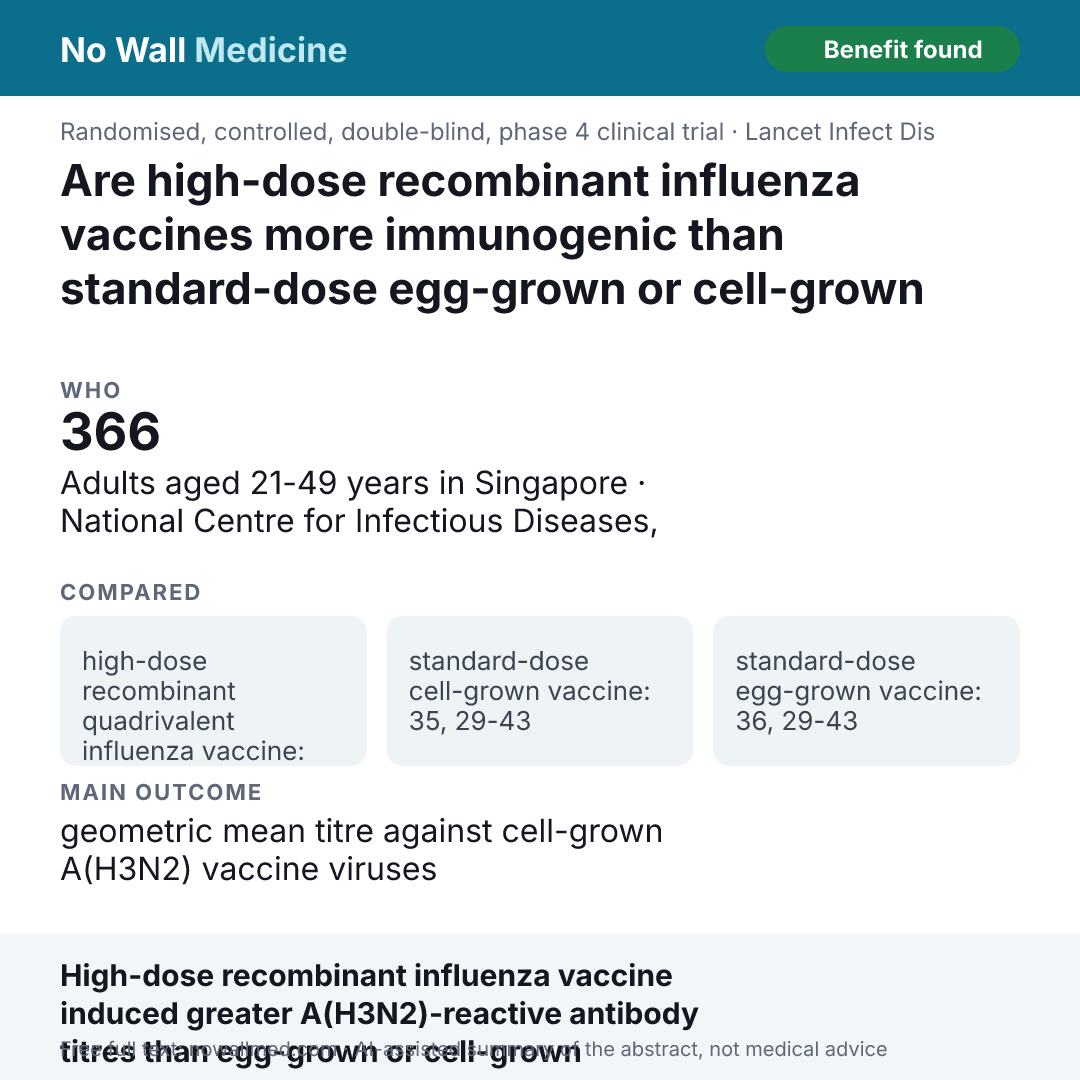
Clinical question: Are high-dose recombinant influenza vaccines more immunogenic than standard-dose egg-grown or cell-grown vaccines?
Why it matters: Egg-grown influenza vaccines may have low effectiveness against certain strains, especially in people who are vaccinated frequently.
Key points
- Researchers studied 366 adults in Singapore to compare high-dose recombinant vaccines, cell-grown vaccines, and egg-grown vaccines.
- The high-dose recombinant vaccine produced antibody levels 2.9-fold higher against cell-grown A(H3N2) viruses than the cell-grown or egg-grown options.
- Antibody levels remained similar between frequent and infrequent vaccinees in the recombinant group, whereas levels were lower in frequent vaccinees for the other two vaccines.
Headline and key points written with AI from the paper’s abstract, with every number checked against it. Read the paper before relying on them.
Was this summary helpful?
Abstract
Background
Egg-grown influenza vaccines can have low effectiveness against A(H3N2), especially among repeat vaccinees. Cell-grown and recombinant-haemagglutinin vaccines can overcome attenuation associated with egg-acquired adaptations, but it is uncertain whether they remain effective with repeated vaccination. Here, we aim to compare immune responses induced by egg-grown, cell-grown, and recombinant vaccines among frequent and infrequent vaccinees. Methods
We conducted a randomised, controlled, single-centre, double-blind, phase 4 clinical trial to assess whether high-dose (45 μg of each antigen) recombinant quadrivalent influenza vaccines (QIV-R) are more immunogenic than standard-dose (15 μg of each antigen) egg-grown (QIV-E) and cell-grown (QIV-C) vaccines. Adults aged 21-49 years with no contraindications to vaccination and no immunocompromising conditions were enrolled at the National Centre for Infectious Diseases, Singapore. Participants were stratified by the number of vaccines received in the preceding 5 years as infrequent (zero or one) and frequent (three or more) and randomly assigned 1:1:1 to receive a single dose of QIV-R, QIV-C, or QIV-E by intramuscular injection. Participants and outcome assessors were masked to group allocation until study completion. The primary outcome was geometric mean titre (GMT) against egg-grown and cell-grown A(H3N2) vaccine viruses at 14 days post-vaccination, estimated by linear regression adjusted for vaccination history and baseline titre and analysed in the per-protocol set. Safety data were collected and reviewed by the study team. This trial is registered with ClinicalTrials.gov (NCT05479370) and is complete. Findings
Between Oct 6, 2022, and March 31, 2023, we enrolled 366 adults. Pre-vaccination and post-vaccination serum pairs were available for 359 (n=120 QIV-R, n=119 QIV-C, n=120 QIV-E). Post-vaccination GMTs against cell-grown A(H3N2) were 2·9-fold higher (95% CI 2·2-3·8) following QIV-R (GMT 100, 95% CI 84-120) compared with QIV-C (35, 29-43; p<0·0001) or QIV-E (36, 29-43; p<0·0001). Adjusted GMTs were lower among frequent compared with infrequent vaccinees who received QIV-E (GMT 25, 95% CI 19-34 vs 50, 38-66) or QIV-C (24, 18-32 vs 53, 40-70) but were similar for frequent and infrequent vaccinees who received QIV-R (93, 70-120 vs 110, 84-150). Rates of adverse events were similar between QIV-E (three [3%] of 120), QIV-C (two [2%] of 119), and QIV-R (zero of 120). Interpretation
QIV-R induced greater A(H3N2)-reactive antibody titres than QIV-E or QIV-C and was equally immunogenic among frequent and infrequent vaccinees. Further work is needed to ascertain whether this gain is sustained with QIV-R vaccination over multiple seasons. Funding
Sanofi.
Abstract reproduced under the article’s CC BY licence.
Subject terms
Headline, design, result, key points, caveat and citation as plain text.
Cite this article
Sullivan SG, Poh XY, Sanchez-Ovando S, et al. Immunogenicity of high-dose recombinant influenza vaccine versus standard-dose egg-grown and cell-grown vaccines among frequently and infrequently vaccinated young adults in Singapore: a randomised, controlled, double-blind, single-centre, phase 4 clinical trial. Lancet Infect Dis. 2026;26(8):778-792. doi:10.1016/S1473-3099(26)00062-9
Spotted a mistake? Suggest a correction