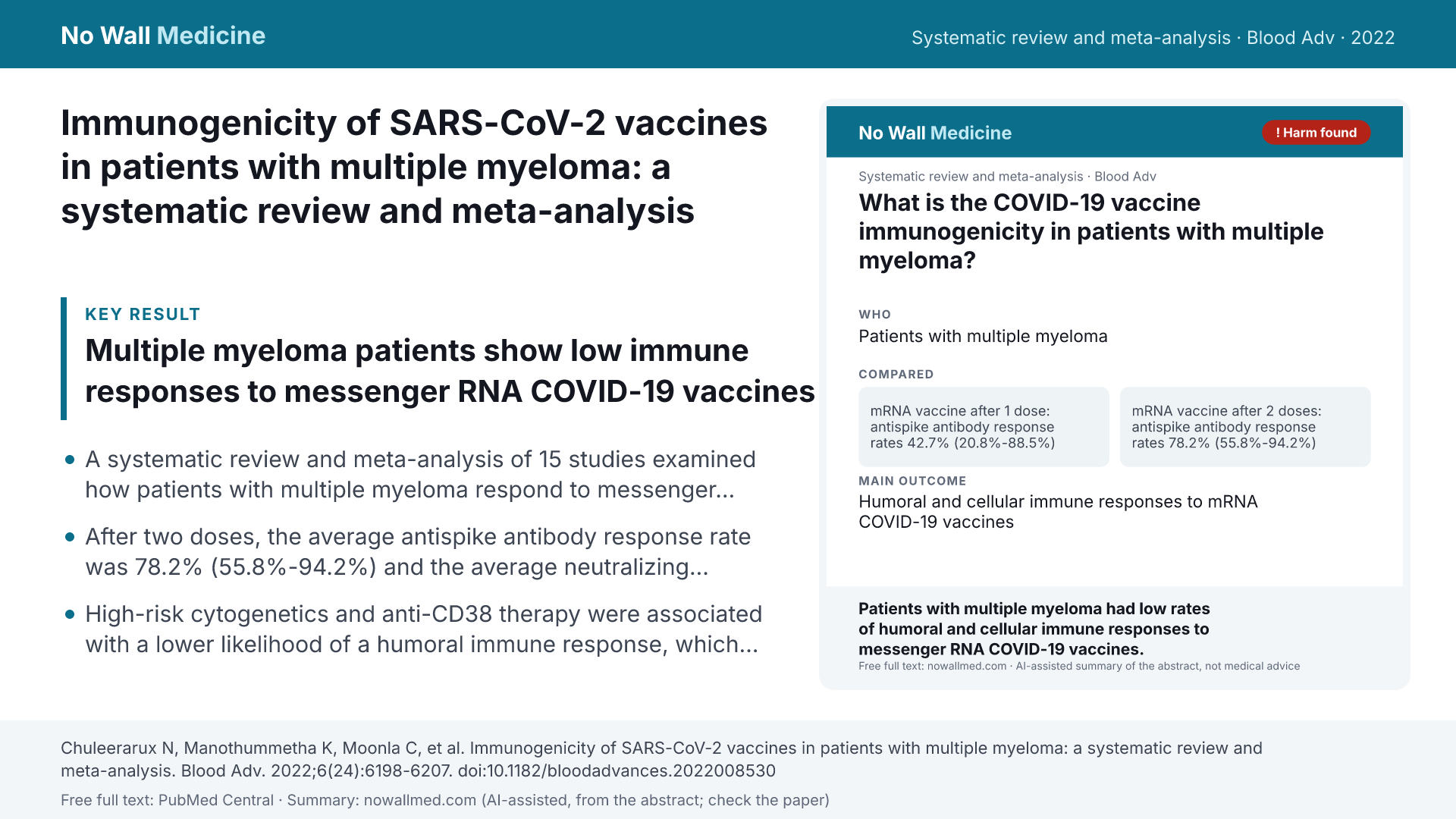
Multiple myeloma patients show low immune responses to messenger RNA COVID-19 vaccines
Immunogenicity of SARS-CoV-2 vaccines in patients with multiple myeloma: a systematic review and meta-analysis
Systematic review and meta-analysisHarm found
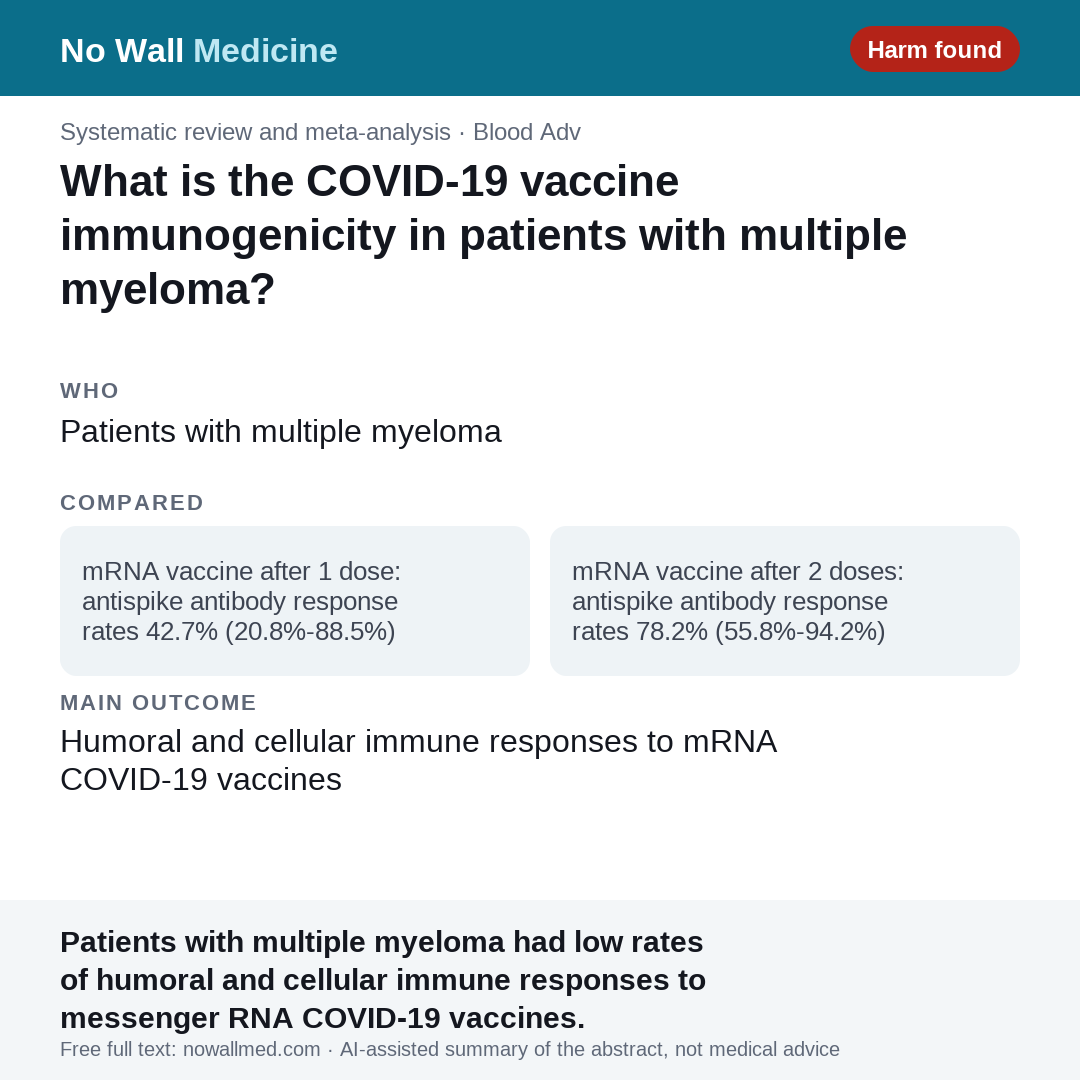
What is the COVID-19 vaccine immunogenicity in patients with multiple myeloma?
Who
Patients with multiple myeloma
Compared
mRNA vaccine after 1 dose: antispike antibody response rates 42.7% (20.8%-88.5%)
mRNA vaccine after 2 doses: antispike antibody response rates 78.2% (55.8%-94.2%)
Main outcome
Humoral and cellular immune responses to mRNA COVID-19 vaccines
Bottom line: Patients with multiple myeloma had low rates of humoral and cellular immune responses to messenger RNA COVID-19 vaccines.
Blood Adv · 2022-12-20Download image
Clinical question: What is the COVID-19 vaccine immunogenicity in patients with multiple myeloma?
Why it matters: The factors that influence the humoral immune response in patients with multiple myeloma are not yet determined.
Key points
- A systematic review and meta-analysis of 15 studies examined how patients with multiple myeloma respond to messenger RNA COVID-19 vaccines.
- After two doses, the average antispike antibody response rate was 78.2% (55.8%-94.2%) and the average neutralizing antibody response rate was 62.7% (53.3%-68.6%).
- High-risk cytogenetics and anti-CD38 therapy were associated with a lower likelihood of a humoral immune response, which is the production of antibodies.
Headline and key points written with AI from the paper’s abstract, with every number checked against it. Read the paper before relying on them.
Was this summary helpful?
Abstract
Patients with multiple myeloma (MM) have a diminished immune response to coronavirus disease 2019 (COVID-19) vaccines. Risk factors for an impaired immune response are yet to be determined. We aimed to summarize the COVID-19 vaccine immunogenicity and to identify factors that influence the humoral immune response in patients with MM. Two reviewers independently conducted a literature search in MEDLINE, Embase, ISI Web of Science, Cochrane library, and Clinicaltrials.gov from existence until 24 May 24 2022. (PROSPERO: CRD42021277005). A total of 15 studies were included in the systematic review and 5 were included in the meta-analysis. The average rate (range) of positive functional T-lymphocyte response was 44.2% (34.2%-48.5%) after 2 doses of messenger RNA (mRNA) COVID-19 vaccines. The average antispike antibody response rates (range) were 42.7% (20.8%-88.5%) and 78.2% (55.8%-94.2%) after 1 and 2 doses of mRNA COVID-19 vaccines, respectively. The average neutralizing antibody response rates (range) were 25% (1 study) and 62.7% (53.3%-68.6%) after 1 and 2 doses of mRNA COVID-19 vaccines, respectively. Patients with high-risk cytogenetics or receiving anti-CD38 therapy were less likely to have a humoral immune response with pooled odds ratios of 0.36 (95% confidence interval [95% CI], 0.18, 0.69), I2 = 0% and 0.42 (95% CI, 0.22, 0.79), I2 = 14%, respectively. Patients who were not on active MM treatment were more likely to respond with pooled odds ratio of 2.42 (95% CI, 1.10, 5.33), I2 = 7%. Patients with MM had low rates of humoral and cellular immune responses to the mRNA COVID-19 vaccines. Further studies are needed to determine the optimal doses of vaccines and evaluate the use of monoclonal antibodies for pre-exposure prophylaxis in this population.
Abstract reproduced under the article’s CC BY NC ND licence.
Subject terms
Cite this article
Chuleerarux N, Manothummetha K, Moonla C, et al. Immunogenicity of SARS-CoV-2 vaccines in patients with multiple myeloma: a systematic review and meta-analysis. Blood Adv. 2022. doi:10.1182/bloodadvances.2022008530
Spotted a mistake? Suggest a correction