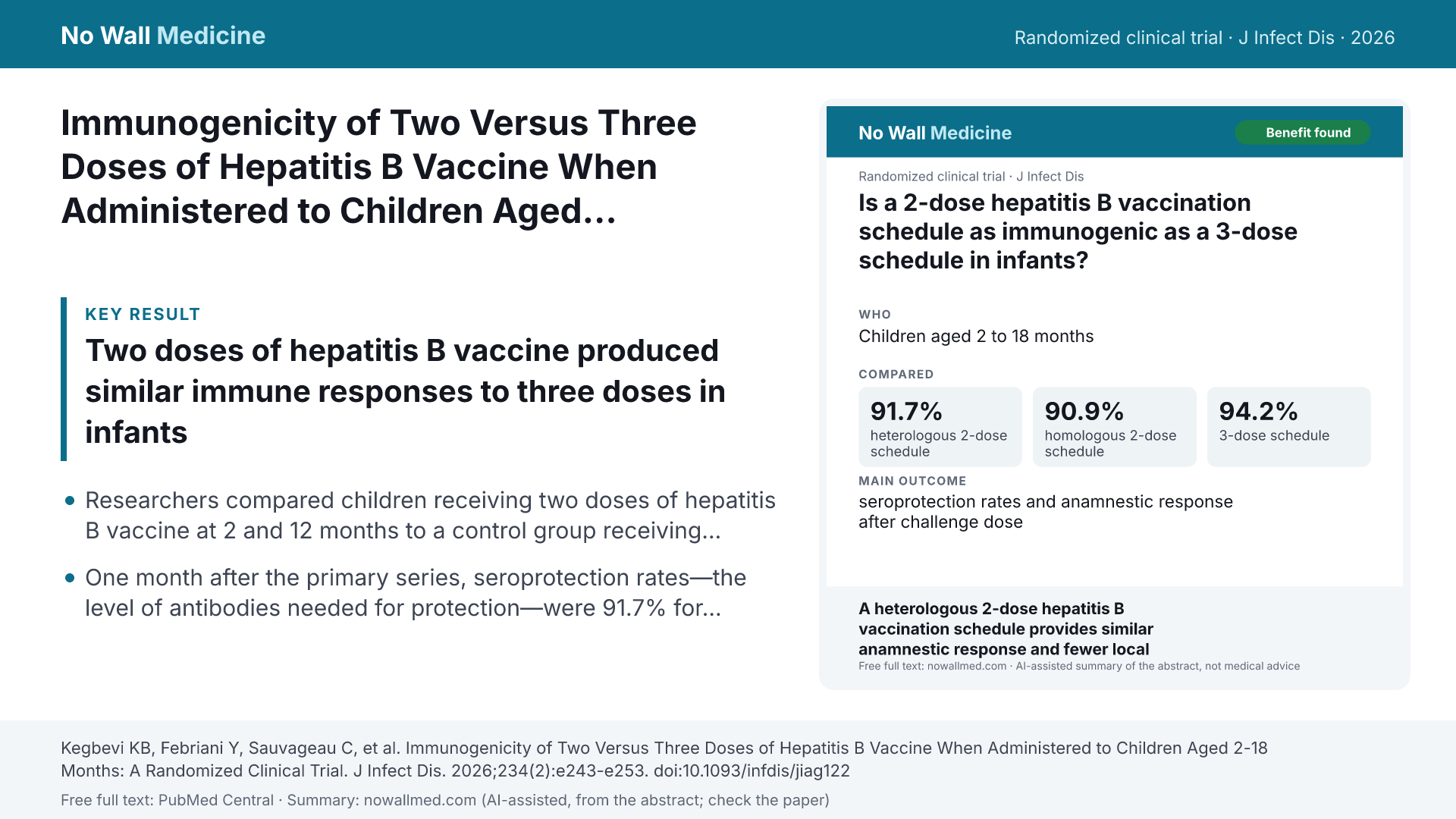
Two doses of hepatitis B vaccine produced similar immune responses to three doses in infants
Immunogenicity of Two Versus Three Doses of Hepatitis B Vaccine When Administered to Children Aged 2-18 Months: A Randomized Clinical Trial
Randomized clinical trialBenefit found
Is a 2-dose hepatitis B vaccination schedule as immunogenic as a 3-dose schedule in infants?
Who
Children aged 2 to 18 months
Compared
91.7%heterologous 2-dose schedule
90.9%homologous 2-dose schedule
94.2%3-dose schedule
Main outcome
seroprotection rates and anamnestic response after challenge dose
Bottom line: A heterologous 2-dose hepatitis B vaccination schedule provides similar anamnestic response and fewer local reactions than other schedules.
J Infect Dis · 2026-02-25 · Save PNG
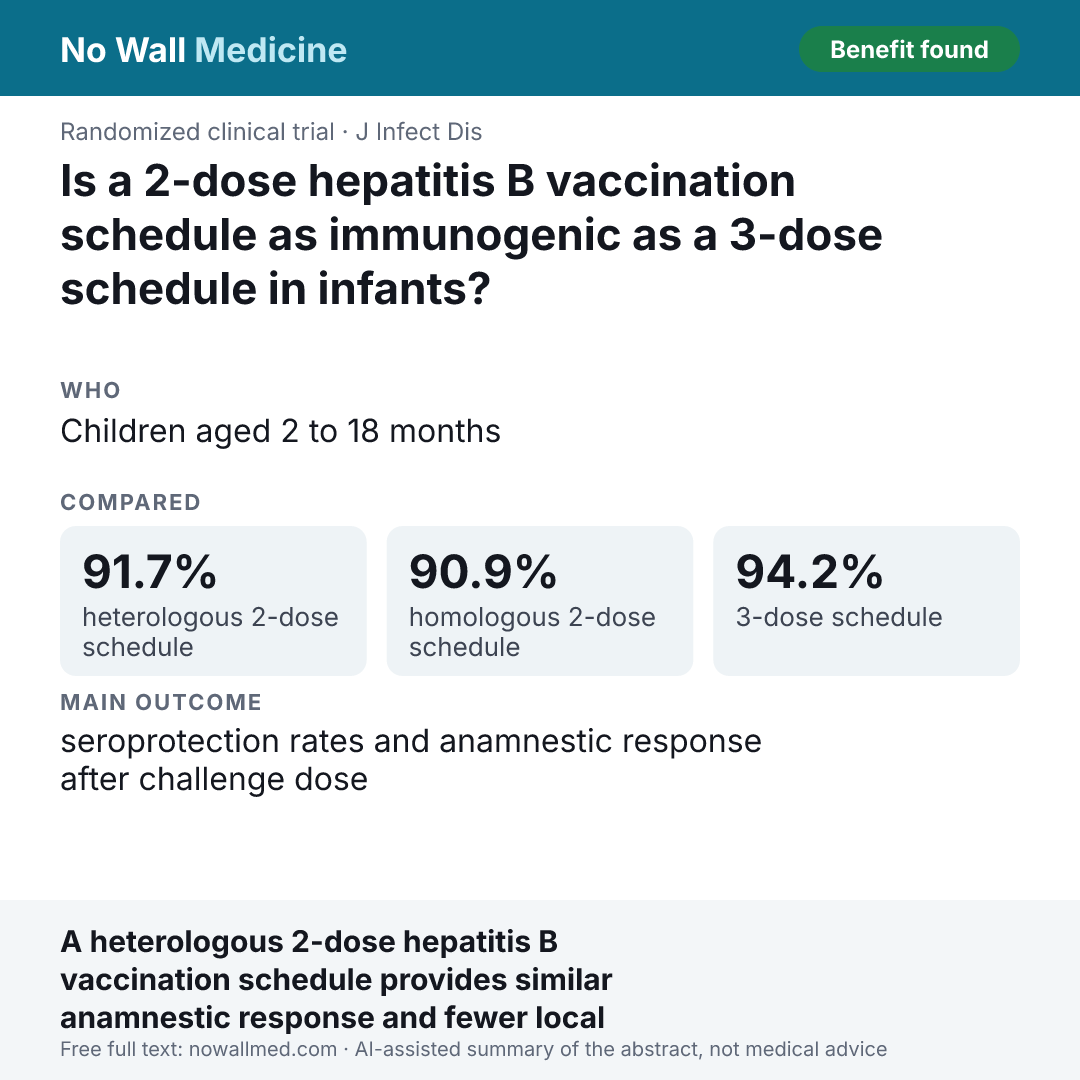
Clinical question: Is a 2-dose hepatitis B vaccination schedule as immunogenic as a 3-dose schedule in infants?
Key points
- Researchers compared children receiving two doses of hepatitis B vaccine at 2 and 12 months to a control group receiving three doses at 2, 4, and 18 months.
- One month after the primary series, seroprotection rates—the level of antibodies needed for protection—were 91.7% for the heterologous 2-dose, 90.9% for the homologous 2-dose, and 94.2% for the 3-dose group.
- Three years later, most children showed an anamnestic response, which is a rapid increase in antibodies after a booster dose, across all three groups.
Headline and key points written with AI from the paper’s abstract, with every number checked against it. Read the paper before relying on them.
Was this summary helpful?
Subject terms
Headline, design, result, key points, caveat and citation as plain text.
Cite this article
Kegbevi KB, Febriani Y, Sauvageau C, et al. Immunogenicity of Two Versus Three Doses of Hepatitis B Vaccine When Administered to Children Aged 2-18 Months: A Randomized Clinical Trial. J Infect Dis. 2026;234(2):e243-e253. doi:10.1093/infdis/jiag122
Spotted a mistake? Suggest a correction