Immunoglobulin replacement and daily antibiotics showed similar survival rates in patients with secondary hypogammaglobulinemia
Immunoglobulin replacement vs prophylactic antibiotics for hypogammaglobulinemia secondary to hematological malignancy
Randomized controlled feasibility trialNo clear difference
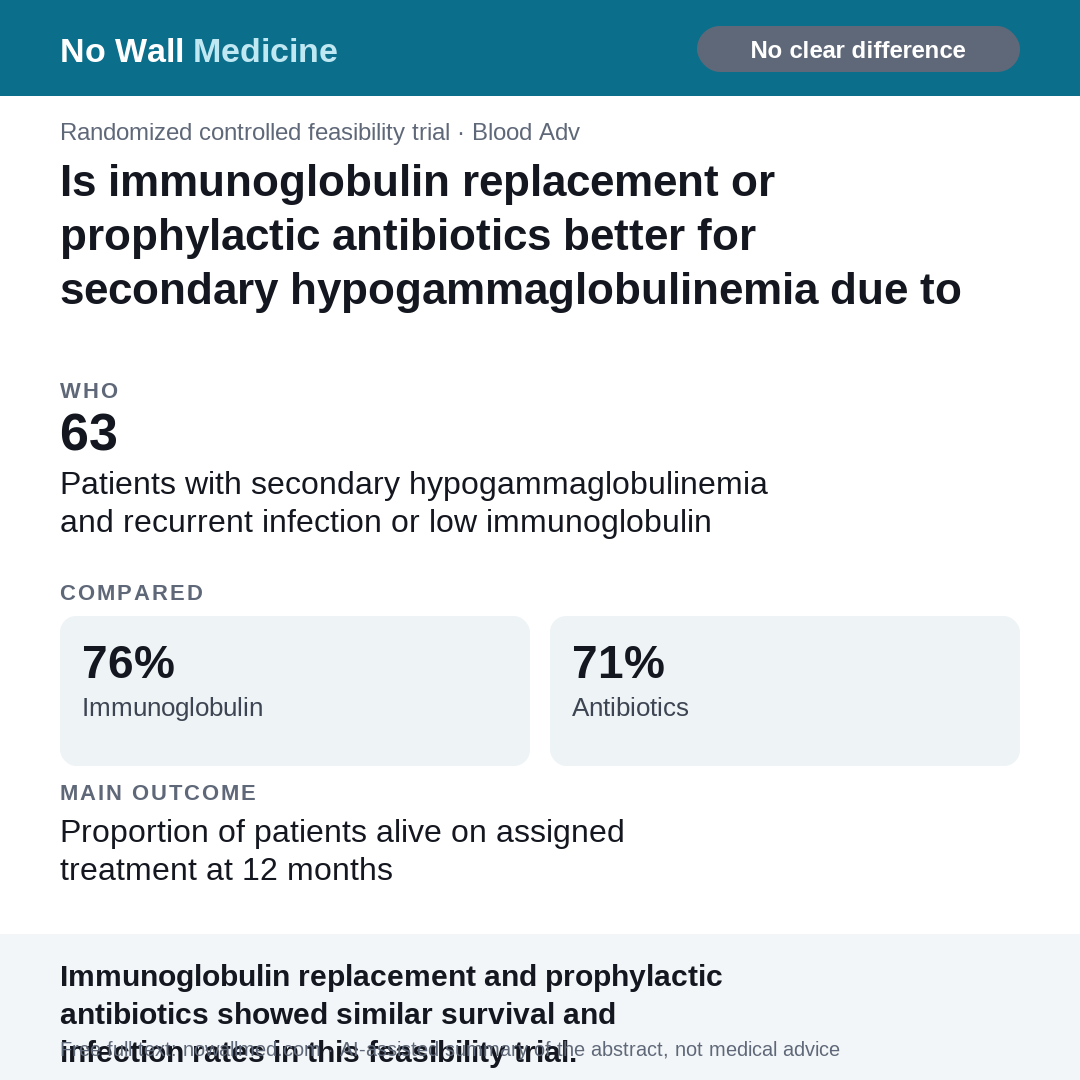
Is immunoglobulin replacement or prophylactic antibiotics better for secondary hypogammaglobulinemia due to hematological malignancy?
Who
63
Patients with secondary hypogammaglobulinemia and recurrent infection or low immunoglobulin G · 7 hospitals in Australia and New Zealand
Compared
76%Immunoglobulin
71%Antibiotics
Main outcome
Proportion of patients alive on assigned treatment at 12 months
Result: odds ratio, 0.78 (95% CI, 0.22-2.52)
Bottom line: Immunoglobulin replacement and prophylactic antibiotics showed similar survival and infection rates in this feasibility trial.
Blood Adv · 2024-04-09Download image
Clinical question: Is immunoglobulin replacement or prophylactic antibiotics better for secondary hypogammaglobulinemia due to hematological malignancy?
Why it matters: It was unknown whether immunoglobulin replacement or prophylactic antibiotics are more effective for preventing infections in patients with secondary hypogammaglobulinemia due to hematological malignancies.
Key points
- Researchers conducted a feasibility trial with 63 patients who had low levels of immunoglobulin G, a protein that helps fight infection, due to blood cancers.
- At 12 months, 76% of patients receiving intravenous immunoglobulin were alive compared to 71% of those receiving daily antibiotics, which was not a statistically significant difference.
- The median time to the first major infection was not reached for either group, and similar proportions of participants remained on their assigned treatments after 12 months.
Headline and key points written with AI from the paper’s abstract, with every number checked against it. Read the paper before relying on them.
Abstract
Immunoglobulin replacement and prophylactic antibiotics are commonly used to prevent infections in patients with secondary hypogammaglobulinemia due to hematological malignancies but have never been directly compared. In this randomized controlled feasibility trial conducted in 7 hospitals in Australia and New Zealand, we enrolled patients with secondary hypogammaglobulinemia with either a history of recurrent/severe infection or an immunoglobulin G level <4 g/L. Participants were randomized in a 1:2 ratio to immunoglobulin (0.4 g/kg per 4 weeks IV) or daily antibiotics (trimethoprim-sulfamethoxazole 160 mg/800 mg or, if contraindicated, 100 mg doxycycline) for 12 months. Participants allocated to antibiotics were allowed to crossover after grade ≥3 infections. The primary outcome was proportion of patients alive on the assigned treatment 12 months after randomization. Between August 2017 and April 2019, 63 patients were randomized: 42 to antibiotics and 21 to immunoglobulin. Proportion of participants alive on allocated treatment at 12 months was 76% in the immunoglobulin and 71% in the antibiotic arm (Fisher exact test P=.77; odds ratio, 0.78; 95% CI, 0.22-2.52). The lower quartile for time to first major infection (median, not reached) was 11.1 months for the immunoglobulin and 9.7 months for the antibiotic arm (log-rank test, P=.65). Three participants in the immunoglobulin and 2 in the antibiotic arm had grade ≥3 treatment-related adverse events. A similar proportion of participants remained on antibiotic prophylaxis at 12 months to those on immunoglobulin, with similar rates of major infections. Our findings support the feasibility of progressing to a phase 3 trial. Trial registration #ACTRN12616001723471.
Abstract reproduced under the article’s CC BY NC ND licence.
Topics
Cite this article
McQuilten ZK, Weinkove R, Thao LTP, Crispin P, Degelia A, Dendle C. Immunoglobulin replacement vs prophylactic antibiotics for hypogammaglobulinemia secondary to hematological malignancy. Blood Adv. 2024. doi:10.1182/bloodadvances.2023011231
Spotted a mistake? Suggest a correction
Top studies every Monday
The week’s key trials and guidelines in your specialties, plus any topics you follow. By email, free.
Get the weekly digest