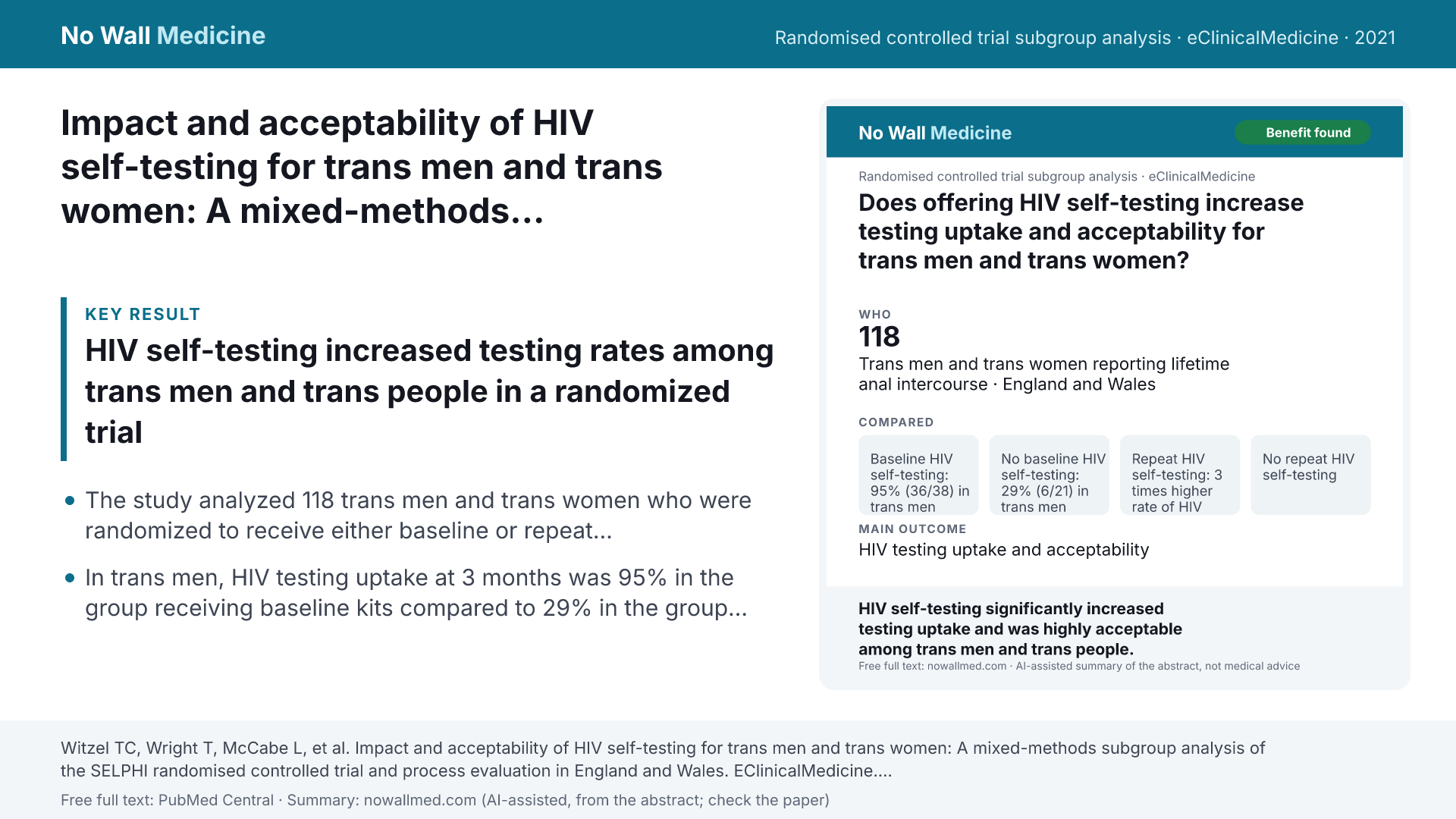
Impact and acceptability of HIV self-testing for trans men and trans women: A mixed-methods subgroup analysis of the SELPHI randomised controlled trial and process evaluation in England and Wales
Key result: HIV self-testing increased testing rates among trans men and trans people in a randomized trial
Key points
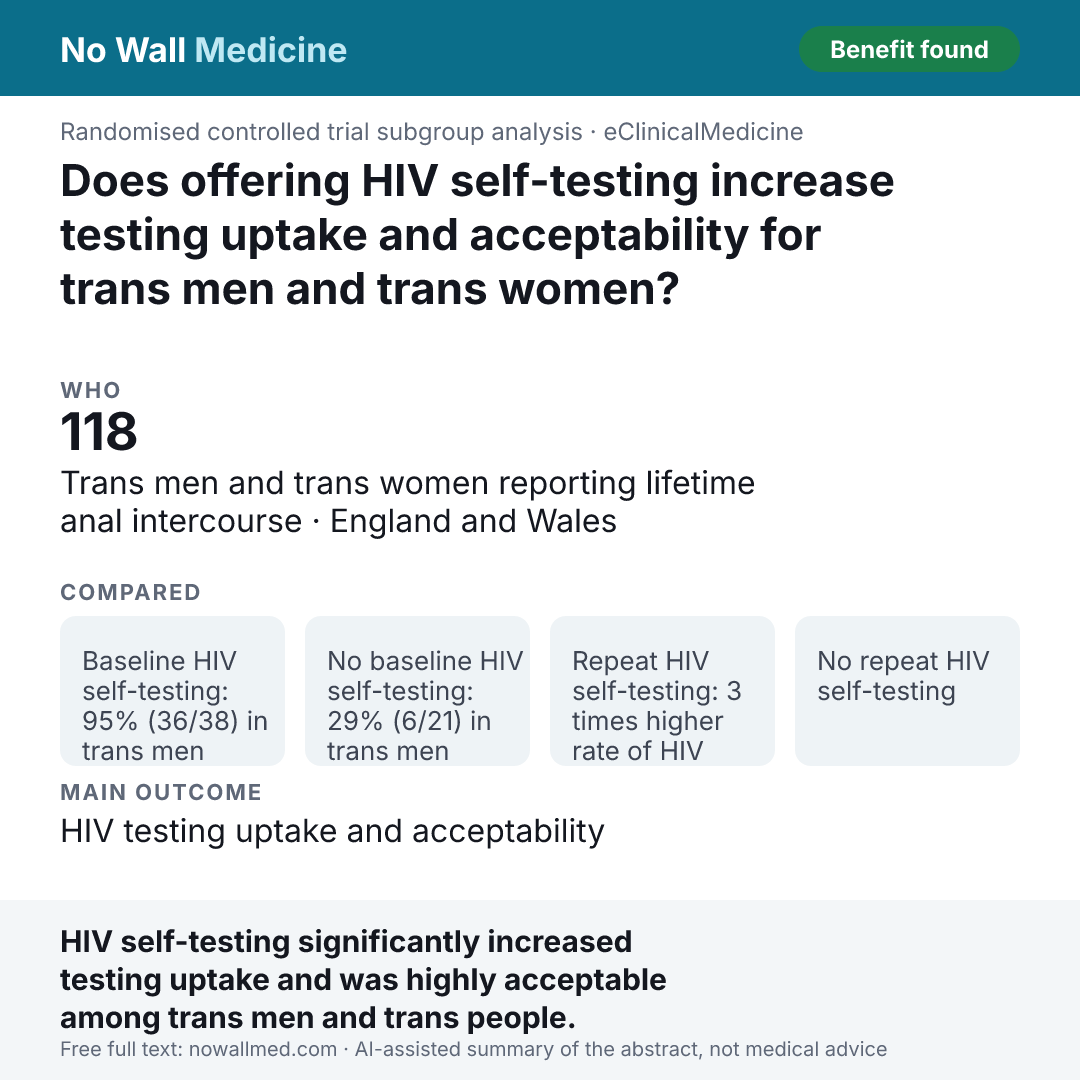
- The study analyzed 118 trans men and trans women who were randomized to receive either baseline or repeat HIV self-testing kits.
- In trans men, HIV testing uptake at 3 months was 95% in the group receiving baseline kits compared to 29% in the group that did not.
- Trans people randomized to receive repeat kits reported a testing rate 3.66 times higher than those not receiving repeat kits during the two-year follow-up.
Why it matters: Research on strategies to increase HIV testing among transgender people is limited.
Limitation the authors note: Recruitment and retention of trans women was low.
Discussion prompts
- Would these patients look like yours? Who was left out?
- Is the main outcome one that matters to patients?
- Is the difference large enough to change what you do?
Cite: Witzel TC, Wright T, McCabe L, et al. Impact and acceptability of HIV self-testing for trans men and trans women: A mixed-methods subgroup analysis of the SELPHI randomised controlled trial and process evaluation in England and Wales. EClinicalMedicine. 2021;32:100700. doi:10.1016/j.eclinm.2020.100700
Free full text: PubMed Central · Summary and visual abstract: nowallmed.com/a/impact-and-acceptability-of-hiv-self-testing-for-trans-men-and-trans-12s2s6j/ (AI-assisted from the abstract; check the paper before relying on it).