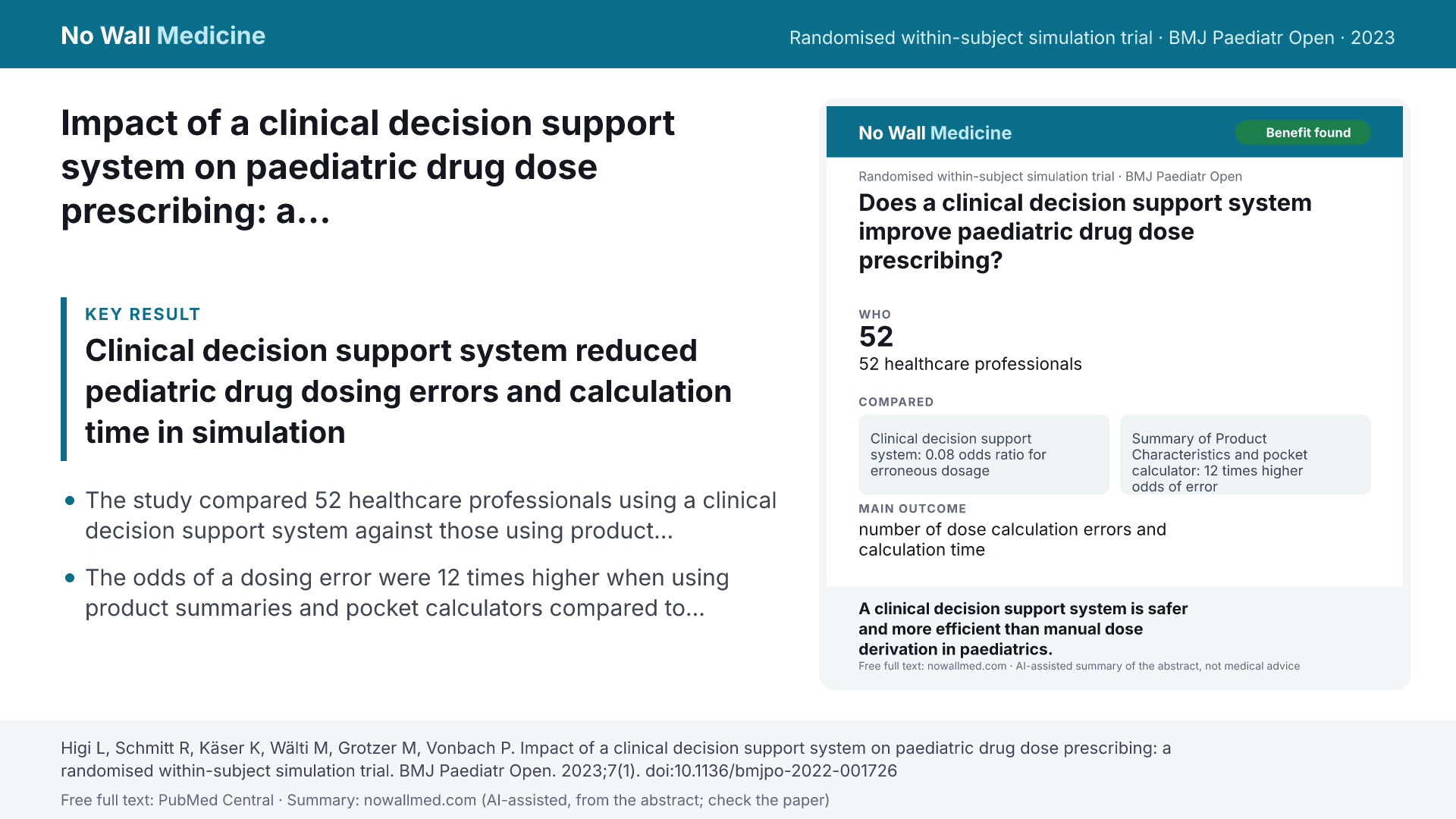
Clinical decision support system reduced pediatric drug dosing errors and calculation time in simulation
Impact of a clinical decision support system on paediatric drug dose prescribing: a randomised within-subject simulation trial
Randomised within-subject simulation trialBenefit found
Does a clinical decision support system improve paediatric drug dose prescribing?
Who
52
52 healthcare professionals
Compared
Clinical decision support system: 0.08 odds ratio for erroneous dosage
Summary of Product Characteristics and pocket calculator: 12 times higher odds of error
Main outcome
number of dose calculation errors and calculation time
Result: odds ratio 0.08 (95% CI 0.02 to 0.36)
Bottom line: A clinical decision support system is safer and more efficient than manual dose derivation in paediatrics.
BMJ Paediatr Open · 2023-01-25 · Save PNG
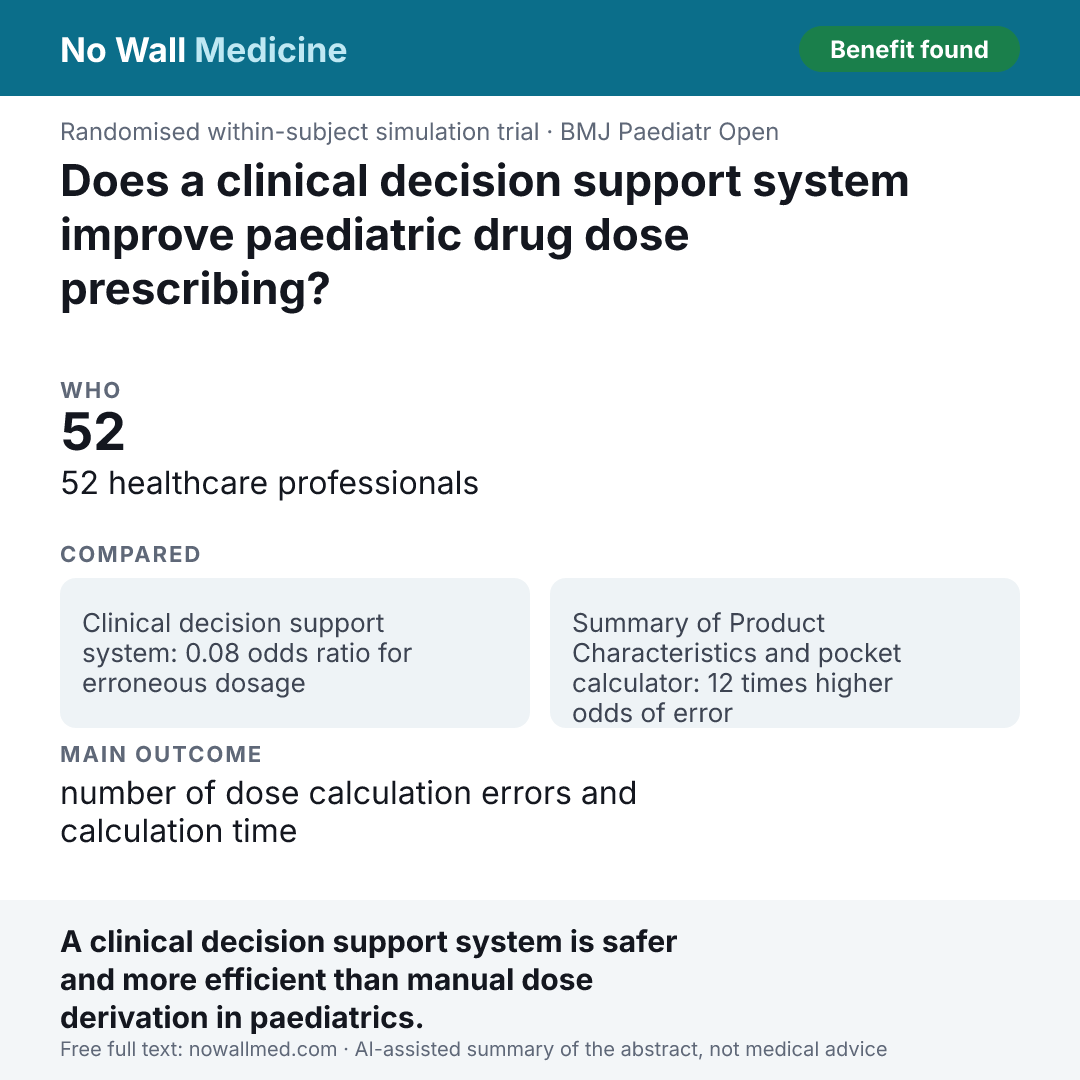
Clinical question: Does a clinical decision support system improve paediatric drug dose prescribing?
Why it matters: Pediatric drug dosing errors are frequent causes of preventable harm due to the complexity of medication therapy and human factors in healthcare.
Key points
- The study compared 52 healthcare professionals using a clinical decision support system against those using product summaries and pocket calculators for 18 hypothetical pediatric cases.
- The odds of a dosing error were 12 times higher when using product summaries and pocket calculators compared to the clinical decision support system.
- Using the clinical decision support system resulted in a 45% reduction in the time needed for dosage calculation.
Headline and key points written with AI from the paper’s abstract, with every number checked against it. Read the paper before relying on them.
Was this summary helpful?
Abstract
Background
Drug dosing errors are among the most frequent causes of preventable harm in paediatrics. Due to the complexity of paediatric pharmacotherapy and the working conditions in healthcare, it is not surprising that human factor is a well-described source of error. Thus, a clinical decision support system (CDSS) that supports healthcare professionals (HCP) during the dose prescribing step provides a promising strategy for error prevention. Methods
The aim of the trial was to simulate the dose derivation step during the prescribing process. HCPs were asked to derive dosages for 18 hypothetical patient cases. We compared the CDSS PEDeDose, which provides a built-in dose calculator to the Summary of Product Characteristics (SmPC) used together with a pocket calculator in a randomised within-subject trial. We assessed the number of dose calculation errors and the time needed for calculation. Additionally, the effect of PEDeDose without using the built-in calculator but with a pocket calculator instead was assessed. Results
A total of 52 HCPs participated in the trial. The OR for an erroneous dosage using the CDSS as compared with the SmPC with pocket calculator was 0.08 (95% CI 0.02 to 0.36, p<0.001). Thus, the odds of an error were 12 times higher while using the SmPC. Furthermore, there was a 45% (95% CI 39% to 51%, p<0.001) time reduction when the dosage was derived using the CDSS. The exploratory analysis revealed that using only PEDeDose but without the built-in calculator did not substantially reduce errors. Conclusion
Our results provide robust evidence that the use of the CDSS is safer and more efficient than manual dose derivation in paediatrics. Interestingly, only consulting a dosing database was not sufficient to substantially reduce errors. We are confident the CDSS PEDeDose ensures a higher safety and speeds up the prescribing process in practice.
Abstract reproduced under the article’s CC BY NC licence.
Subject terms
Headline, design, result, key points, caveat and citation as plain text.
Cite this article
Higi L, Schmitt R, Käser K, Wälti M, Grotzer M, Vonbach P. Impact of a clinical decision support system on paediatric drug dose prescribing: a randomised within-subject simulation trial. BMJ Paediatr Open. 2023;7(1). doi:10.1136/bmjpo-2022-001726
Spotted a mistake? Suggest a correction