Feedback loop for clinicians did not reduce intensive care unit admissions for older patients
Impact of a prospective feedback loop aimed at reducing non-beneficial treatments in older people admitted to hospital and potentially nearing the end of life. A cluster stepped-wedge randomised controlled trial
Stepped-wedge cluster randomised trialNo clear difference
Does a prospective feedback loop reduce non-beneficial treatment in older hospital patients?
Who
4268
4,268 patients aged 75+ years potentially near end of life · Three large tertiary public hospitals in Australia
Compared
Usual care
Intervention
Main outcome
Proportion of patients with one or more intensive care unit admissions
Result: mean probability difference -0.01 (95% confidence interval -0.08 to 0.01)
Bottom line: The nudge intervention did not reduce intensive care unit admissions in older hospital patients nearing end of life.
Age Ageing · 2024-06-09Download image
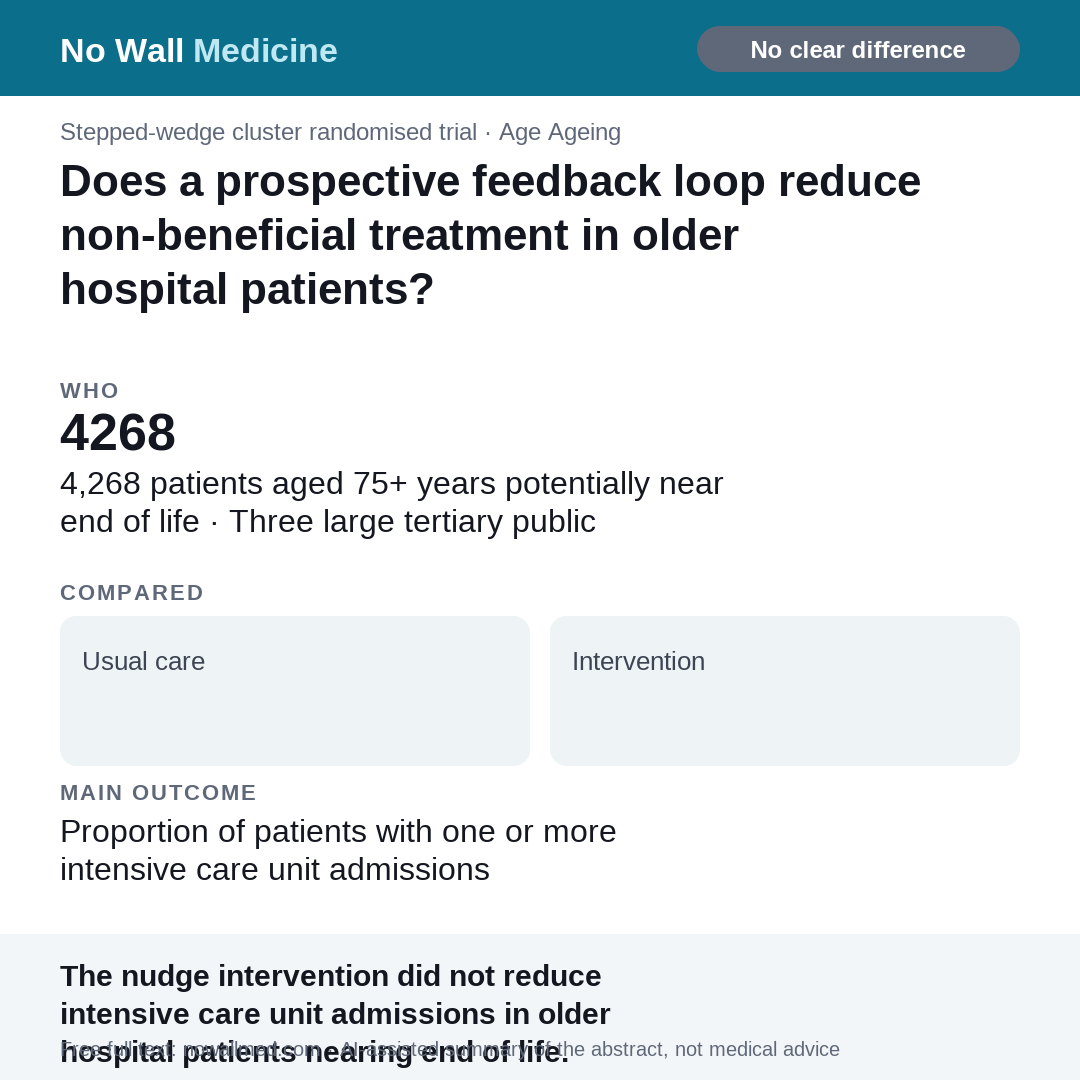
Clinical question: Does a prospective feedback loop reduce non-beneficial treatment in older hospital patients?
Why it matters: It was unknown if a prospective feedback loop flagging patients at risk of death could reduce non-beneficial treatments for older people in hospitals.
Key points
- Researchers studied 4,268 patients with a median age of 84 years across 14 clinical teams in three Australian hospitals.
- The intervention, which used real-time and email notifications, did not improve the primary outcome of intensive care unit admissions (mean probability difference -0.01, 95% confidence interval -0.08 to 0.01).
- The intervention was associated with a reduction in the probability of hospital re-admission (mean probability difference -0.08, 95% confidence interval -0.13 to -0.03).
Headline and key points written with AI from the paper’s abstract, with every number checked against it. Read the paper before relying on them.
Was this summary helpful?
Subject terms
Cite this article
White NM, Barnett AG, Lee XJ, Farrington A, Carter H, McPhail SM. Impact of a prospective feedback loop aimed at reducing non-beneficial treatments in older people admitted to hospital and potentially nearing the end of life. A cluster stepped-wedge randomised controlled trial. Age Ageing. 2024. doi:10.1093/ageing/afae115
Spotted a mistake? Suggest a correction
Top studies every Monday
The week’s key trials and guidelines in your specialties, plus any topics you follow. By email, free.
Get the weekly digest