Physical activity and micronutrient supplements affected body composition in South African primary school children
Impact of a school-based health intervention program on body composition among South African primary schoolchildren: results from the KaziAfya cluster-randomized controlled trial
Cluster-randomized controlled trialBenefit found
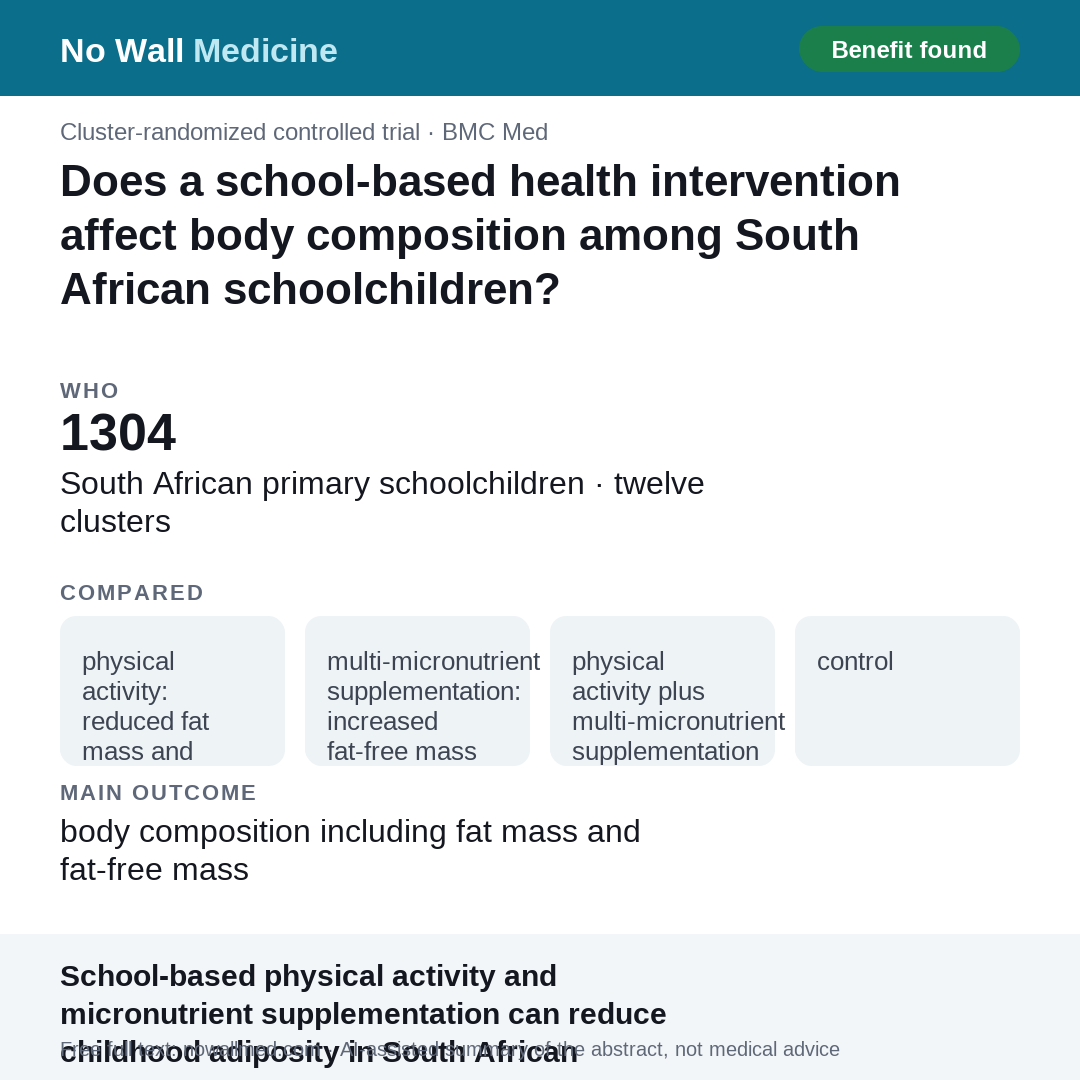
Does a school-based health intervention affect body composition among South African schoolchildren?
Who
1304
South African primary schoolchildren · twelve clusters
Compared
physical activity: reduced fat mass and truncal fat mass in girls
multi-micronutrient supplementation: increased fat-free mass in girls
physical activity plus multi-micronutrient supplementation
control
Main outcome
body composition including fat mass and fat-free mass
Bottom line: School-based physical activity and micronutrient supplementation can reduce childhood adiposity in South African children.
BMC Med · 2022-01-27Download image
Clinical question: Does a school-based health intervention affect body composition among South African schoolchildren?
Why it matters: The rising prevalence of overweight and obesity in African children may increase the risk of non-communicable diseases in adulthood, especially among children with impaired growth.
Key points
- Researchers studied 1304 children, including 614 girls and 667 boys, across twelve clusters over a 9 month period.
- In girls, physical activity was associated with reduced fat mass and truncal fat mass, while multi-micronutrient supplementation was associated with increased fat-free mass.
- Among children with reduced height velocity, physical activity was associated with reduced fat mass, while multi-micronutrient supplementation was associated with increased fat mass.
Headline and key points written with AI from the paper’s abstract, with every number checked against it. Read the paper before relying on them.
Was this summary helpful?
Subject terms
Cite this article
Long KZ, Beckmann J, Lang C, Seelig H, Nqweniso S, Probst-Hensch N. Impact of a school-based health intervention program on body composition among South African primary schoolchildren: results from the KaziAfya cluster-randomized controlled trial. BMC Med. 2022. doi:10.1186/s12916-021-02223-x
Spotted a mistake? Suggest a correction
Top studies every Monday
The week’s key trials and guidelines in your specialties, plus any topics you follow. By email, free.
Get the weekly digest