Impact of accredited advanced life support course participation on in-hospital cardiac arrest patient outcomes: A systematic review
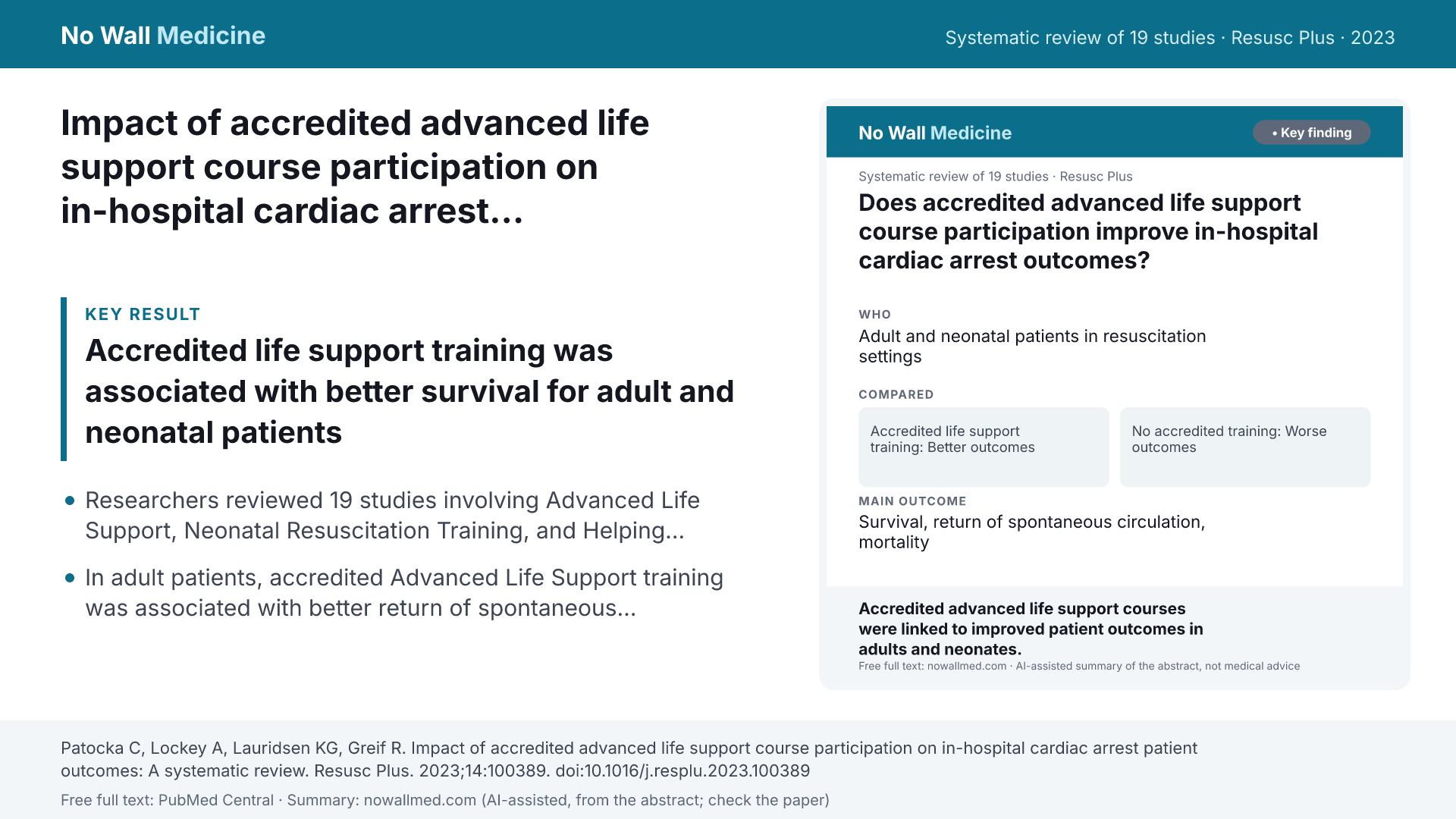
Key result: Accredited life support training was associated with better survival for adult and neonatal patients
Systematic review of 19 studiesKey finding
Does accredited advanced life support course participation improve in-hospital cardiac arrest outcomes?
Who
Adult and neonatal patients in resuscitation settings
Compared
Accredited life support training: Better outcomes
No accredited training: Worse outcomes
Main outcome
Survival, return of spontaneous circulation, mortality
Bottom line: Accredited advanced life support courses were linked to improved patient outcomes in adults and neonates.
Resusc Plus · 2023-04-14
Key points
- Researchers reviewed 19 studies involving Advanced Life Support, Neonatal Resuscitation Training, and Helping Babies Breathe courses.
- In adult patients, accredited Advanced Life Support training was associated with better return of spontaneous circulation, survival to discharge, and survival to 30 days.
- Among neonatal patients, participation in these courses was associated with reductions in stillbirths and early neonatal mortality.
Discussion prompts
- Would these patients look like yours? Who was left out?
- Is the main outcome one that matters to patients?
- Is the difference large enough to change what you do?
Cite: Patocka C, Lockey A, Lauridsen KG, Greif R. Impact of accredited advanced life support course participation on in-hospital cardiac arrest patient outcomes: A systematic review. Resusc Plus. 2023;14:100389. doi:10.1016/j.resplu.2023.100389
Free full text: PubMed Central · Summary and visual abstract: nowallmed.com/a/impact-of-accredited-advanced-life-support-course-participation-on-in-22ipmk/ (AI-assisted from the abstract; check the paper before relying on it).