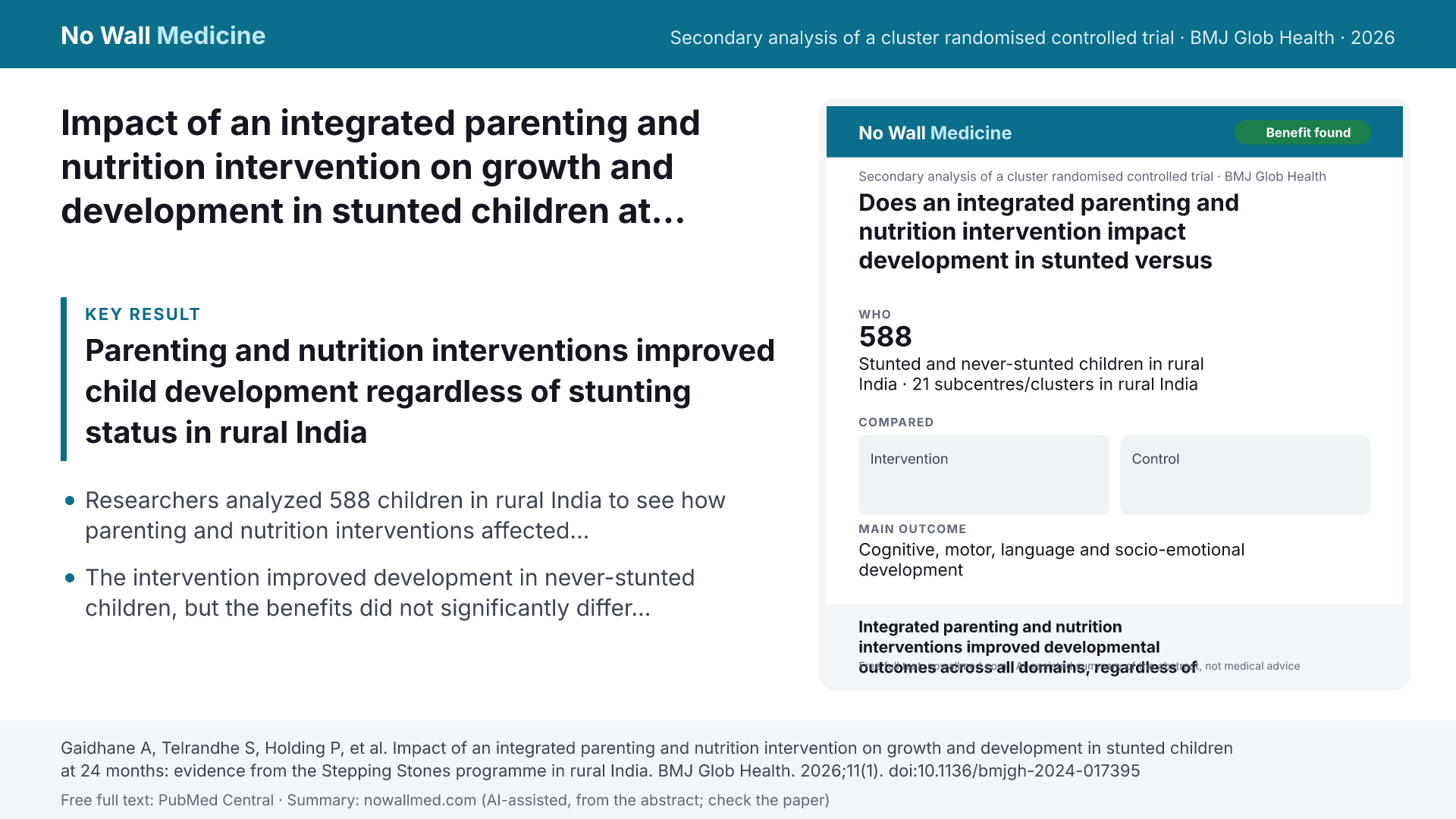
Parenting and nutrition interventions improved child development regardless of stunting status in rural India
Impact of an integrated parenting and nutrition intervention on growth and development in stunted children at 24 months: evidence from the Stepping Stones programme in rural India
Secondary analysis of a cluster randomised controlled trialBenefit found
Does an integrated parenting and nutrition intervention impact development in stunted versus never-stunted children?
Who
588
Stunted and never-stunted children in rural India · 21 subcentres/clusters in rural India
Compared
Intervention
Control
Main outcome
Cognitive, motor, language and socio-emotional development
Bottom line: Integrated parenting and nutrition interventions improved developmental outcomes across all domains, regardless of stunting status.
BMJ Glob Health · 2026-01-08 · Save PNG
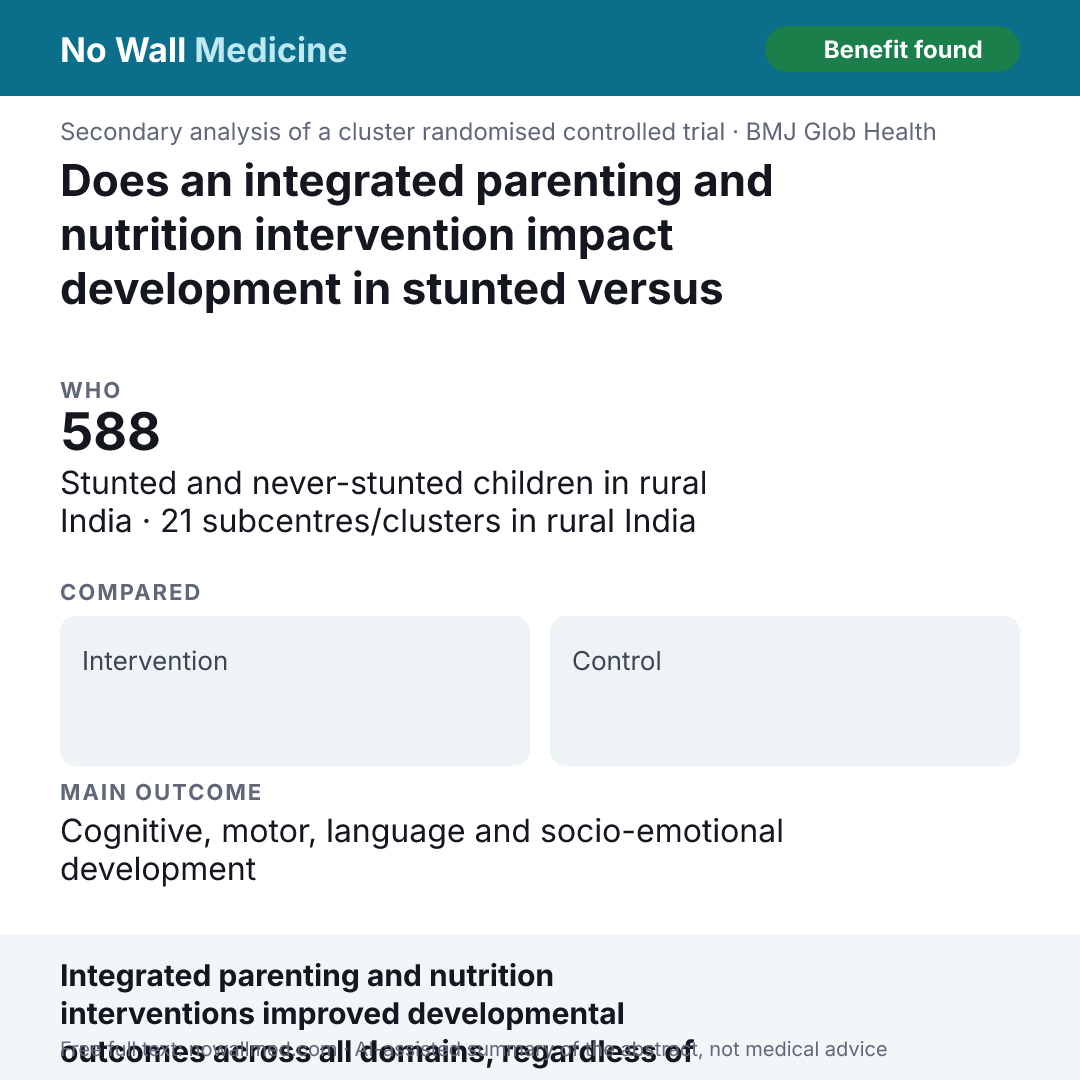
Clinical question: Does an integrated parenting and nutrition intervention impact development in stunted versus never-stunted children?
Why it matters: Researchers wanted to examine if parenting and nutrition interventions have different impacts on early child development in stunted versus never-stunted children.
Key points
- Researchers analyzed 588 children in rural India to see how parenting and nutrition interventions affected cognitive, motor, language, and socio-emotional development.
- The intervention improved development in never-stunted children, but the benefits did not significantly differ based on whether a child was stunted or not.
- Among the children studied, 35.9% were stunted at 24 months, and 35 (5.95%) of them showed early-onset persistent stunting.
Headline and key points written with AI from the paper’s abstract, with every number checked against it. Read the paper before relying on them.
Was this summary helpful?
Abstract
Objectives
This paper examines the differential impact of responsive parenting and nutrition interventions on early child development in stunted versus never-stunted children at 24 months of age in rural India. Methods
We conducted a secondary analysis of data from Stepping Stones-a cluster randomised controlled trial involving 21 subcentres/clusters allocated to intervention or control group. The intervention comprised home visits, group sessions and community workshops, focusing on responsive parenting and nutrition. Developmental outcomes, cognitive, motor, language and socio-emotional, were assessed at 24 months using validated tools. A mixed-effects regression model with an interaction term was used to estimate effect sizes for stunted and never-stunted children. Results
Among 588 children analysed, 35.9% were stunted at 24 months, and 35 (5.95%) of them exhibited 'early-onset persistent stunting'. The intervention improved cognitive (β=0.22), motor (β=0.23), language (β=0.17) and socio-emotional development (β=0.23) in never-stunted children compared with those who have not received intervention. For stunted children who have not received the intervention, a development score was lower for all development domains compared with never-stunted children, but not statistically significant (p>0.05). Although the effects differed between stunted and never-stunted children, the interaction effects between intervention and stunting were not statistically significant across all domains (p>0.05), indicating that the intervention's benefits did not significantly differ by stunting status. Conclusion
Integrated parenting and nutrition interventions improved developmental outcomes across all domains, regardless of the child's stunting status. These findings support universal application of such programmes, highlighting the need to integrate them into existing child development and nutrition programmes.
Abstract reproduced under the article’s CC BY licence.
Subject terms
Headline, design, result, key points, caveat and citation as plain text.
Cite this article
Gaidhane A, Telrandhe S, Holding P, et al. Impact of an integrated parenting and nutrition intervention on growth and development in stunted children at 24 months: evidence from the Stepping Stones programme in rural India. BMJ Glob Health. 2026;11(1). doi:10.1136/bmjgh-2024-017395
Spotted a mistake? Suggest a correction