Artificial intelligence improved workflow efficiency, patient engagement, and clinical outcomes in cardiology trials
Impact of artificial intelligence on cardiovascular workflow, engagement, and outcomes: a systematic review
Systematic review and meta-analysisBenefit found
What is the impact of artificial intelligence on cardiovascular workflow, engagement, and outcomes?
Who
Patients in cardiovascular randomized controlled trials
Compared
Artificial intelligence interventions
Control groups
Main outcome
Workflow efficiency, patient engagement, and clinical outcomes
Result: mortality RR 0.84 (95% CI 0.75-0.94)
Bottom line: Artificial intelligence improves cardiovascular workflow efficiency, enhances patient engagement, and reduces all-cause mortality.
Limitation: Restricted blinding and insufficient sham-artificial intelligence controls.
NPJ Digit Med · 2026-05-06Download image
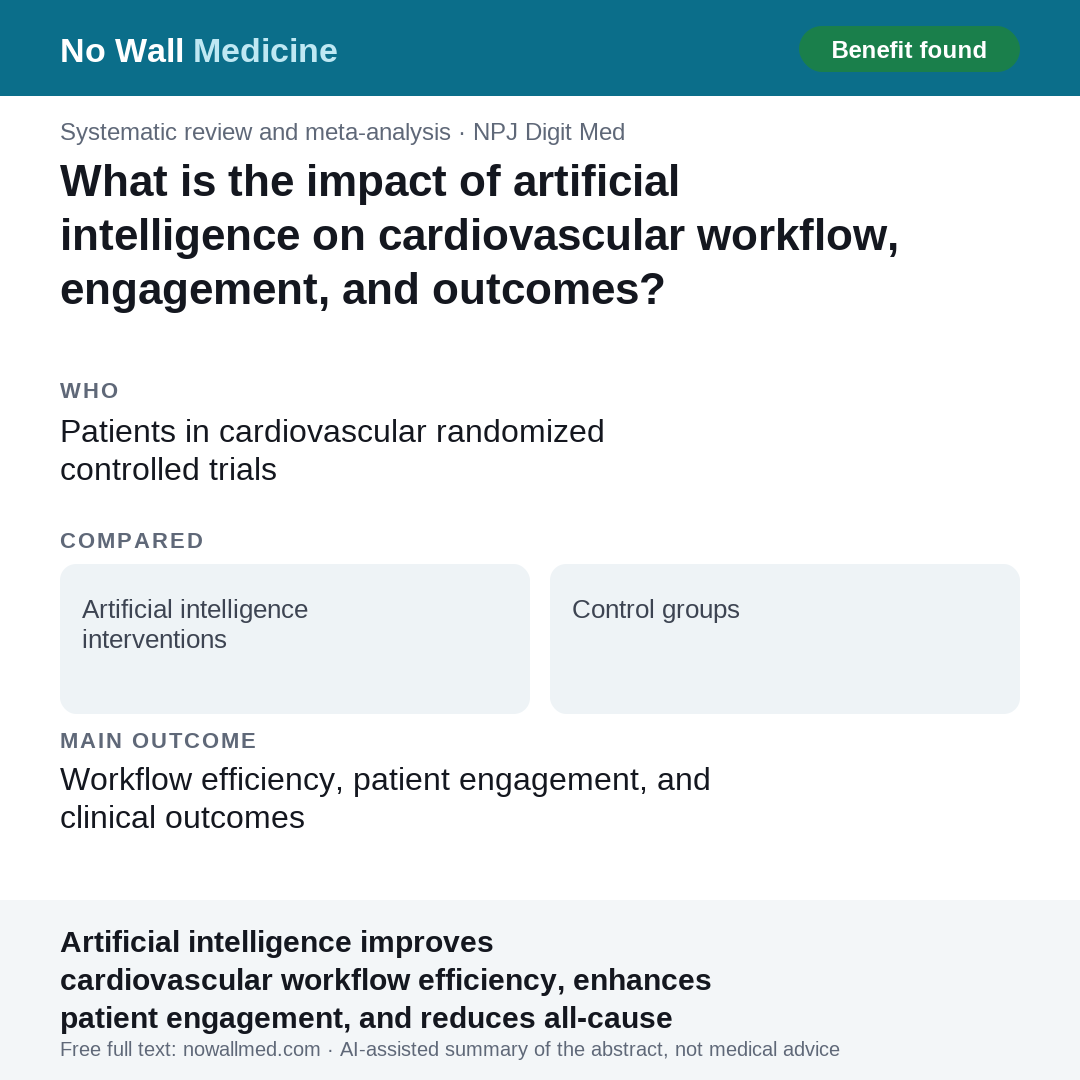
Clinical question: What is the impact of artificial intelligence on cardiovascular workflow, engagement, and outcomes?
Why it matters: The overarching advantages of using artificial intelligence across various cardiology care domains remained ambiguous.
Key points
- Researchers reviewed 32 randomized controlled trials to assess how machine and deep-learning algorithms affect cardiology care domains.
- Artificial intelligence reduced diagnostic time by 30-120 seconds and decreased hospital stays by 1.0-4.2 days.
- Decision-support tools decreased all-cause mortality with a number needed to treat of 32 and enhanced medication adherence.
Limitation the authors note: The authors noted that the studies were limited by restricted blinding and insufficient sham-artificial intelligence controls.
Headline and key points written with AI from the paper’s abstract, with every number checked against it. Read the paper before relying on them.
Spotted a mistake? Suggest a correction