Higher breathing frequencies reduce airway resistance measurements in patients with asthma
Impact of breathing frequency on respiratory oscillometry measurements: a randomised cross-over and observational study of asthma patients
Randomised cross-over and observational studyMixed results
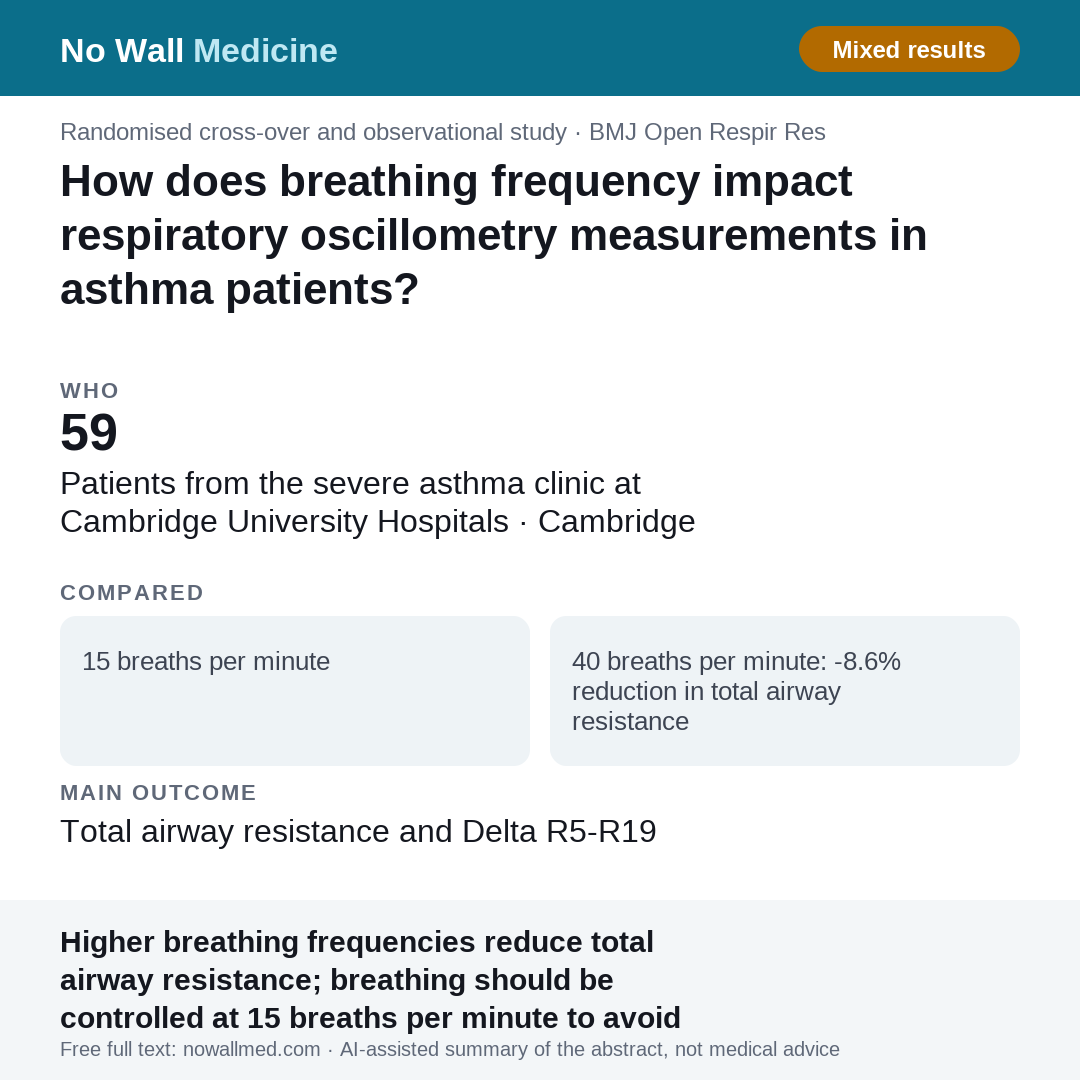
How does breathing frequency impact respiratory oscillometry measurements in asthma patients?
Who
59
Patients from the severe asthma clinic at Cambridge University Hospitals · Cambridge University Hospitals
Compared
15 breaths per minute
40 breaths per minute: -8.6% reduction in total airway resistance
Main outcome
Total airway resistance and Delta R5-R19
Bottom line: Higher breathing frequencies reduce total airway resistance; breathing should be controlled at 15 breaths per minute to avoid misclassification.
BMJ Open Respir Res · 2026-02-23Download image
Clinical question: How does breathing frequency impact respiratory oscillometry measurements in asthma patients?
Why it matters: The impact of different breathing frequencies on respiratory oscillometry measurements in patients with asthma is unknown.
Key points
- Researchers studied 59 asthma patients using a randomized-crossover design to compare forced oscillation technique measurements at breathing frequencies of 15, 30, and 40 breaths per minute.
- Increasing breathing frequency from 15 to 40 breaths per minute caused a -8.6% reduction in total airway resistance and a -14.9% reduction in Delta R5-R19.
- At higher breathing frequencies, 5% of the study participants were reclassified as having respiratory oscillometry measurements within normal limits.
Headline and key points written with AI from the paper’s abstract, with every number checked against it. Read the paper before relying on them.
Abstract
Introduction
The impact of breathing frequency on respiratory oscillometry measurements is unknown. We aimed to investigate the impact of different breathing frequencies in patients with asthma. Method
We recruited patients from the severe asthma clinic at Cambridge University Hospitals. Using a randomised-crossover design, participants performed the forced oscillation technique at three different breathing frequencies (15, 30, 40 bpm) in a randomised order for each participant. A metronome was used to ensure the correct breathing frequency. Analysis of variance (ANOVA) and Friedman tests were utilised to assess the significance of any differences across the breathing frequencies. We then leveraged cross-sectional data from asthma patients who performed respiratory oscillometry and investigated the determinants of self-selected breathing frequency using multivariable linear regression. Results
We recruited 59 patients. Mean age 54.1 years, 58% female, median forced expiratory volume in 1 s (FEV1)/FVC z-score -2.56 (-3.26 to -1.96). As breathing frequency increased from 15 bpm to 40 bpm, there was a significant reduction (-8.6%, p<0.001) in total airway resistance (Rrs at 5 Hz), which was not mediated by changes in tidal volume or flow rate. There was also a significant reduction (-14.9%, p<0.001) in Delta R5-R19, and an increase (+10.9%, p=0.081) in reactance (Xrs at 5 Hz). At higher breathing frequencies, 5% of study participants were reclassified as having respiratory oscillometry measurements within normal limits. Data from 796 asthma patients were extracted for the cross-sectional analysis. The median (range) self-selected breathing frequency was 16.55 bpm (8.0, 42.0). Demographic data and lung function explained 23.5% of the variation in breathing frequency. Conclusion
Higher breathing frequencies significantly reduce total Rrs . When performing respiratory oscillometry, breathing frequency should be controlled at approximately 15 bpm to reduce risk of misclassification.
Abstract reproduced under the article’s CC BY NC licence.
Topics
Cite this article
Knox-Brown B, Carozzo O, Sylvester KP. Impact of breathing frequency on respiratory oscillometry measurements: a randomised cross-over and observational study of asthma patients. BMJ Open Respir Res. 2026. doi:10.1136/bmjresp-2025-003657
Spotted a mistake? Suggest a correction