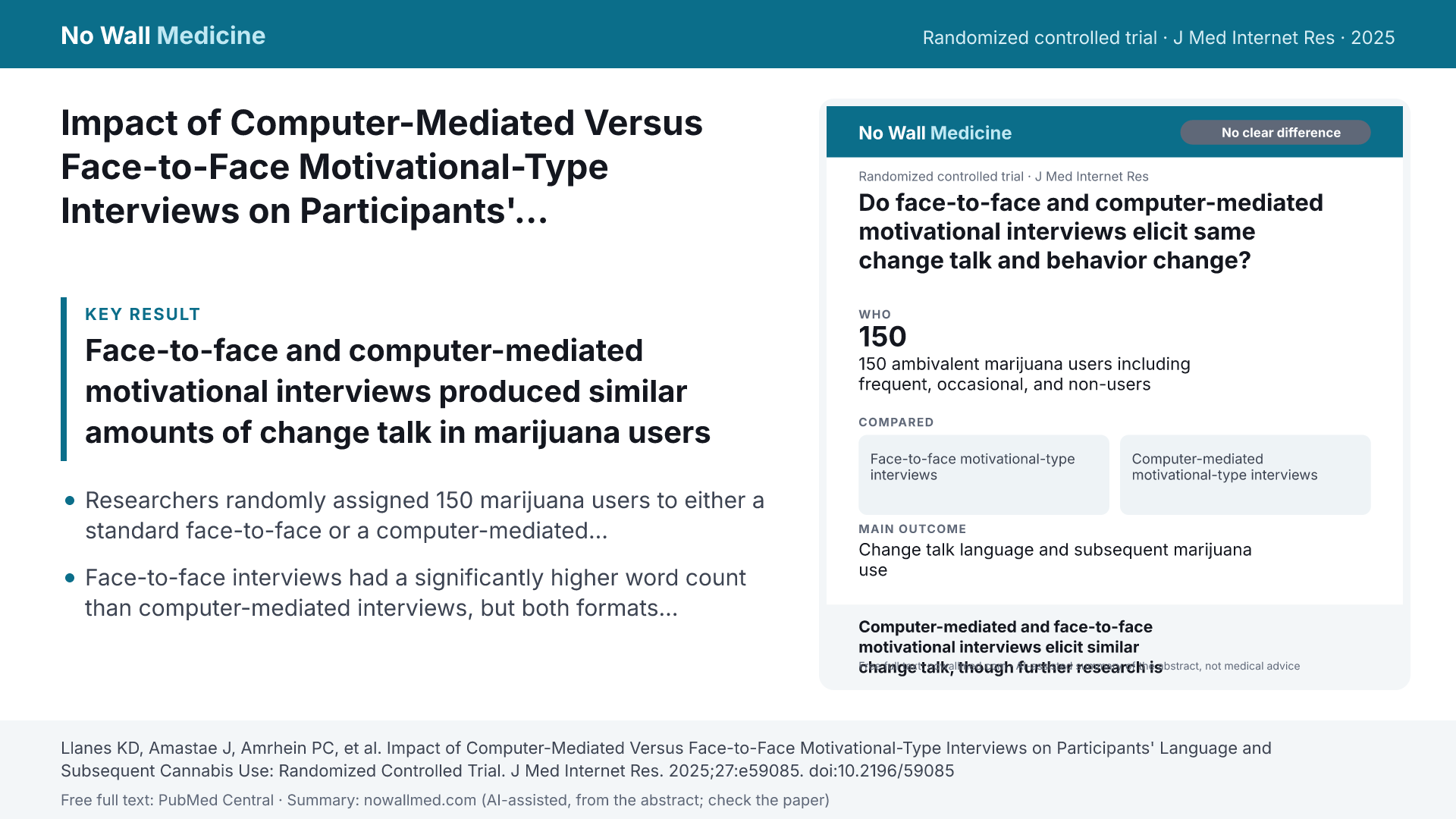
Face-to-face and computer-mediated motivational interviews produced similar amounts of change talk in marijuana users
Impact of Computer-Mediated Versus Face-to-Face Motivational-Type Interviews on Participants' Language and Subsequent Cannabis Use: Randomized Controlled Trial
Randomized controlled trialNo clear difference
Do face-to-face and computer-mediated motivational interviews elicit same change talk and behavior change?
Who
150
150 ambivalent marijuana users including frequent, occasional, and non-users
Compared
Face-to-face motivational-type interviews
Computer-mediated motivational-type interviews
Main outcome
Change talk language and subsequent marijuana use
Bottom line: Computer-mediated and face-to-face motivational interviews elicit similar change talk, though further research is needed for predictive validity.
Limitation: Further research is needed to enhance the predictive validity of computer-delivered language.
J Med Internet Res · 2025-04-25Download image

Clinical question: Do face-to-face and computer-mediated motivational interviews elicit same change talk and behavior change?
Key points
- Researchers randomly assigned 150 marijuana users to either a standard face-to-face or a computer-mediated motivational interview format.
- Face-to-face interviews had a significantly higher word count than computer-mediated interviews, but both formats produced similar amounts of change talk and sustain talk.
- The relationship between initial change talk and marijuana use at a 2-month follow-up was not statistically significant.
Headline and key points written with AI from the paper’s abstract, with every number checked against it. Read the paper before relying on them.
Was this summary helpful?
Subject terms
Headline, design, result, key points, caveat and citation as plain text.
Cite this article
Llanes KD, Amastae J, Amrhein PC, et al. Impact of Computer-Mediated Versus Face-to-Face Motivational-Type Interviews on Participants' Language and Subsequent Cannabis Use: Randomized Controlled Trial. J Med Internet Res. 2025. doi:10.2196/59085
Spotted a mistake? Suggest a correction