Researchers plan to study if creatine and exercise improve physical and mental health in older adults
Impact of creatine monohydrate supplementation combined with multicomponent training in older adults (≥ 75 years): study protocol of a randomised controlled trial
Randomised, double-blind, placebo-controlled trialUnclear result
Does creatine monohydrate combined with multicomponent training affect older adults?
Who
Older adults aged 75 years or older
Compared
placebo
placebo with multicomponent training
creatine monohydrate supplementation
creatine monohydrate with multicomponent training
Main outcome
Functional capacity, fall risk, physical tests, cognitive and emotional assessments
Bottom line: This study protocol describes a trial to assess creatine and training in older adults.
Br J Nutr · 2026-05-07Download image
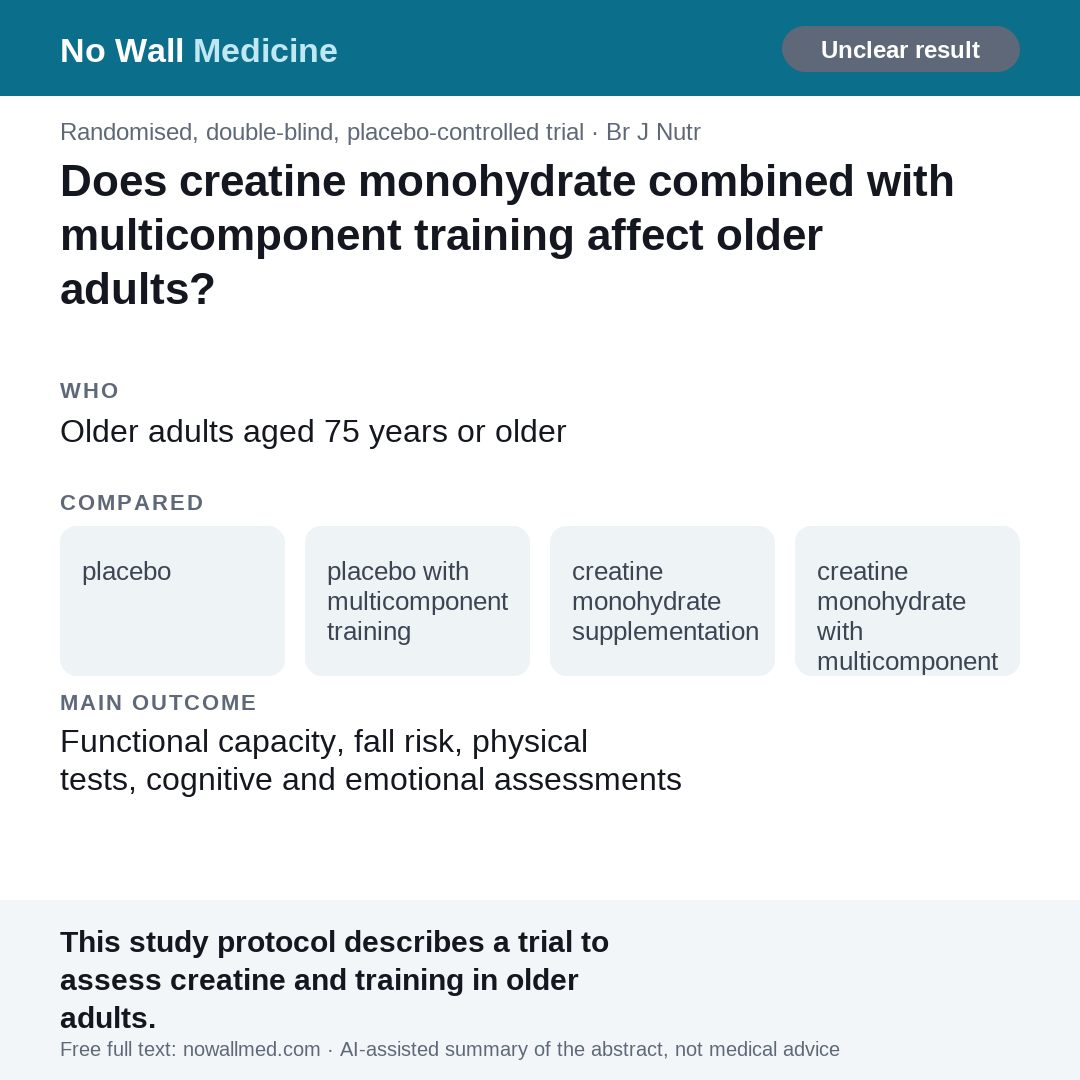
Clinical question: Does creatine monohydrate combined with multicomponent training affect older adults?
Why it matters: Data regarding the effects of creatine monohydrate on older adults are currently scarce.
Key points
- The study protocol describes a randomized, double-blind, placebo-controlled trial involving adults aged 75 years or older.
- Participants will be assigned to one of four groups to compare creatine monohydrate supplementation alone, with multicomponent training, with a placebo, or with a placebo and training.
- Researchers will measure functional capacity, fall risk, muscle strength, and cognitive and emotional health over the course of the intervention.
Headline and key points written with AI from the paper’s abstract, with every number checked against it. Read the paper before relying on them.
Abstract
Creatine monohydrate (CrM) is a widely used supplement to improve physical performance and strength. Recent studies suggest it may also benefit cognitive function and depression treatment. However, data on its effects in older adults are scarce, highlighting the need for further research in this population. This study is a randomised, double-blind, placebo-controlled trial assessing 5 weeks of CrM supplementation combined with physical training in older adults (≥ 75 years). Participants will be divided into four groups: placebo (PL), placebo with multicomponent training (PL + MT), creatine monohydrate supplementation (CrM) and creatine monohydrate with multicomponent training (CrM + MT). Evaluations will be conducted before, during and after the intervention and again after a 5-week washout period. The training programme includes supervised sessions twice a week over 4 weeks, focusing on resistance, cardiovascular, balance, reaction and agility exercises. Functional capacity and fall risk will be measured, alongside physical tests such as handgrip strength and one-repetition maximum (1RM) tests for leg press, bench press, seated row and leg extension. Cognitive and emotional assessments will also be conducted during the intervention. The results of this study aim to increase our understanding of the effects of CrM supplementation in older adults. This study is expected to generate valuable information on the impact and safety of this nutrition and exercise strategy, and its application can be extended to a variety of health conditions. CLINICAL TRIALS: https://clinicaltrials.gov/study/NCT06677359.
Abstract reproduced under the article’s CC BY licence.
Cite this article
Fernández-González de la Riva M, Zambom-Ferraresi F, Zambom-Ferraresi F, Izco-Cubero M, Álvarez-Rodríguez P, Zugasti-Murillo A. Impact of creatine monohydrate supplementation combined with multicomponent training in older adults (≥ 75 years): study protocol of a randomised controlled trial. Br J Nutr. 2026. doi:10.1017/s0007114526107302
Spotted a mistake? Suggest a correction