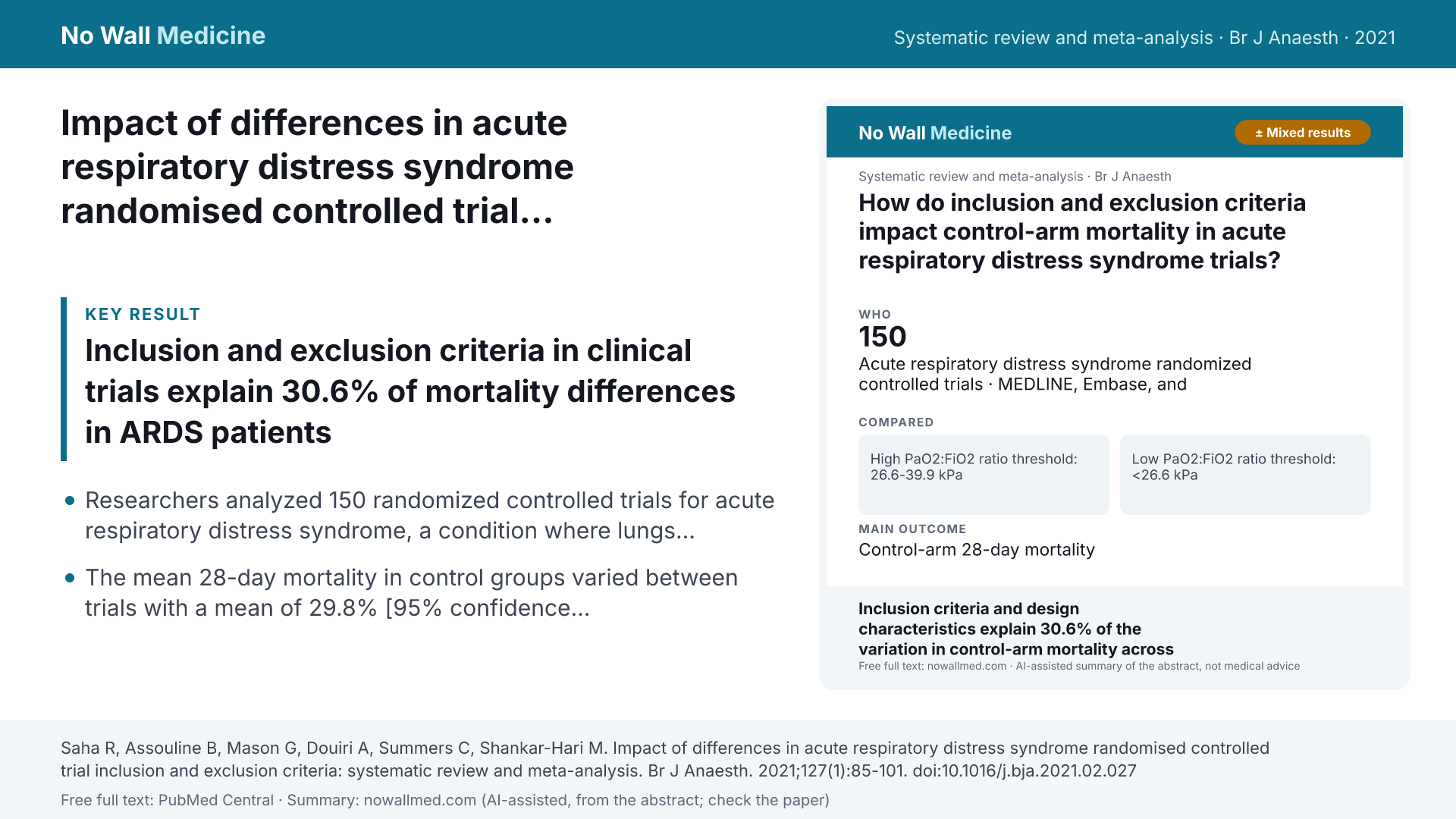
Inclusion and exclusion criteria in clinical trials explain 30.6% of mortality differences in ARDS patients
Impact of differences in acute respiratory distress syndrome randomised controlled trial inclusion and exclusion criteria: systematic review and meta-analysis
Systematic review and meta-analysisMixed results
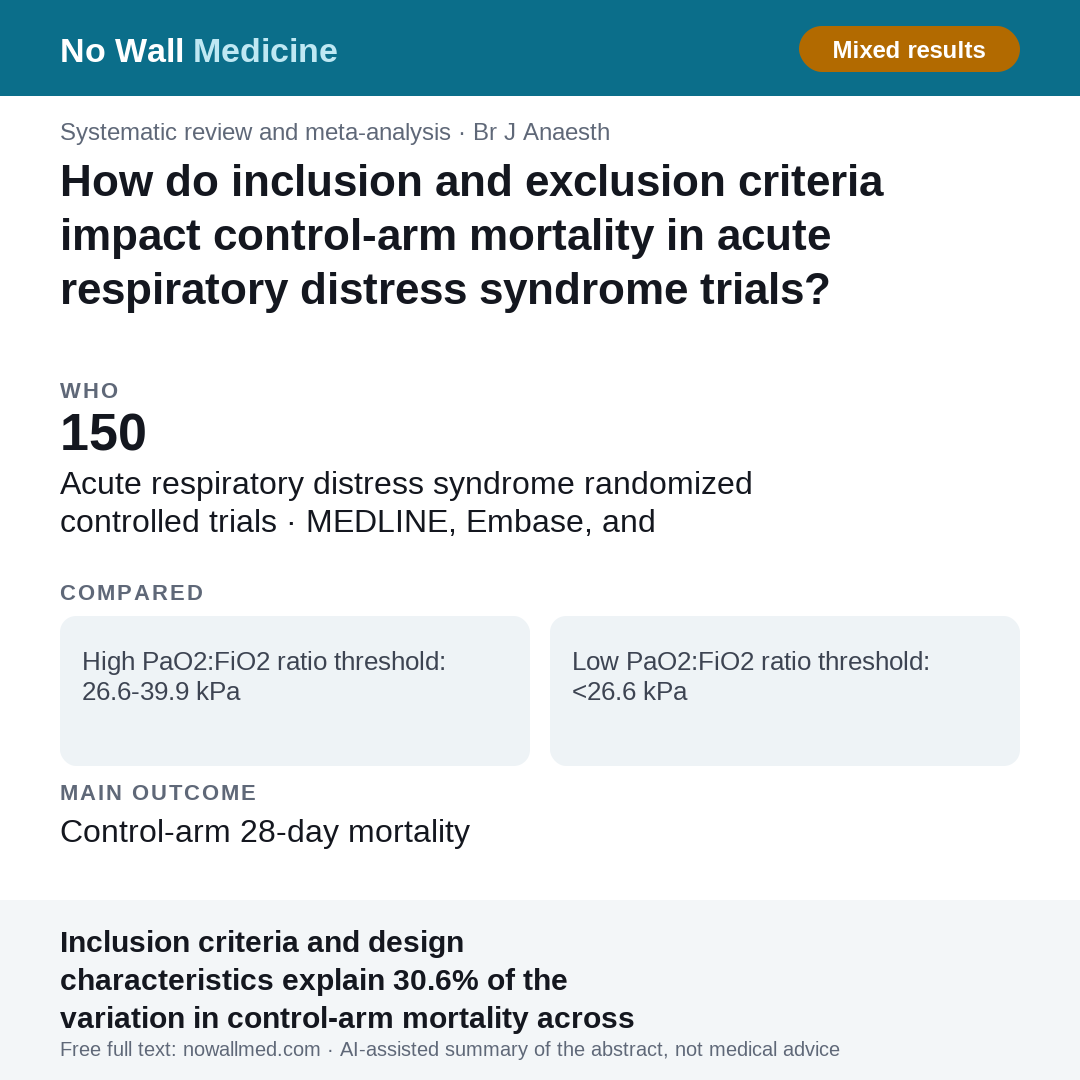
How do inclusion and exclusion criteria impact control-arm mortality in acute respiratory distress syndrome trials?
Who
150
Acute respiratory distress syndrome randomized controlled trials · MEDLINE, Embase, and Cochrane central register of controlled trials
Compared
High PaO2:FiO2 ratio threshold: 26.6-39.9 kPa
Low PaO2:FiO2 ratio threshold: <26.6 kPa
Main outcome
Control-arm 28-day mortality
Result: 30.6% of between-trial difference explained by inclusion and design characteristics
Bottom line: Inclusion criteria and design characteristics explain 30.6% of the variation in control-arm mortality across trials.
Br J Anaesth · 2021-04-01Download image
Clinical question: How do inclusion and exclusion criteria impact control-arm mortality in acute respiratory distress syndrome trials?
Why it matters: Control-arm mortality rates vary between different clinical trials for acute respiratory distress syndrome, and it is unclear how much inclusion and exclusion criteria drive these differences.
Key points
- Researchers analyzed 150 randomized controlled trials for acute respiratory distress syndrome, a condition where lungs cannot provide enough oxygen to the body.
- The mean 28-day mortality in control groups varied between trials with a mean of 29.8% [95% confidence interval: 27.0-32.7%].
- Differences in mortality were significantly associated with different oxygenation thresholds, specifically comparing a Pao2:FiO2 ratio of 26.6-39.9 kPa versus <26.6 kPa.
Headline and key points written with AI from the paper’s abstract, with every number checked against it. Read the paper before relying on them.
Was this summary helpful?
Subject terms
Cite this article
Saha R, Assouline B, Mason G, Douiri A, Summers C, Shankar-Hari M. Impact of differences in acute respiratory distress syndrome randomised controlled trial inclusion and exclusion criteria: systematic review and meta-analysis. Br J Anaesth. 2021. doi:10.1016/j.bja.2021.02.027
Spotted a mistake? Suggest a correction