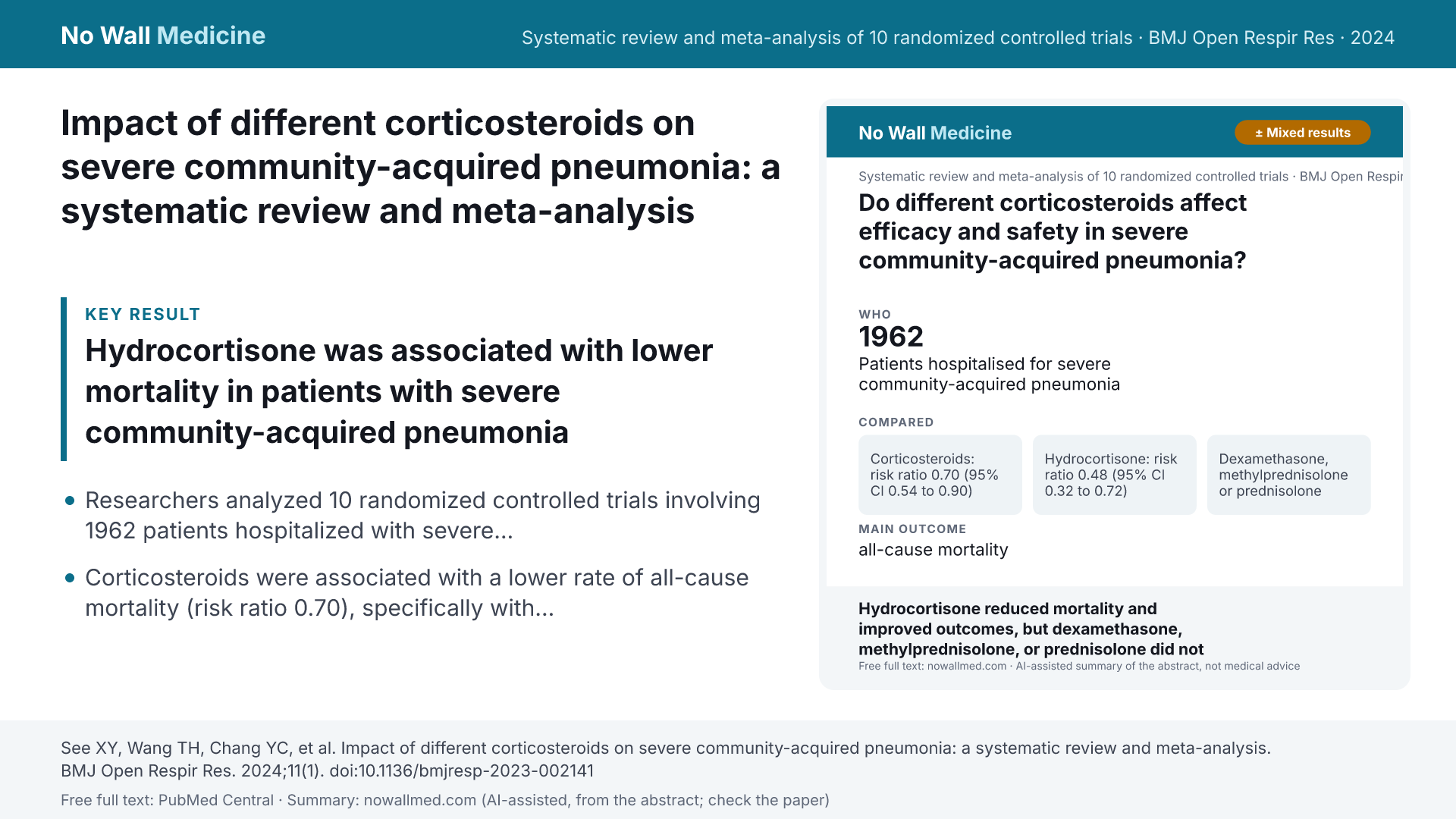
Hydrocortisone was associated with lower mortality in patients with severe community-acquired pneumonia
Impact of different corticosteroids on severe community-acquired pneumonia: a systematic review and meta-analysis
Systematic review and meta-analysis of 10 randomized controlled trialsMixed results
Do different corticosteroids affect efficacy and safety in severe community-acquired pneumonia?
Who
1962
Patients hospitalised for severe community-acquired pneumonia
Compared
Corticosteroids: risk ratio 0.70 (95% CI 0.54 to 0.90)
Hydrocortisone: risk ratio 0.48 (95% CI 0.32 to 0.72)
Dexamethasone, methylprednisolone or prednisolone
Main outcome
all-cause mortality
Result: risk ratio 0.70 (95% CI 0.54 to 0.90)
Bottom line: Hydrocortisone reduced mortality and improved outcomes, but dexamethasone, methylprednisolone, or prednisolone did not show mortality benefits.
BMJ Open Respir Res · 2024-01-22Download image
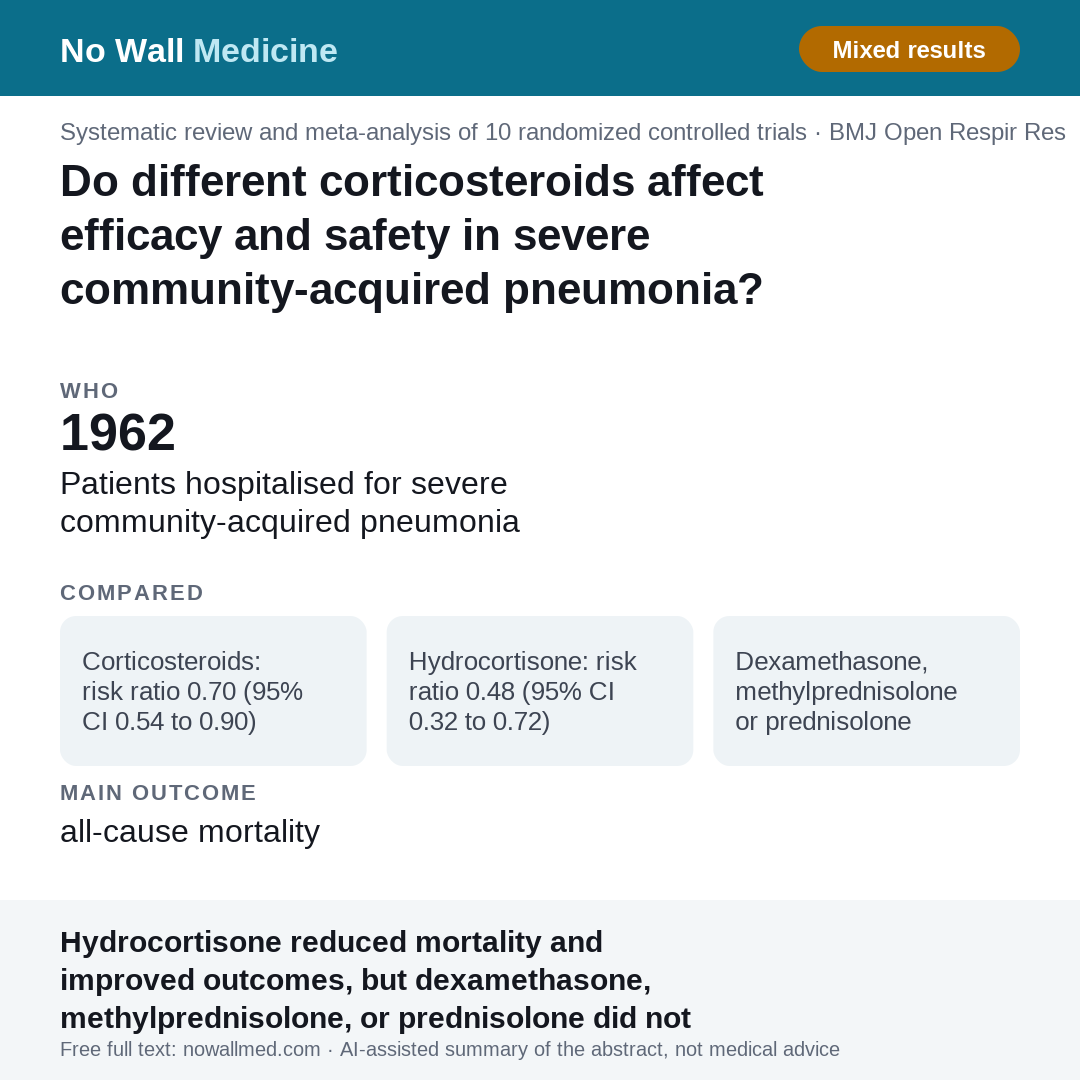
Clinical question: Do different corticosteroids affect efficacy and safety in severe community-acquired pneumonia?
Why it matters: Randomized controlled trials have shown conflicting results regarding whether corticosteroids help treat patients hospitalized with severe community-acquired pneumonia.
Key points
- Researchers analyzed 10 randomized controlled trials involving 1962 patients hospitalized with severe community-acquired pneumonia.
- Corticosteroids were associated with a lower rate of all-cause mortality (risk ratio 0.70), specifically with hydrocortisone showing an approximately 50% lower mortality risk (risk ratio 0.48).
- Hydrocortisone was also associated with lower rates of mechanical ventilation, acute respiratory distress syndrome, shock, and shorter intensive care unit stays compared to other steroids.
Headline and key points written with AI from the paper’s abstract, with every number checked against it. Read the paper before relying on them.
Was this summary helpful?
Abstract
Objectives
Randomised controlled trials (RCTs) have demonstrated conflicting results regarding the effects of corticosteroids on the treatment of severe community-acquired pneumonia (CAP). We aimed to investigate the efficacy and safety of different corticosteroids on patients who were hospitalised for severe CAP. Methods
We performed a systematic search through PubMed, Embase, Cochrane Central Register of Controlled Trials, Web of Science, and Scopus from inception to May 2023. The primary outcome was all-cause mortality. Data analysis was performed using a random-effects model. Results
A total of 10 RCTs comprising 1962 patients were included. Corticosteroids were associated with a lower rate of all-cause mortality (risk ratio (RR), 0.70 (95% CI 0.54 to 0.90); I2=0.00%). When stratified into different corticosteroid types, hydrocortisone was associated with an approximately 50% lower mortality risk (RR, 0.48 (95% CI 0.32 to 0.72); I2=0.00%). However, dexamethasone, methylprednisolone or prednisolone were not associated with an improvement in mortality. Furthermore, hydrocortisone was associated with a reduction in the rate of mechanical ventilation, acute respiratory distress syndrome, shock and duration of intensive care unit stay. These trends were not observed for dexamethasone, methylprednisolone or prednisolone. Corticosteroids were not associated with an increased risk of adverse events including gastrointestinal bleeding, secondary infection or hyperglycaemia. Conclusions
The use of hydrocortisone, but not other types of corticosteroids, was associated with a reduction in mortality and improvement in pneumonia outcomes among patients hospitalised with severe CAP.PROSPERO registration numberCRD42023431360.
Abstract reproduced under the article’s CC BY NC licence.
Subject terms
Cite this article
See XY, Wang TH, Chang YC, et al. Impact of different corticosteroids on severe community-acquired pneumonia: a systematic review and meta-analysis. BMJ Open Respir Res. 2024. doi:10.1136/bmjresp-2023-002141
Spotted a mistake? Suggest a correction