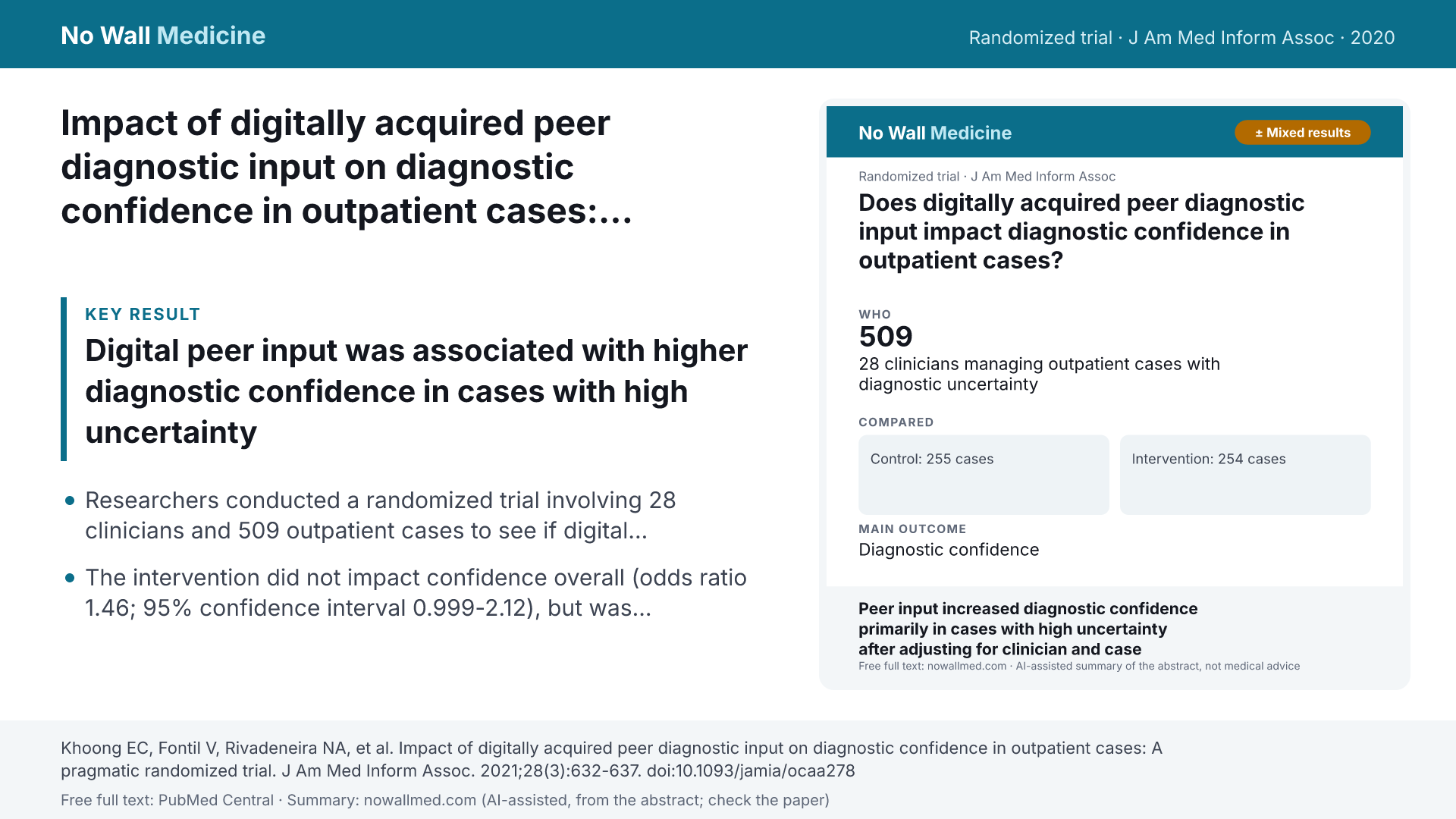
Impact of digitally acquired peer diagnostic input on diagnostic confidence in outpatient cases: A pragmatic randomized trial
Key result: Digital peer input was associated with higher diagnostic confidence in cases with high uncertainty
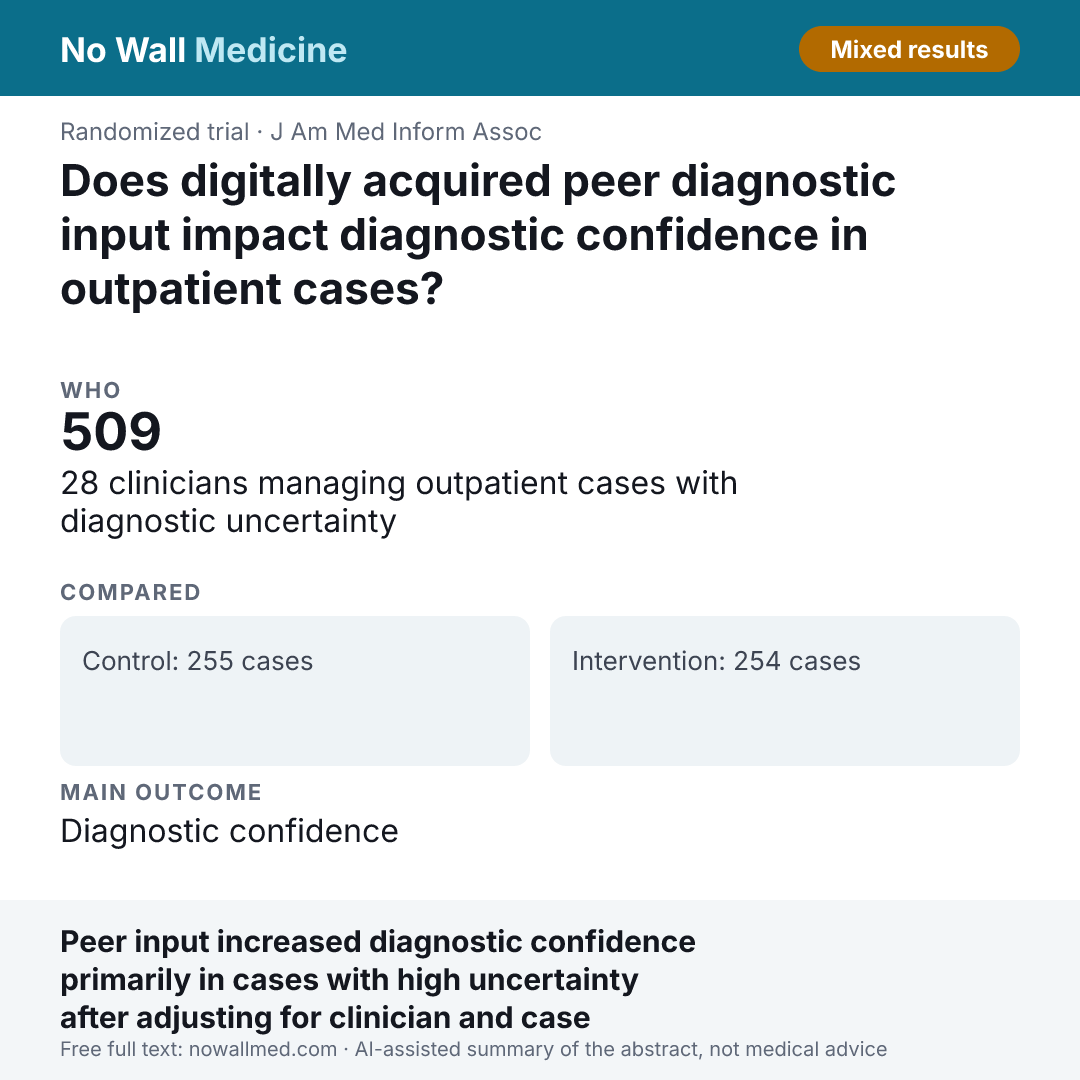
Randomized trialMixed results
Does digitally acquired peer diagnostic input impact diagnostic confidence in outpatient cases?
Who
509
28 clinicians managing outpatient cases with diagnostic uncertainty
Compared
Control: 255 cases
Intervention: 254 cases
Main outcome
Diagnostic confidence
Result: odds ratio 1.46 (95% confidence interval 0.999-2.12)
Bottom line: Peer input increased diagnostic confidence primarily in cases with high uncertainty after adjusting for clinician and case traits.
J Am Med Inform Assoc · 2020-12-02 · Save PNG
Key points
- Researchers conducted a randomized trial involving 28 clinicians and 509 outpatient cases to see if digital input from at least 5 peers affected diagnostic confidence.
- The intervention did not impact confidence overall (odds ratio 1.46; 95% confidence interval 0.999-2.12), but was associated with higher confidence after adjusting for clinician and case traits (odds ratio 1.53; 95% confidence interval 1.01-2.32).
- The impact of the peer input was greater in cases characterized by high uncertainty (odds ratio 3.23; 95% confidence interval 1.09-9.52).
Discussion prompts
- Would these patients look like yours? Who was left out?
- Is the main outcome one that matters to patients?
- Is the difference large enough to change what you do?
Cite: Khoong EC, Fontil V, Rivadeneira NA, et al. Impact of digitally acquired peer diagnostic input on diagnostic confidence in outpatient cases: A pragmatic randomized trial. J Am Med Inform Assoc. 2021;28(3):632-637. doi:10.1093/jamia/ocaa278
Free full text: PubMed Central · Summary and visual abstract: nowallmed.com/a/impact-of-digitally-acquired-peer-diagnostic-input-on-diagnostic-igggo4/ (AI-assisted from the abstract; check the paper before relying on it).