High lymph node count and low positive ratio linked to better survival after esophageal cancer surgery
Impact of Dissected Lymph Node Count and Positive Lymph Node Ratio Following Esophagectomy on Long-Term Outcomes in Esophageal Cancer: A Systematic Review and Meta-Analysis
Systematic review and meta-analysisBenefit found
How do lymph node dissected count and positive lymph node ratio influence esophageal cancer survival?
Who
Patients with esophageal cancer undergoing esophagectomy with lymphadenectomy
Compared
High lymph nodes dissected
Low lymph nodes dissected
Low positive lymph node ratio
High positive lymph node ratio
Main outcome
overall survival
Result: LND: hazard ratio 0.75 (95% CI 0.67-0.85); LNR: hazard ratio 0.39 (95% CI 0.33-0.47)
Bottom line: High lymph node dissection count and low positive lymph node ratio are associated with improved overall survival.
Ann Surg Open · 2025-06-13Download image
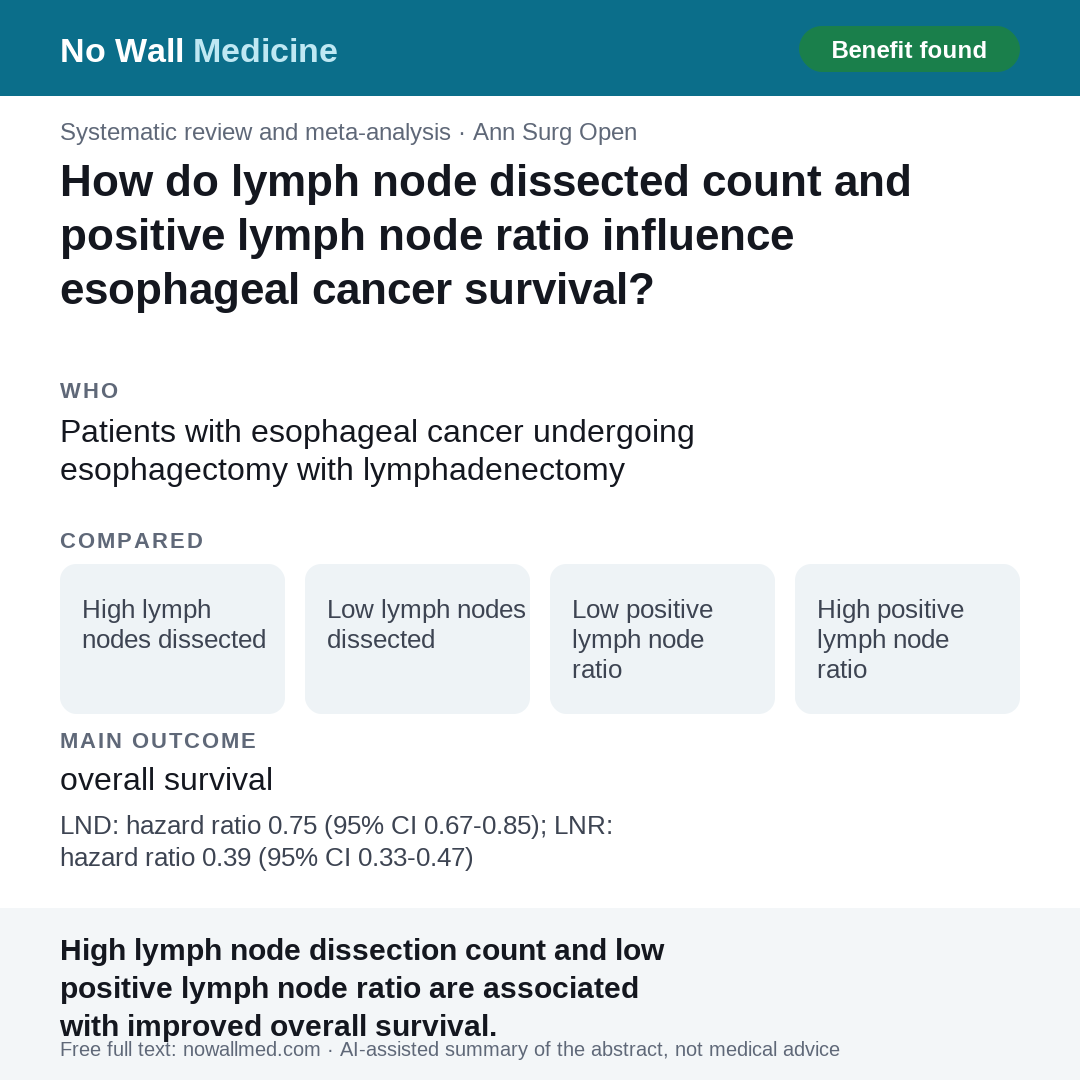
Clinical question: How do lymph node dissected count and positive lymph node ratio influence esophageal cancer survival?
Why it matters: The optimal extent of lymphadenectomy, or the removal of lymph nodes, remains debated in the era of modern neoadjuvant protocols.
Key points
- Researchers analyzed 18 studies on lymph node dissection count and 19 studies on the positive lymph node ratio in patients undergoing esophagectomy, which is surgery to remove the esophagus.
- High lymph node dissection counts were associated with a hazard ratio of 0.75 and low positive lymph node ratios were associated with a hazard ratio of 0.39 for overall survival.
- These survival associations persisted in patients who received neoadjuvant therapy, which is treatment given before the main surgery.
Headline and key points written with AI from the paper’s abstract, with every number checked against it. Read the paper before relying on them.
Cite this article
Booka E, Takeuchi H, Sakai Y, Haneda R, Soneda W, Murakami T. Impact of Dissected Lymph Node Count and Positive Lymph Node Ratio Following Esophagectomy on Long-Term Outcomes in Esophageal Cancer: A Systematic Review and Meta-Analysis. Ann Surg Open. 2025. doi:10.1097/AS9.0000000000000587
Spotted a mistake? Suggest a correction
Top studies every Monday
The week’s key trials and guidelines in your specialties, plus any topics you follow. By email, free.
Get the weekly digest