Impact of Estrogen Replacement on Endothelial Dysfunction and Psychological Health in Women With Hypothalamic Amenorrhea
Randomized, double-blind, placebo-controlled trialNo clear difference
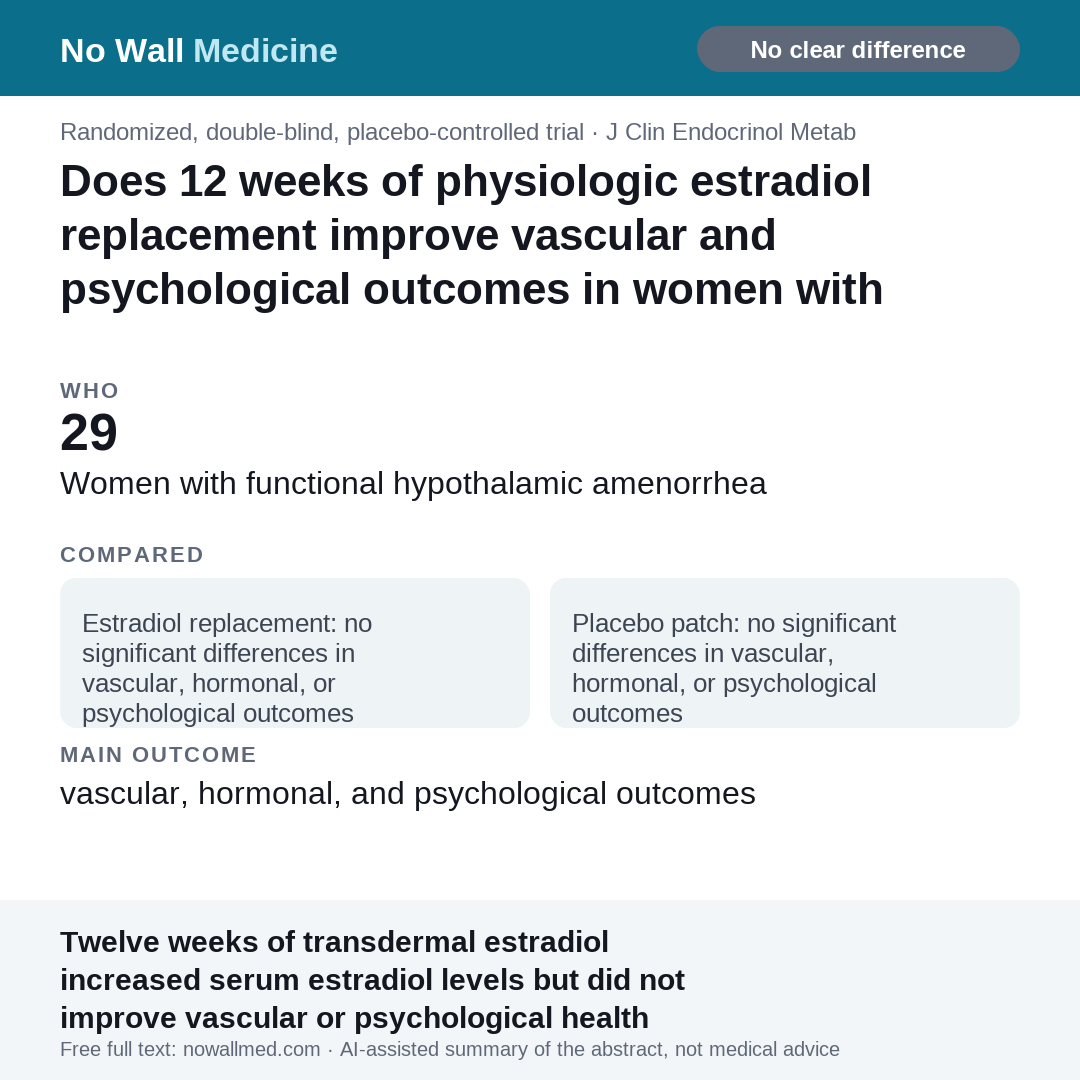
Does 12 weeks of physiologic estradiol replacement improve vascular and psychological outcomes in women with hypothalamic amenorrhea?
Who
29
Women with functional hypothalamic amenorrhea
Compared
Estradiol replacement: no significant differences in vascular, hormonal, or psychological outcomes
Placebo patch: no significant differences in vascular, hormonal, or psychological outcomes
Main outcome
vascular, hormonal, and psychological outcomes
Bottom line: Twelve weeks of transdermal estradiol increased serum estradiol levels but did not improve vascular or psychological health measures.
Limitation: Further studies with larger sample sizes and longer follow-up are needed.
J Clin Endocrinol Metab · 2025-06-27Download image
Clinical question: Does 12 weeks of physiologic estradiol replacement improve vascular and psychological outcomes in women with hypothalamic amenorrhea?
Why it matters: The effect of estrogen replacement on endothelial dysfunction and psychological health in women with FHA was unknown
Abstract
Context
Endothelial dysfunction and altered psychological measures have been identified in women with functional hypothalamic amenorrhea (FHA). Estradiol (E2) replacement, a known vasodilator, may potentially reverse vascular dysfunction and improve psychological health. Objective
To evaluate 12 weeks of physiologic E2 replacement on vascular, hormonal, and psychological outcomes in women with FHA. Methods
A randomized, double-blind, placebo-controlled trial was conducted in 29 women with FHA with 0.1 mg/day transdermal E2 (n = 14) or placebo patch (n = 15) twice weekly for 12 weeks. FHA was defined as amenorrhea ≥3 consecutive months, E2 < 50 pg/mL, follicle-stimulating hormone (FSH) and luteinizing hormone (LH) <10 mIU/L, LH:FSH <1, excluding other etiologies. Endothelial dysfunction (reactive hyperemic index ≤ 1.67) was assessed, as were hormonal and psychological measures. Results
Women with FHA had a mean age of 26.2 ± 6.3 years, body mass index of 21.5 ± 3.3 kg/m2, with 63% being non-Hispanic White. Baseline characteristics did not differ between groups. After 12 weeks, E2 levels were significantly higher in the E2 group (112.0 vs 36.5 pg/mL, P = .0002). However, there were no significant differences in vascular, hormonal, or psychological outcomes between E2 and placebo groups at week 12. Cortisol levels showed a near-significant decrease in the E2 group compared to an increase with placebo (-.4 vs 3.1 µg/dL, P = .05). Conclusion
In women with FHA, 12 weeks of transdermal E2 increased serum E2 levels but did not improve vascular or psychological health measures. Further studies with larger sample sizes and longer follow-up are needed to explore the long-term effects of E2 therapy on cardiovascular and mental health outcomes in this population.
Topics
Cite this article
Shufelt CL, Safwan N, Saadedine M, Cook-Wiens G, Maughan J, Pisarska MD. Impact of Estrogen Replacement on Endothelial Dysfunction and Psychological Health in Women With Hypothalamic Amenorrhea. J Clin Endocrinol Metab. 2025. doi:10.1210/clinem/dgaf364
Spotted a mistake? Suggest a correction
Top studies every Monday
The week’s key trials and guidelines in your specialties, by email. Free.
Get the weekly digest