High drug concentration variability in kidney transplant patients increases rejection and graft loss risks
Impact of Intrapatient Immunosuppression Variability in Renal Transplantation Outcomes: A Systematic Review and Meta-analysis
Systematic review and meta-analysisHarm found
Does intrapatient immunosuppression variability impact renal transplantation outcomes?
Who
Renal transplantation patients
Compared
High intrapatient variability
Low intrapatient variability: 44% lower risk of acute rejection
Main outcome
acute rejection and allograft survival
Result: hazard ratio 2.42 (95% CI, 1.70-3.46)
Bottom line: High intrapatient immunosuppression variability is a significant risk factor for acute rejection and graft loss.
Transplantation · 2026-06-23Download image
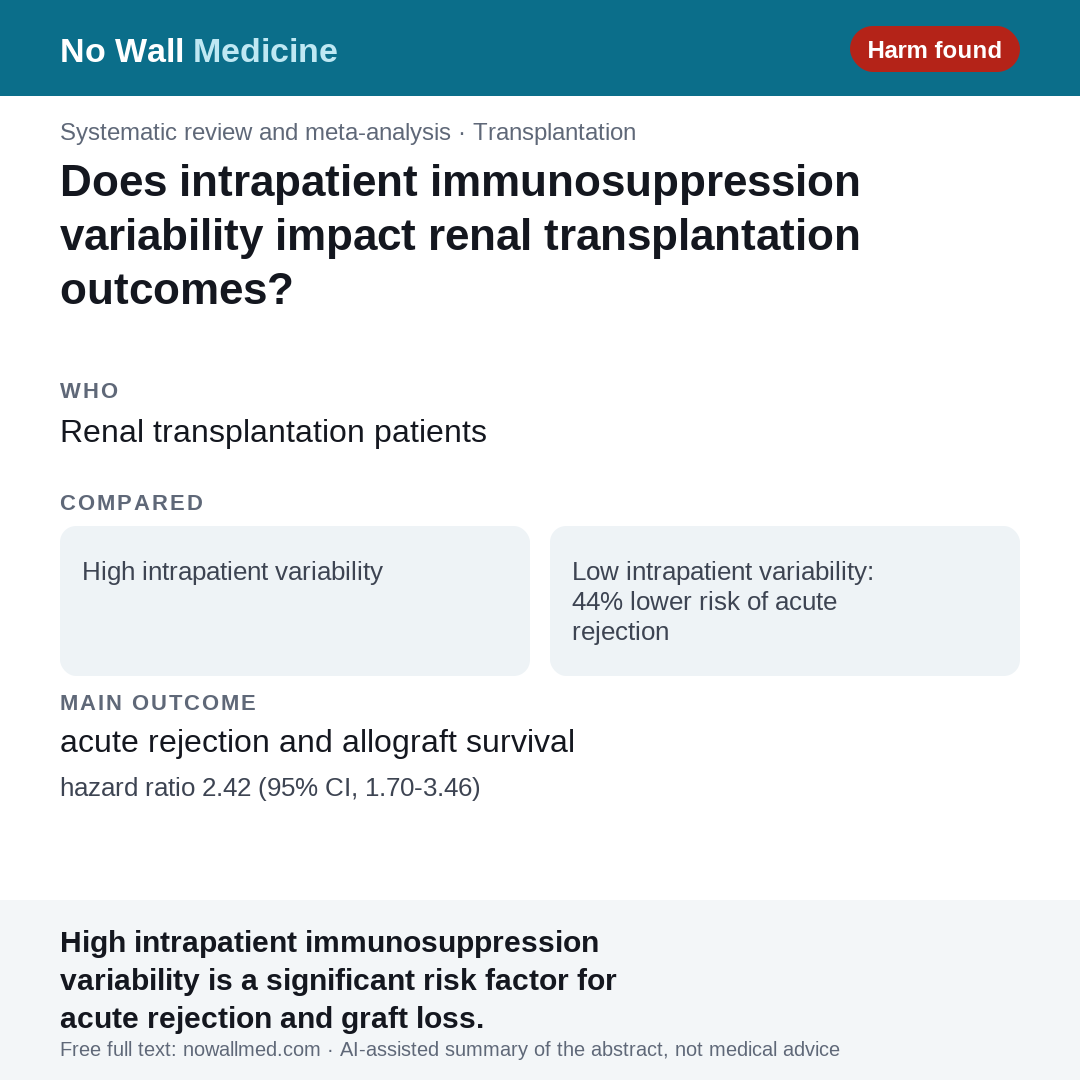
Clinical question: Does intrapatient immunosuppression variability impact renal transplantation outcomes?
Why it matters: There is a lack of consensus on whether high intrapatient variability in drug blood levels is associated with poor outcomes in transplantation.
Key points
- Researchers performed a meta-analysis of 41 articles to examine how changes in drug blood levels affect kidney transplant outcomes.
- Patients with low drug concentration variability had a 44% lower risk of acute rejection compared to those with high variability.
- High variability was associated with an increased risk of graft loss, with a hazard ratio of 2.42 (95% CI, 1.70-3.46).
Headline and key points written with AI from the paper’s abstract, with every number checked against it. Read the paper before relying on them.
Topics
Cite this article
Lattimore S, Chambers A, Angeli-Pahim I, Shrestha A, Eke BO, Pomputius A. Impact of Intrapatient Immunosuppression Variability in Renal Transplantation Outcomes: A Systematic Review and Meta-analysis. Transplantation. 2026. doi:10.1097/TP.0000000000005785
Spotted a mistake? Suggest a correction