Impact of Methicillin-Resistant Staphylococcus aureus Nasal Screening in Lower Respiratory Tract Infections: A Systematic Review Incorporating Network and Bayesian Meta-Analyses
Systematic review and meta-analysisBenefit found
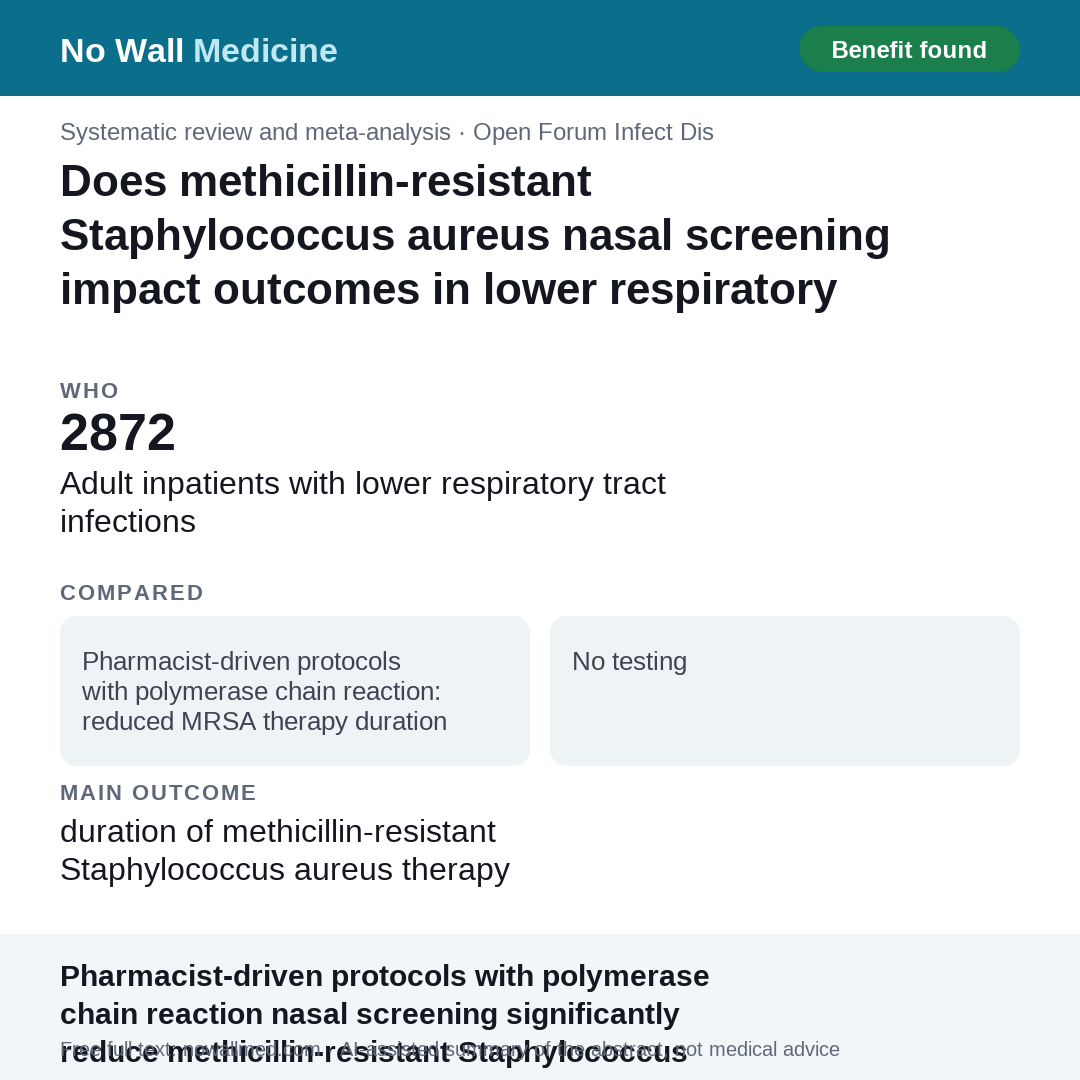
Does methicillin-resistant Staphylococcus aureus nasal screening impact outcomes in lower respiratory tract infections?
Who
2872
Adult inpatients with lower respiratory tract infections
Compared
Pharmacist-driven protocols with polymerase chain reaction: reduced MRSA therapy duration
No testing
Main outcome
duration of methicillin-resistant Staphylococcus aureus therapy
Result: mean difference -1.34 days (95% CI -1.59 to -1.08)
Bottom line: Pharmacist-driven protocols with polymerase chain reaction nasal screening significantly reduce methicillin-resistant Staphylococcus aureus therapy duration and improve clinical outcomes.
Open Forum Infect Dis · 2026-03-27Download image
Clinical question: Does methicillin-resistant Staphylococcus aureus nasal screening impact outcomes in lower respiratory tract infections?
Abstract
Background
Methicillin-resistant Staphylococcus aureus (MRSA) pneumonia requires empirical therapy coverage for patients with risk factors, yet MRSA causes <1% of community-acquired and 20%-40% of nosocomial pneumonias. Methicillin-resistant Staphylococcus aureus polymerase chain reaction (PCR) nasal screening offers rapid results with 95%-99% negative predictive value. We systematically evaluated clinical outcomes associated with MRSA nasal screening in hospitalized patients with lower respiratory tract infections (LRTIs). Methods
We searched PubMed and EMBASE through 29 June 2024 for studies evaluating MRSA nasal screening in adult inpatients with LRTIs. The primary outcome was duration of MRSA therapy. Secondary outcomes included frequency of vancomycin trough monitoring, hospital length of stay, incidence of acute kidney injury (AKI), in-hospital mortality, and 30-day readmission. We performed frequentist and Bayesian meta-analyses. Results
Fifteen studies (2872 patients) were included. Pharmacist-driven protocols (PDP) with PCR versus standard of care significantly reduced MRSA therapy duration (mean difference -1.34 days, 95% CI -1.59 to -1.08; I 2 = 61%). Network meta-analysis showed PDP+PCR was most effective (-1.51 days versus no testing, 95% CI -2.04 to -.98), while PCR or culture alone showed no significant benefit. PDP+PCR reduced vancomycin trough monitoring (OR 0.21, 95% CI .13-.33), AKI (OR 0.54, 95% CI .39-.76), and in-hospital mortality (OR 0.70, 95% CI .50 to .96). Bayesian analysis showed >99% probability of exceeding minimal clinically important differences for duration of MRSA therapy and trough monitoring, but 36% or less for other outcomes. Conclusions
Methicillin-resistant Staphylococcus aureus nasal PCR screening with pharmacist-driven protocols significantly reduces MRSA therapy exposure and improves clinical outcomes in hospitalized LRTI patients, supporting broader implementation of this diagnostic-antimicrobial stewardship synergy.
Cite this article
Timbrook TT, Zhang Z, Krekel T. Impact of Methicillin-Resistant Staphylococcus aureus Nasal Screening in Lower Respiratory Tract Infections: A Systematic Review Incorporating Network and Bayesian Meta-Analyses. Open Forum Infect Dis. 2026. doi:10.1093/ofid/ofag178
Spotted a mistake? Suggest a correction