Parent education programmes in neonatal intensive care units improve parental confidence and self-efficacy
Impact of parent education programmes on confidence and self-efficacy in parents of preterm infants: a systematic review
Systematic reviewBenefit found
Do parent education programmes impact confidence and self-efficacy in parents of preterm infants?
Who
Parents of preterm infants · Neonatal intensive care unit
Compared
Education programmes: all interventions demonstrated improvements from baseline
Control groups
Main outcome
Parent confidence or self-efficacy
Bottom line: Parent education programmes are generally effective in building confidence and self-efficacy among parents of preterm infants.
Limitation: Vast variability in duration, facilitator training, methodological limitations, and potential confounding factors reduced evidence quality.
BMJ Paediatr Open · 2026-04-03Download image
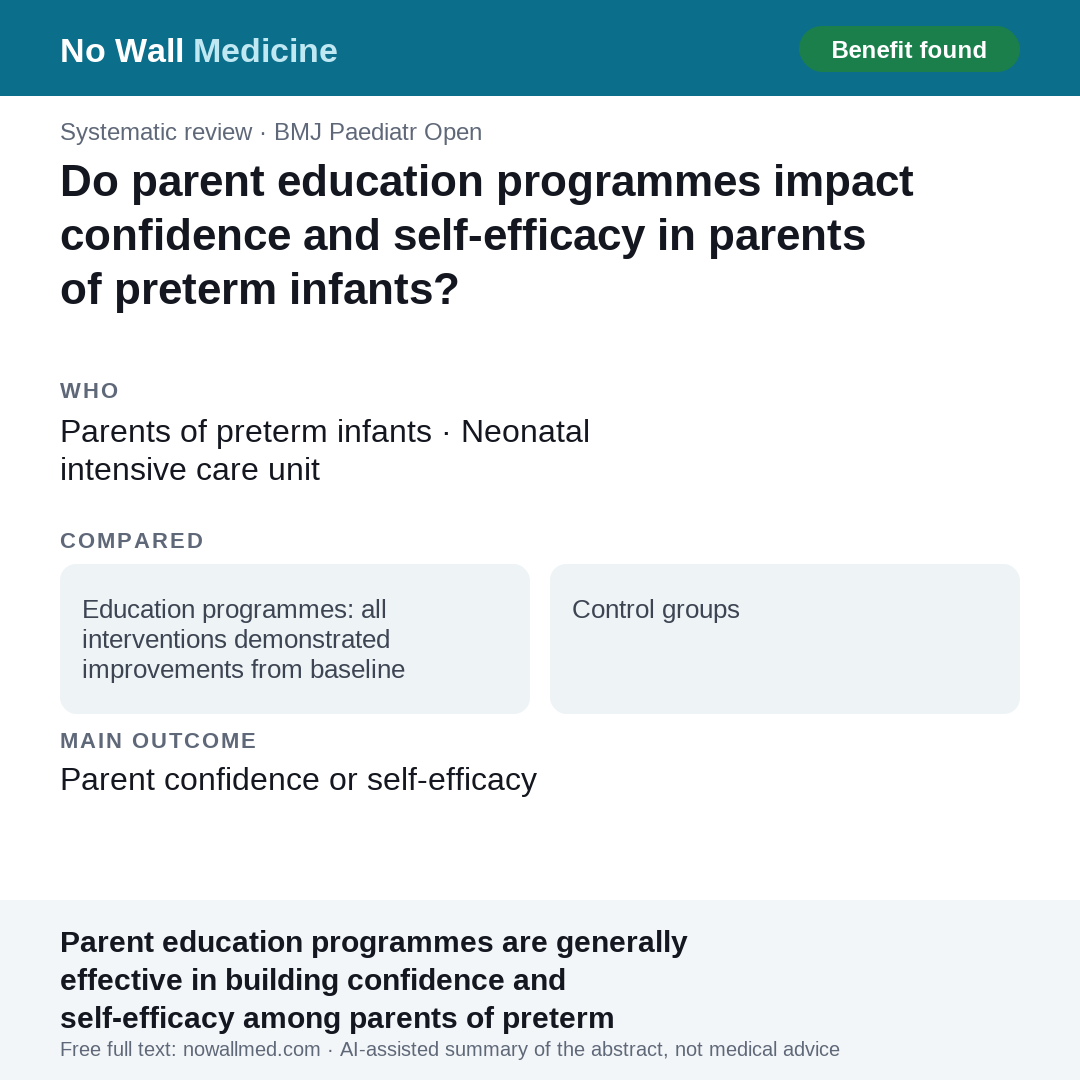
Clinical question: Do parent education programmes impact confidence and self-efficacy in parents of preterm infants?
Why it matters: Families of preterm infants experience high stress during neonatal intensive care unit hospitalisation, which can interfere with the development of parenting confidence and self-efficacy.
Key points
- Researchers reviewed 14 studies involving parents of preterm infants to evaluate the effects of education programmes on confidence and self-efficacy.
- All interventions showed improvements from baseline, although 6 of the 14 studies did not show statistically significant differences between groups.
- Programmes that combined information delivery with opportunities for parent-infant engagement were found to be most effective.
Limitation the authors note: The overall quality of evidence was reduced to a low level due to variability in intervention duration, descriptions of facilitator training, methodological limitations, and potential confounding factors.
Headline and key points written with AI from the paper’s abstract, with every number checked against it. Read the paper before relying on them.
Abstract
Objective
Families of preterm infants can experience high stress during neonatal intensive care unit (NICU) hospitalisation, which interferes with the development of parenting confidence and self-efficacy through active engagement with their infants. Parent NICU support programmes provide guidance and education to build this connection. This systematic review examined the effects of parent education programmes on confidence and self-efficacy among parents of preterm infants. Design
Systematic review in PubMed/Medline, PsycINFO, CINAHL, Google Scholar and Web of Science. Setting
NICU. Participants
Parents of preterm infants. Intervention
Education programmes offered to parents in the NICU. Main outcome measures
Quantitative surveys measuring parent confidence or self-efficacy. Results
14 studies met inclusion criteria from an initial 220 identified. Five were randomised controlled trials and nine were non-randomised studies. Programmes combining information delivery with opportunities for parent-infant engagement were most effective. Infant access and time to practise skills were key factors in transferring programme knowledge to increase parent confidence and self-efficacy. While 6 of the 14 studies did not show statistically significant differences between groups, all interventions demonstrated improvements in parental confidence or self-efficacy from baseline. Vast variability in duration of intervention, proper descriptions of facilitator trainings, methodological limitations and potential confounding factors reduced the overall quality of evidence to a low level. Conclusion
Both unit-specific programmes developed within individual NICUs and commercially available, copyrighted parent education programmes hold value. They are generally effective in building parent confidence and self-efficacy among parents of preterm infants. Integrating either type of programme into standard NICU care may hold promise for strengthening parental competence and promoting family-centred outcomes. Clarity on content/topics of programmes, duration and level of facilitator trainings can strengthen the process of supporting parents in the NICU, even in low resource settings. Prospero registration number
CRD42024524063.
Abstract reproduced under the article’s CC BY NC licence.
Topics
Cite this article
Padbidri P, Joshi V, Hix-Small H, Dekhane PB. Impact of parent education programmes on confidence and self-efficacy in parents of preterm infants: a systematic review. BMJ Paediatr Open. 2026. doi:10.1136/bmjpo-2025-004454
Spotted a mistake? Suggest a correction