Patient support programmes were associated with lower treatment discontinuation in severe asthma patients
Impact of patient support programmes among patients with severe asthma treated with biological therapies: a systematic literature review and indirect treatment comparison
Systematic literature review and indirect treatment comparisonBenefit found
Do patient support programmes impact outcomes in severe asthma patients treated with biological therapies?
Who
Patients with severe asthma treated with biological therapies · United Kingdom
Compared
Connect 360 patient support programme
Non-enrolled group
Main outcome
treatment discontinuation
Result: odds ratio 0.26 (95% CI 0.11 to 0.57)
Bottom line: Patient support programmes contribute to positive clinical outcomes and reduce treatment discontinuation in severe asthma.
BMJ Open Respir Res · 2024-05-02Download image
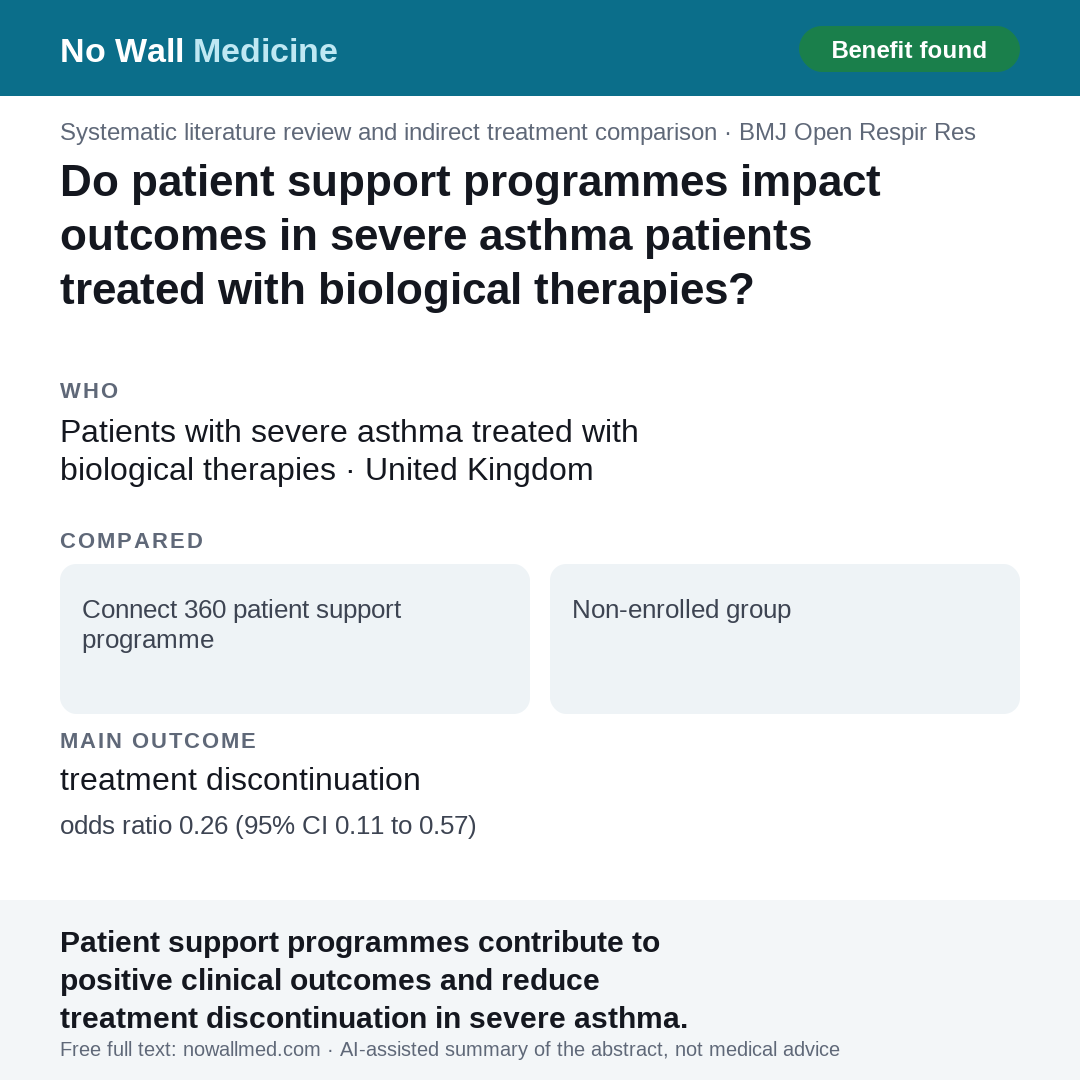
Clinical question: Do patient support programmes impact outcomes in severe asthma patients treated with biological therapies?
Why it matters: The impact of patient support programmes on adherence, asthma control, and quality of life for patients using biological therapies for severe asthma has not been thoroughly investigated.
Key points
- Researchers reviewed 21 studies published between 2003 and June 2023 regarding patient support programmes for people with severe asthma using biological therapies.
- An indirect treatment comparison showed that patients in the Connect 360 patient support programme were less likely to stop treatment than those not in a programme (OR 0.26, 95% CI 0.11 to 0.57, p<0.001).
- Six studies found that participation in these programmes was linked to better treatment adherence, asthma control, and health-related quality of life.
Headline and key points written with AI from the paper’s abstract, with every number checked against it. Read the paper before relying on them.
Was this summary helpful?
Abstract
Introduction
Effective treatment of severe asthma requires patient adherence to inhaled and biological medications. Previous work has shown that patient support programmes (PSP) can improve adherence in patients with chronic diseases, but the impact of PSPs in patients with severe asthma treated with biologics has not been thoroughly investigated. Methods
We conducted a systematic literature review to understand the impact of PSPs on treatment adherence, asthma control and health-related quality of life (HRQoL) in patients with severe asthma. Embase, MEDLINE and EconLit databases were searched for studies published from 2003 (the year of the first biological approval for severe asthma) to June 2023 that described PSP participation among patients with severe asthma on biological treatment. Direct pooling of outcomes was not possible due to the heterogeneity across studies, so an indirect treatment comparison (ITC) was performed to determine the effect of PSP participation on treatment discontinuation. The ITC used patient-level data from patients treated with benralizumab either enrolled in a PSP (VOICE study, Connect 360 PSP) or not enrolled in a PSP (Benralizumab Patient Access Programme study) in the UK. Findings
25 records of 21 studies were selected. Six studies investigated the impact of PSPs on treatment adherence, asthma control or HRQoL. All six studies reported positive outcomes for patients enrolled in PSPs; the benefits of each PSP were closely linked to the services provided. The ITC showed that patients in the Connect 360 PSP group were less likely to discontinue treatment compared with the non-PSP group (OR 0.26, 95% CI 0.11 to 0.57, p<0.001). Conclusions
PSPs contribute to positive clinical outcomes in patients with severe asthma on biological treatment. Future analyses will benefit from thorough descriptions of PSP services, and study designs that allow direct comparisons of patient outcomes with and without a PSP.
Abstract reproduced under the article’s CC BY NC licence.
Subject terms
Cite this article
Rabe APJ, Loke WJ, Kielar D, Morris T, Shih VH, Olinger L. Impact of patient support programmes among patients with severe asthma treated with biological therapies: a systematic literature review and indirect treatment comparison. BMJ Open Respir Res. 2024. doi:10.1136/bmjresp-2023-001799
Spotted a mistake? Suggest a correction
Top studies every Monday
The week’s key trials and guidelines in your specialties, plus any topics you follow. By email, free.
Get the weekly digest