Nitrous oxide and almitrine were associated with lower intrapulmonary shunt during thoracic surgery
Impact of pharmacological interventions on intrapulmonary shunt during one-lung ventilation in adult thoracic surgery: a systematic review and component network meta-analysis
Systematic review and network meta-analysisMixed results
How do pharmacological interventions impact intrapulmonary shunt during one-lung ventilation?
Who
2788
Adult thoracic surgery patients under one-lung ventilation
Compared
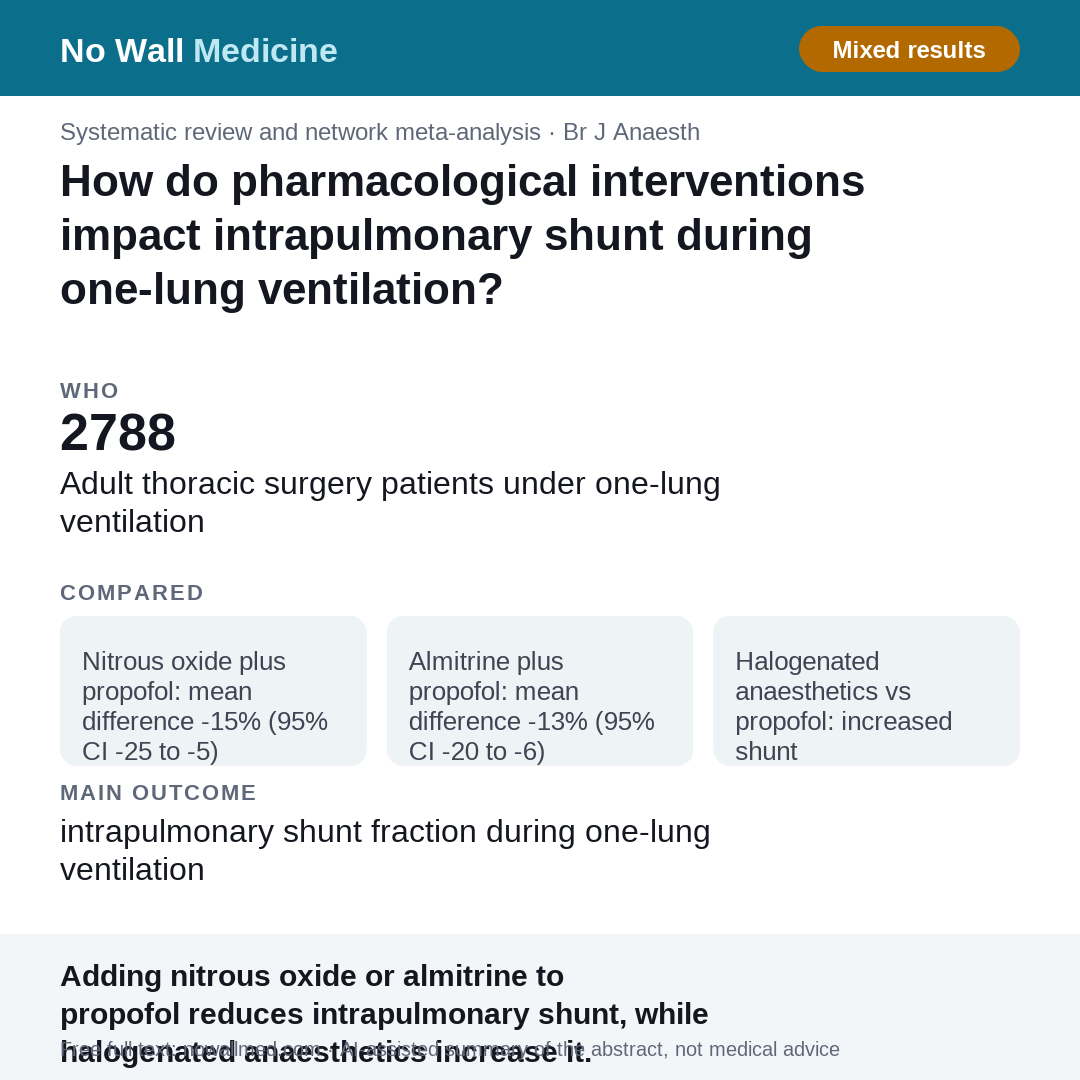
Nitrous oxide plus propofol: mean difference -15% (95% CI -25 to -5)
Almitrine plus propofol: mean difference -13% (95% CI -20 to -6)
Halogenated anaesthetics vs propofol: increased shunt
Main outcome
intrapulmonary shunt fraction during one-lung ventilation
Bottom line: Adding nitrous oxide or almitrine to propofol reduces intrapulmonary shunt, while halogenated anaesthetics increase it.
Limitation: Certainty of evidence ranged from very low to moderate.
Br J Anaesth · 2022-10-26Download image
Clinical question: How do pharmacological interventions impact intrapulmonary shunt during one-lung ventilation?
Why it matters: It is unknown which pharmacological treatments most effectively manage intrapulmonary shunt, which is a major factor in oxygenation during thoracic surgery.
Key points
- Researchers analyzed 55 randomized controlled trials involving 2788 participants to compare different drugs used during one-lung ventilation in thoracic surgery.
- Adding nitrous oxide or almitrine to propofol anesthesia was associated with a decrease in the intrapulmonary shunt fraction by a mean difference of -15% and -13% respectively.
- Compared to propofol, the use of sevoflurane, isoflurane, and desflurane was associated with increased shunt fractions.
Limitation the authors note: The certainty of evidence for these findings ranged from very low to moderate.
Headline and key points written with AI from the paper’s abstract, with every number checked against it. Read the paper before relying on them.
Was this summary helpful?
Subject terms
Cite this article
Schorer R, Dombret AL, Hagerman A, Bédat B, Putzu A. Impact of pharmacological interventions on intrapulmonary shunt during one-lung ventilation in adult thoracic surgery: a systematic review and component network meta-analysis. Br J Anaesth. 2022. doi:10.1016/j.bja.2022.08.039
Spotted a mistake? Suggest a correction
Top studies every Monday
The week’s key trials and guidelines in your specialties, plus any topics you follow. By email, free.
Get the weekly digest