Impact of precoding on reimbursement in diagnosis-related group systems: Randomized controlled trial
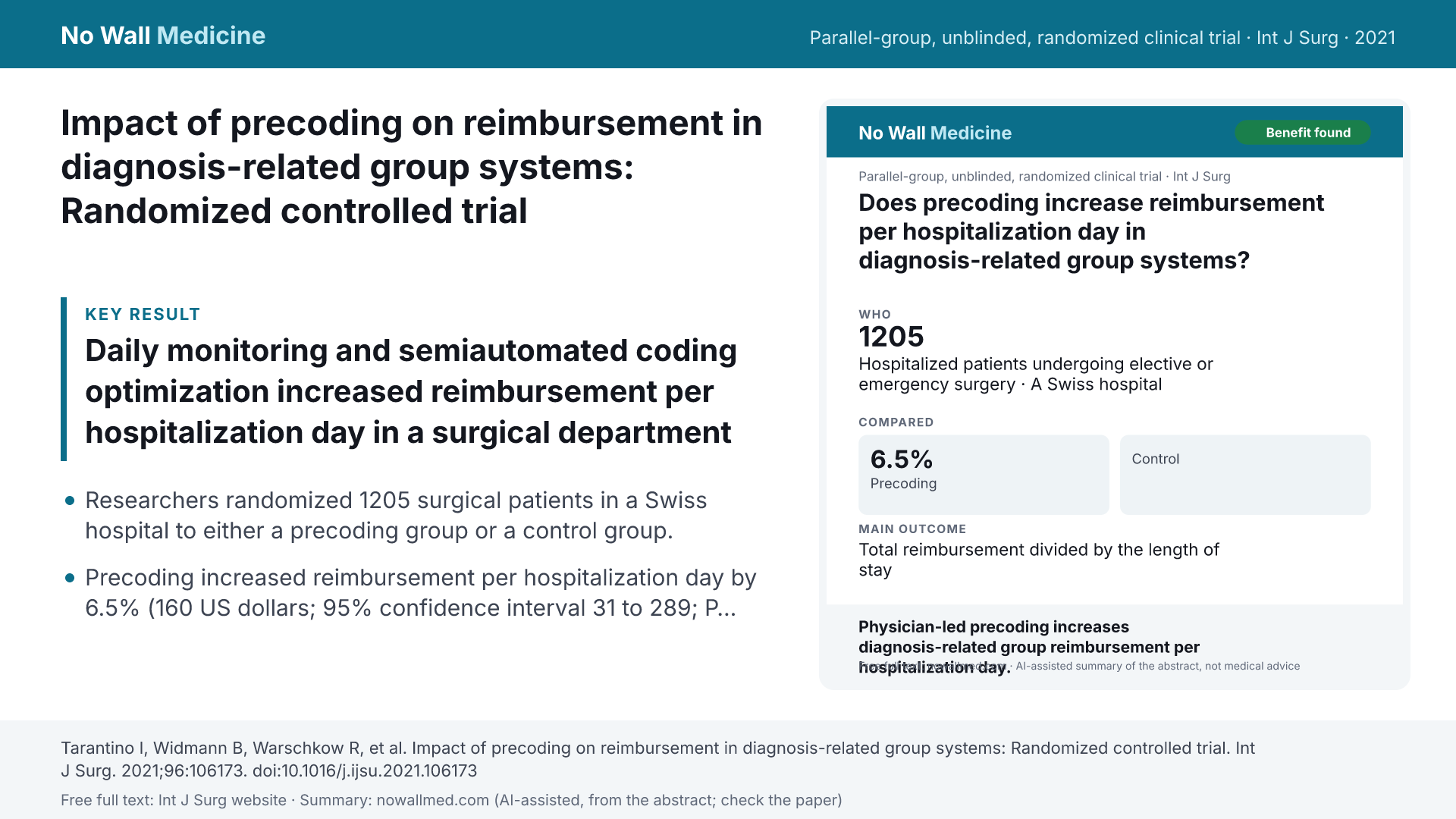
Key result: Daily monitoring and semiautomated coding optimization increased reimbursement per hospitalization day in a surgical department
Parallel-group, unblinded, randomized clinical trialBenefit found
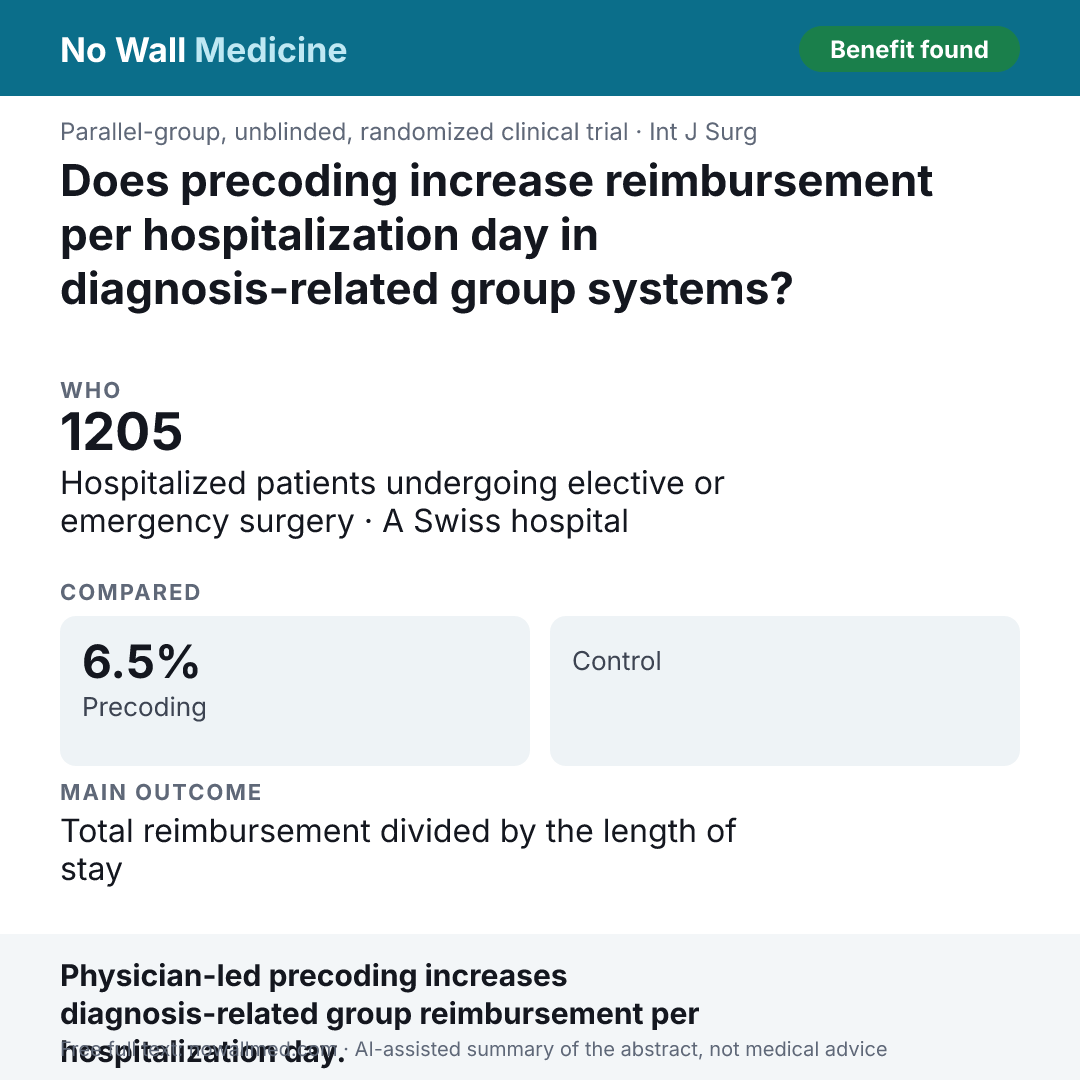
Does precoding increase reimbursement per hospitalization day in diagnosis-related group systems?
Who
1205
Hospitalized patients undergoing elective or emergency surgery · A Swiss hospital
Compared
6.5%Precoding (160 US dollars; 95% confidence interval 31 to 289)
Control
Main outcome
Total reimbursement divided by the length of stay
Result: 6.5% (160 US dollars; 95% confidence interval 31 to 289)
Bottom line: Physician-led precoding increases diagnosis-related group reimbursement per hospitalization day.
Int J Surg · 2021-11-07 · Save PNG
Key points
- Researchers randomized 1205 surgical patients in a Swiss hospital to either a precoding group or a control group.
- Precoding increased reimbursement per hospitalization day by 6.5% (160 US dollars; 95% confidence interval 31 to 289; P = 0.015).
- The precoding group had more documented secondary diagnoses (mean [SD]: 5.16 [5.60] vs 4.39 [5.34]) and nonsurgical postoperative complications (mean [SD]: 0.68 [1.45] vs 0.45 [1.12]).
Discussion prompts
- Would these patients look like yours? Who was left out?
- Is the main outcome one that matters to patients?
- Is the difference large enough to change what you do?
Cite: Tarantino I, Widmann B, Warschkow R, et al. Impact of precoding on reimbursement in diagnosis-related group systems: Randomized controlled trial. Int J Surg. 2021;96:106173. doi:10.1016/j.ijsu.2021.106173
Free full text: Int J Surg website · Summary and visual abstract: nowallmed.com/a/impact-of-precoding-on-reimbursement-in-diagnosis-related-group-19cizux/ (AI-assisted from the abstract; check the paper before relying on it).