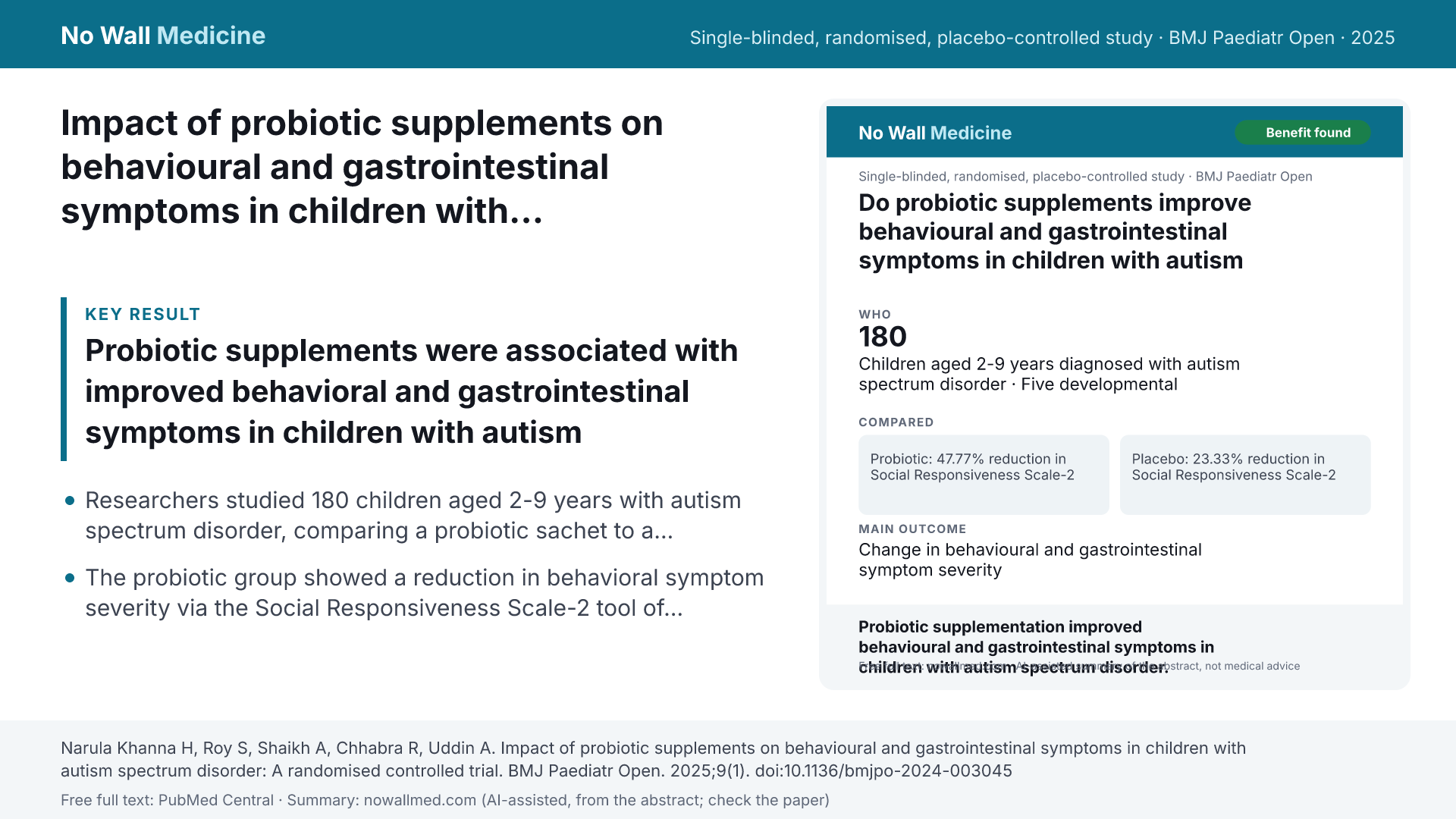
Probiotic supplements were associated with improved behavioral and gastrointestinal symptoms in children with autism
Impact of probiotic supplements on behavioural and gastrointestinal symptoms in children with autism spectrum disorder: A randomised controlled trial
Single-blinded, randomised, placebo-controlled studyBenefit found
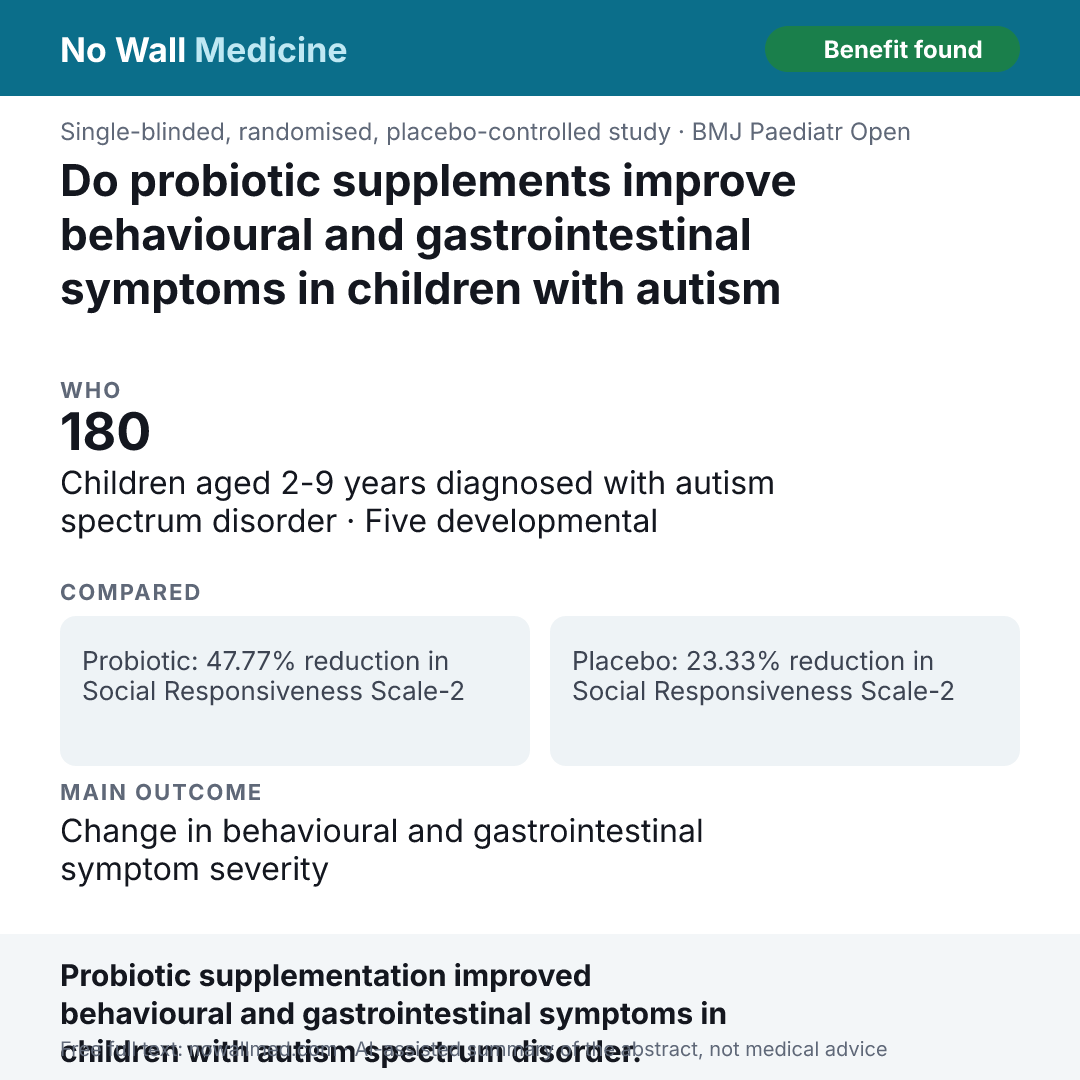
Do probiotic supplements improve behavioural and gastrointestinal symptoms in children with autism spectrum disorder?
Who
180
Children aged 2-9 years diagnosed with autism spectrum disorder · Five developmental paediatric outpatient clinics
Compared
Probiotic: 47.77% reduction in Social Responsiveness Scale-2
Placebo: 23.33% reduction in Social Responsiveness Scale-2
Main outcome
Change in behavioural and gastrointestinal symptom severity
Bottom line: Probiotic supplementation improved behavioural and gastrointestinal symptoms in children with autism spectrum disorder.
Limitation: These results need to be validated in a larger sample size.
BMJ Paediatr Open · 2025-03-04
Headline and visual abstract written with AI from the paper’s abstract, with every number checked against it. Read the paper before relying on them.
Was this summary helpful?
Abstract
Objective
To investigate whether probiotic supplementation can improve behavioural and gastrointestinal (GI) symptoms in children with autism spectrum disorder (ASD) aged 2-9 years and further explore the correlation between these symptoms. Design
Single-blinded, randomised, placebo-controlled study. Setting
Five developmental paediatric outpatient clinics of 'Continua Kids'. Patients
Children aged 2-9 years diagnosed with ASD along with their caregivers. Interventions
Probiotic or placebo sachet reconstituted in 50 mL of lukewarm milk/water, taken two times per day for 3 months. Main outcome measures
Change in behavioural (measured by Social Responsiveness Scale-2 (SRS-2) and Aberrant Behaviour Checklist-2 (ABC-2) tools) and GI (measured by GI Severity Index (GSI) score) symptoms after receiving intervention for 3 months. Results
A total of 180 children with ASD were enrolled in the study (probiotic group: 90 and placebo group: 90). All children completed the study. The probiotic group showed a significant reduction in behavioural symptom severity as measured by the SRS-2 tool (47.77% vs 23.33%; p=0.000) compared with the placebo. Probiotic-treated children demonstrated significant reductions in severe symptoms, including social withdrawal/lethargy (40%), stereotypic behaviour (37.77%), hyperactivity (34.44%) and inappropriate speech (32.22%) post-intervention (p=0.000). They also had marked improvements in constipation (p=0.003) and diarrhoea (p=0.043) compared with the placebo group. Both groups exhibited a statistically significant correlation between behavioural and GI symptoms. Conclusions
Probiotic supplementation improved behavioural and GI symptoms in children with ASD with no adverse effects. Both symptoms were significantly correlated. However, these results need to be validated in a larger sample size. Trial registration number
CTRI/2021/11/038213.
Abstract reproduced under the article’s CC BY NC licence.
Subject terms
Cite this article
Narula Khanna H, Roy S, Shaikh A, Chhabra R, Uddin A. Impact of probiotic supplements on behavioural and gastrointestinal symptoms in children with autism spectrum disorder: A randomised controlled trial. BMJ Paediatr Open. 2025;9(1). doi:10.1136/bmjpo-2024-003045
Spotted a mistake? Suggest a correction