Rapid pathogen testing improved the appropriateness of initial antibiotic treatment for children with pneumonia
Impact of respiratory pathogens detection by a rapid multiplex polymerase chain reaction assay on the management of community-acquired pneumonia for children at the paediatric emergency department. A randomized controlled trial, the Optimization of Pneumonia Acute Care (OPTIPAC) study
Randomized controlled trialBenefit found
Does rapid PCR improve antibiotic treatment?
Who
499
Children with community-acquired pneumonia · 11 French centres
Compared
68.6%PCR test (168/245)
48.2%Usual care (120/249)
Main outcome
Appropriateness of antibiotic treatment
Result: Relative risk 1.42 [1.22-1.66]
Bottom line: Rapid PCR improves antibiotic treatment appropriateness
Clin Microbiol Infect · 2024-08-05Download image
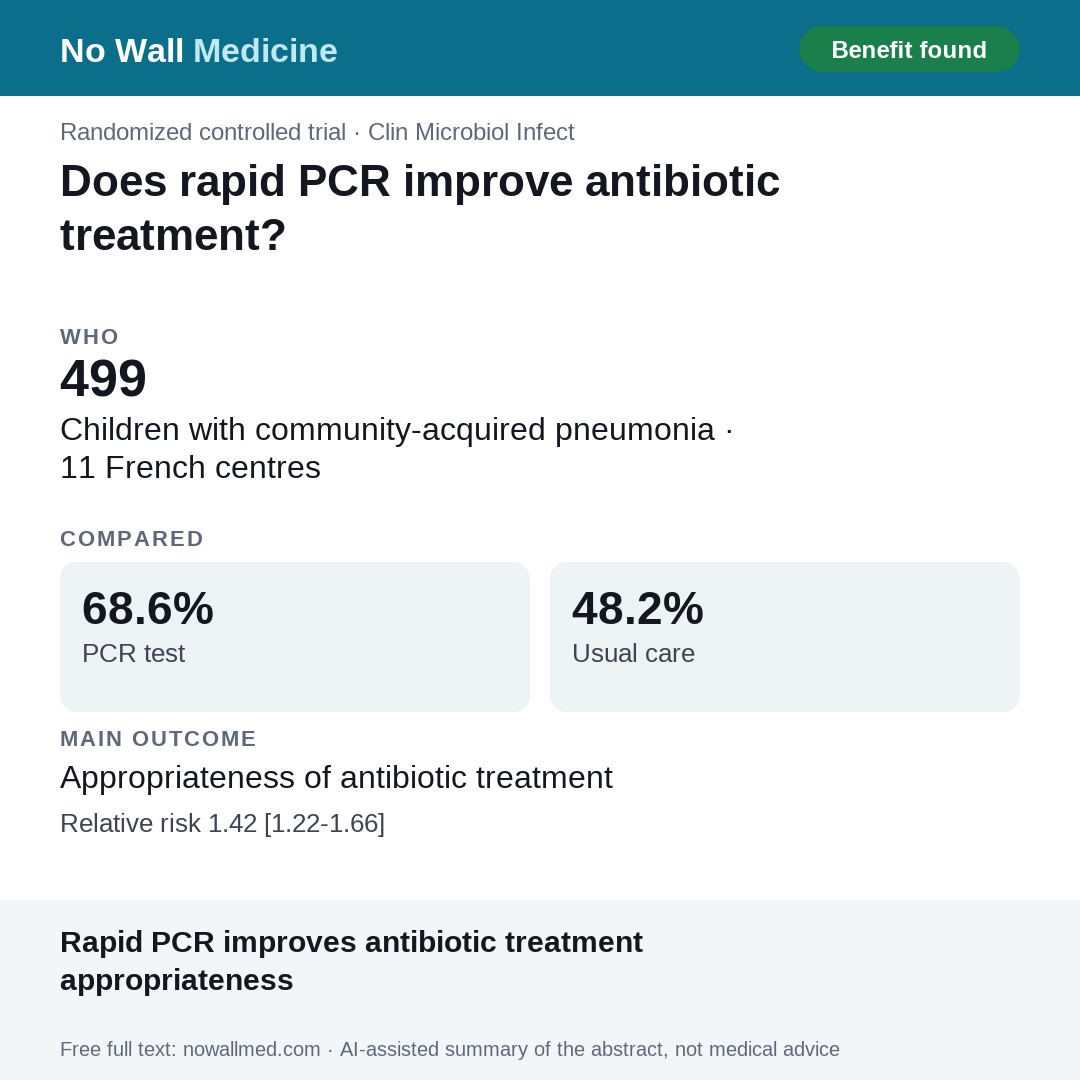
Clinical question: Does rapid PCR improve antibiotic treatment?
Why it matters: The specific germ causing community-acquired pneumonia is often unknown during initial treatment, which leads to the routine use of antibiotics.
In absolute numbers
PCR test: 68.6% · Usual care: 48.2% → a difference of 20.4 percentage points, so about 5 people would need the treatment for 1 more to benefit (number needed to treat) over the trial’s follow-up.
Worked out by us from the two group results above, not reported by the authors. Check the paper for the exact outcome and timing.
Key points
- Researchers randomized 499 children with community-acquired pneumonia to receive either a rapid multiplex polymerase chain reaction test—a test that detects multiple germs at once—plus usual care or usual care alone.
- The group receiving the rapid test had a higher rate of appropriate antibiotic treatment at 68.6% compared to 48.2% in the usual care group.
- The use of the rapid test was associated with a reduction in unnecessary antibiotics for cases of viral pneumonia.
Headline and key points written with AI from the paper’s abstract, with every number checked against it. Read the paper before relying on them.
Was this summary helpful?
Subject terms
Cite this article
Cantais A, Pillet S, Rigaill J, Angoulvant F, Gras-Le-Guen C, Cros P. Impact of respiratory pathogens detection by a rapid multiplex polymerase chain reaction assay on the management of community-acquired pneumonia for children at the paediatric emergency department. A randomized controlled trial, the Optimization of Pneumonia Acute Care (OPTIPAC) study. Clin Microbiol Infect. 2024. doi:10.1016/j.cmi.2024.08.001
Spotted a mistake? Suggest a correction
Top studies every Monday
The week’s key trials and guidelines in your specialties, plus any topics you follow. By email, free.
Get the weekly digest