Visual abstractsVisuals
Randomized trialJournal of Medical Internet Research · Jul 23, 2026

Different responsibility structures between doctors and artificial intelligence affect diagnostic accuracy and confidence calibration

Impact of Responsibility Allocation Structures on Diagnostic Quality in AI-Assisted Diagnosis: Randomized Controlled Experiment

Liu T, Wu J
Digital Health & AIAdult
Randomized, 4-arm, parallel-group controlled experimentMixed results
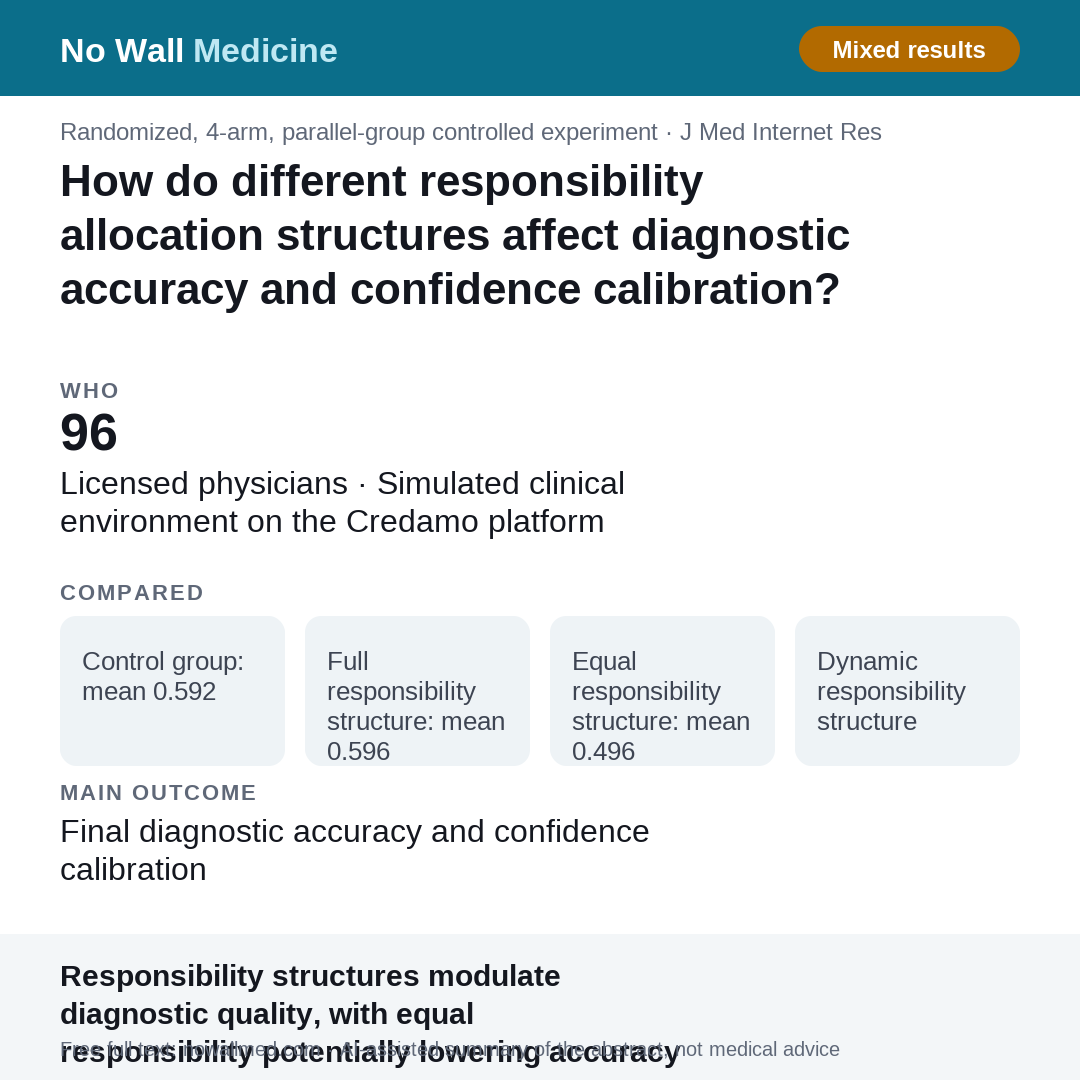
How do different responsibility allocation structures affect diagnostic accuracy and confidence calibration?
Who
96
Licensed physicians · Simulated clinical environment on the Credamo platform
Compared
Control group: mean 0.592
Full responsibility structure: mean 0.596
Equal responsibility structure: mean 0.496
Dynamic responsibility structure
Main outcome
Final diagnostic accuracy and confidence calibration
Bottom line: Responsibility structures modulate diagnostic quality, with equal responsibility potentially lowering accuracy and confidence calibration compared to control.
J Med Internet Res · 2026-07-23Download image

Clinical question: How do different responsibility allocation structures affect diagnostic accuracy and confidence calibration?

Why it matters: It is currently unclear how different ways of dividing responsibility between clinicians and artificial intelligence influence diagnostic quality and how doctors judge their own certainty.

Key points

Headline and key points written with AI from the paper’s abstract, with every number checked against it. Read the paper before relying on them.

Read the full paper free at PubMed Central ↗

Topics

Humans; Artificial Intelligence; Female; Diagnosis, Computer-Assisted; Male; Adult; Physicians

DOI: 10.2196/97588 · PubMed: 42492064

Spotted a mistake? Suggest a correction

More in Digital Health & AI

ResearchLancet Digit Health · Nov 23, 2026 · Digital Health & AI

ClinicalAge biomarker associated with mortality and disease risk in UK datasets

ClinicalAge, a framework for modelling ageing trajectories from longitudinal electronic health records in the UK: a model development and validation study

ResearchLancet Digit Health · Nov 23, 2026 · Digital Health & AI

Facial photographs used to estimate age and predict survival in cancer patients

Foundation artificial intelligence models for health recognition by use of face photographs (FAHR-Face): a model development and validation study

ResearchLancet Digit Health · Nov 23, 2026 · Digital Health & AI

New model predicts severe fetal compromise risk at birth with 33.4% sensitivity

A prognostic model for use at labour onset to estimate the risk of severe fetal compromise at birth: a retrospective, model development and validation study
ResearchNPJ Digit Med · Nov 21, 2026 · Digital Health & AI

ECG foundation models performed well on general data but less so on athletes' data

ECG foundation models for cardiovascular screening in a cohort of young competitive athletes

ResearchJ Med Internet Res · Nov 20, 2026 · Digital Health & AI

Six large language models showed similar question-answering accuracy on medical exam questions

Medical Reasoning in Large Language Models: Development and Evaluation of the MedEvalArena Benchmark