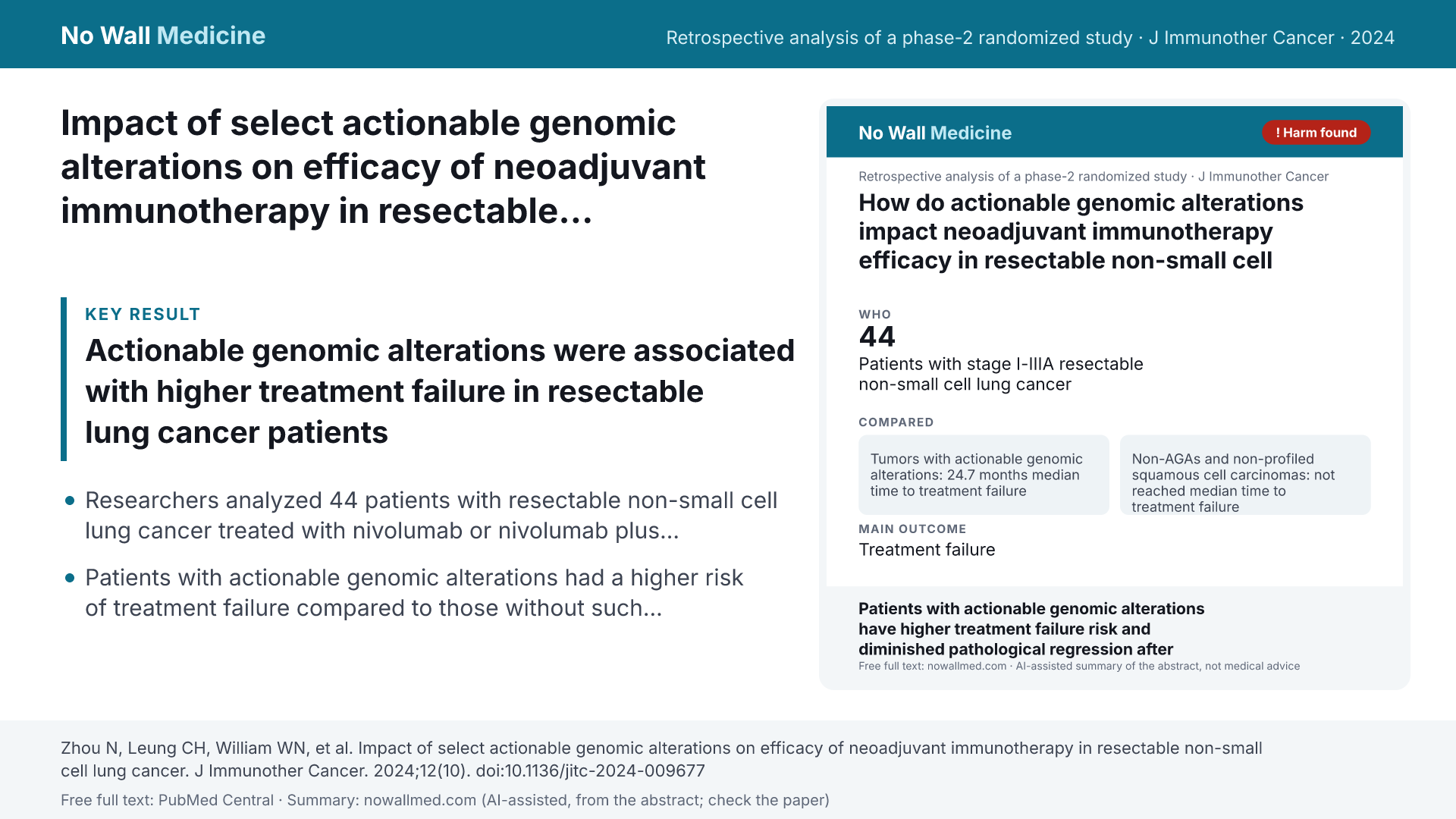
Actionable genomic alterations were associated with higher treatment failure in resectable lung cancer patients
Impact of select actionable genomic alterations on efficacy of neoadjuvant immunotherapy in resectable non-small cell lung cancer
Retrospective analysis of a phase-2 randomized studyHarm found
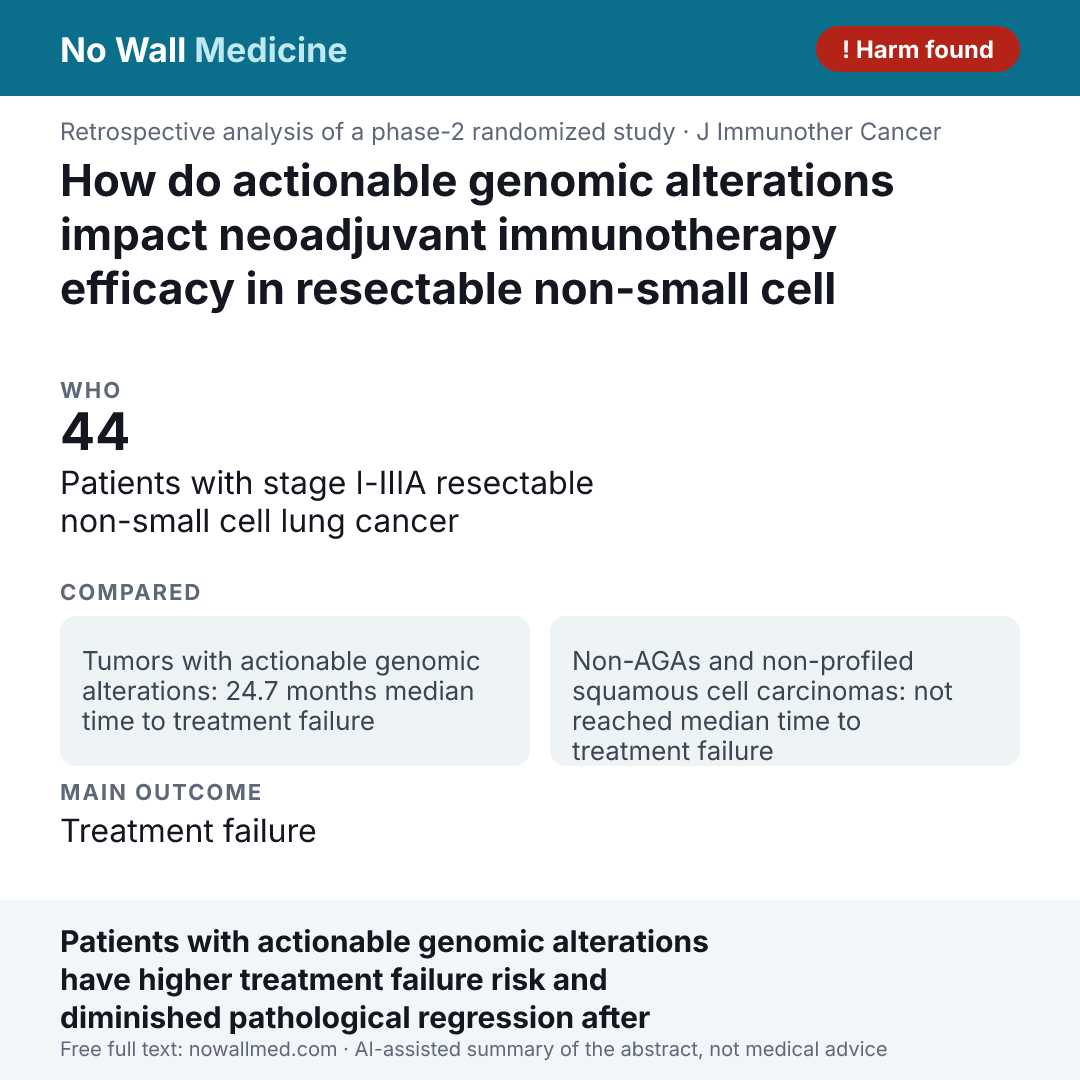
How do actionable genomic alterations impact neoadjuvant immunotherapy efficacy in resectable non-small cell lung cancer?
Who
44
Patients with stage I-IIIA resectable non-small cell lung cancer
Compared
Tumors with actionable genomic alterations: 24.7 months median time to treatment failure
Non-AGAs and non-profiled squamous cell carcinomas: not reached median time to treatment failure
Main outcome
Treatment failure
Result: hazard ratio 5.51 (95% CI 1.68 to 18.1)
Bottom line: Patients with actionable genomic alterations have higher treatment failure risk and diminished pathological regression after neoadjuvant immunotherapy.
Limitation: Tumor molecular profiling was retrospectively obtained in 47.7% of patients.
J Immunother Cancer · 2024-10-23 · NCT03158129
Same trial (NCT03158129)
Papers we list that report this registered trial, oldest first. Read a secondary analysis alongside the main results.
- Main results Early signal
Nivolumab plus ipilimumab was associated with higher pathologic response rates in operable lung cancer Nat Med 2021-02 - Related analysis
Neoadjuvant chemotherapy plus nivolumab with or without ipilimumab in operable non-small cell lung cancer: the phase 2 platform NEOSTAR trial Nat Med 2023-03 - Secondary analysis Harm found
This paper J Immunother Cancer 2024-10
Headline and visual abstract written with AI from the paper’s abstract, with every number checked against it. Read the paper before relying on them.
Was this summary helpful?
Abstract
Background
Neoadjuvant immune checkpoint inhibitors (ICIs) have improved survival outcomes compared with chemotherapy in resectable non-small cell lung cancer (NSCLC). However, the impact of actionable genomic alterations (AGAs) on the efficacy of neoadjuvant ICIs remains unclear. We report the influence of AGAs on treatment failure (TF) in patients with resectable NSCLC treated with neoadjuvant ICIs. Methods
Tumor molecular profiles were obtained from patients with stage I-IIIA resectable NSCLC (American Joint Committee on Cancer seventh edition) treated with either neoadjuvant nivolumab (N, n=23) or nivolumab+ipilimumab (NI, n=21) followed by surgery in a previously reported phase-2 randomized study (NCT03158129). TF was defined as any progression of primary lung cancer after neoadjuvant ICI therapy in patients without surgery, radiographic and/or biopsy-proven primary lung cancer recurrence after surgery, or death from possibly treatment-related complications or from primary lung cancer since randomization. Tumors with AGAs (n=12) were compared with tumors without AGAs and non-profiled squamous cell carcinomas (non-AGAs+NP SCC, n=20). Results
With a median follow-up of 60.2 months, the overall TF rate was 34.1% (15/44). Tumor molecular profiling was retrospectively obtained in 47.7% (21/44) of patients and select AGAs were identified in 12 patients: 5 epidermal growth factor receptor (EGFR), 2 KRAS, 1 ERBB2, and 1 BRAF mutations, 2 anaplastic lymphoma kinase (ALK) and 1 RET fusions. The median time to TF in patients with AGAs was 24.7 months (95% CI: 12.6 to 40.4), compared with not reached (95% CI: not evaluable (NE)-NE) in the non-AGAs+NP SCC group. The TF risk was higher in AGAs (HR: 5.51, 95% CI: 1.68 to 18.1), and lower in former/current smokers (HR: 0.24, 95% CI: 0.08 to 0.75). The odds of major pathological response were 4.71 (95% CI: 0.49 to 45.2) times higher in the non-AGAs+NP SCC group, and the median percentage of residual viable tumor was 72.5% in AGAs compared with 33.0% in non-AGS+NP SCC tumors. Conclusions
Patients with NSCLC harboring select AGAs, including EGFR and ALK alterations, have a higher risk for TF, shorter median time to TF, and diminished pathological regression after neoadjuvant ICIs. The suboptimal efficacy of neoadjuvant chemotherapy-sparing, ICI-based regimens in this patient subset underscores the importance of tumor molecular testing prior to initiation of neoadjuvant ICI therapy in patients with resectable NSCLC.
Abstract reproduced under the article’s CC BY NC licence.
Subject terms
Cite this article
Zhou N, Leung CH, William WN, et al. Impact of select actionable genomic alterations on efficacy of neoadjuvant immunotherapy in resectable non-small cell lung cancer. J Immunother Cancer. 2024;12(10). doi:10.1136/jitc-2024-009677
Spotted a mistake? Suggest a correction